
 en
en TR
TR  SK
SK  ITA
ITA  FR
FR  DE
DE  ES
ES  BG
BG 
Understanding Average Forehead Size: Ideal Sizes by Gender!
Medically reviewed by Dr Ahmet Dilber, Consultant Plastic, Reconstructive and Aesthetic Surgeon, Hair of Istanbul. Last updated: April 2026.
Have you ever wondered how your forehead size affects your overall appearance? Understanding the average forehead size — particularly for your gender — can help you identify whether your forehead is proportionate, assess whether you might be experiencing early hairline recession, and make informed decisions about haircuts, makeup, or even aesthetic procedures. This comprehensive guide provides the exact measurements, a simple finger test, and expert advice from Hair of Istanbul’s plastic surgery team.
Quick answer: The average forehead size for men is approximately 2.4 inches (6 cm) tall and 5.5 inches (14 cm) wide. For women, the average is 2.3 inches (5.8 cm) tall and 5.1 inches (13 cm) wide. A normal forehead is roughly 4 fingers wide using the finger method. Foreheads significantly larger than these measurements may indicate either naturally high hairlines or early androgenetic recession.
Why Your Forehead Size Matters
Forehead size plays a bigger role in appearance than most people realize. It’s one of the three key facial thirds that determine perceived balance and attractiveness — the other two being the mid-face and lower face. When these thirds are roughly equal, the face reads as “harmonious.” When one is noticeably larger, the overall balance shifts.
A larger-than-average forehead isn’t automatically a problem — many attractive celebrities have high foreheads. But if you’ve noticed yours increasing over time, that’s often the first sign of androgenetic alopecia (pattern hair loss). In fact, hairline recession is one of the most common reasons men search for forehead measurements online.
How Forehead Size Complements Your Facial Structure?
Your forehead size significantly impacts the harmony of your features. Achieving balance is key to enhancing your overall appearance. By observing your forehead in relation to your other facial elements, you can better understand how to emphasize your unique characteristics. Our helpful guide, including the photo below, will assist you in mastering the art of creating a visually appealing look without diving into specific face shape details.
Face Shape Features
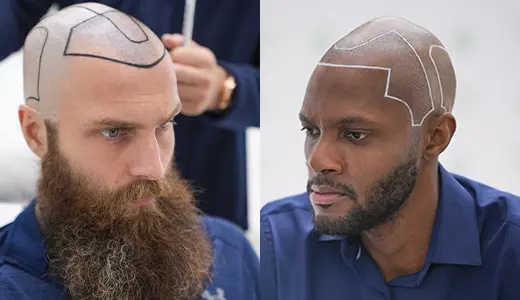
- Square Face: This face shape is characterized by a strong, angular jawline and a broad forehead, with roughly equal width and length.
- Heart Face: A heart-shaped face features a wider forehead, high cheekbones, and a narrow, pointed chin.
- Oval Face: An oval face shape is defined by balanced proportions, slightly wider cheekbones, and a gentle narrowing towards the forehead and chin.
- Triangle Face: A triangular face shape exhibits a broad forehead that tapers down to a narrower, more pointed chin.
- Round Face: Round faces are marked by soft, curved lines, with the width and length being nearly equal and full, rounded cheeks.
- Diamond Face: Diamond-shaped faces have narrow foreheads and chins, with the widest part being the cheekbones, creating a unique angular appearance.
How to Measure Forehead Size?
In this section, we’ll explore various techniques to help you determine your forehead proportions, from the finger measuring method to using inches and centimeters. Equipped with these easy-to-follow approaches, you’ll be able to evaluate your forehead objectively — and spot any changes over time.[1]
Measuring by Finger Method
Looking for a quick and easy way to measure your forehead? The finger method might be just the solution you need. By simply placing your fingers horizontally along your forehead, you can get a rough estimate of its size. Though finger widths may vary among individuals, this method boasts a remarkable 90% accuracy rate, making it a practical choice for those seeking a fast measurement.
To ensure the best possible results, line up your fingers parallel to your forehead, touching each other. Keep in mind that while this technique is highly convenient, it may not be as precise as using a ruler or measuring tape. Nonetheless, the finger method offers a reliable starting point for understanding your forehead size and its impact on your overall appearance.
How Many Fingers Is A Normal Forehead?
Ideally, a normal forehead should be about 4 fingers wide (measured vertically from eyebrow to hairline). If yours measures 3 fingers, you have a shorter-than-average forehead. If it measures 5 fingers or more, your forehead is taller than average — which can indicate either natural anatomy or hairline recession.
Measuring in Inches & Cm
If you’re looking for a more precise approach, measuring your forehead in inches or centimeters is the way to go. While it may not be as convenient as the finger method, this technique guarantees 100% accuracy, ensuring you get a true reflection of your forehead size. By using a measuring tape or ruler, you can obtain the exact dimensions needed to better understand the role of forehead size in your overall appearance.
To measure your forehead, simply place the ruler or measuring tape at your eyebrow level and extend it to your hairline. Record the distance in either inches or centimeters. If you want to track changes over time (to monitor potential recession), take the same measurement every 6 months and keep notes.
Also Read: Hairline Design Using the Golden Ratio
What is the Average Forehead Size?
Many individuals are curious about average forehead size, as an unusually large forehead can sometimes affect perceived facial harmony. Striking the right balance in facial proportions is crucial for an attractive look. It’s important to note that the ideal forehead size varies between men and women — men typically have slightly larger foreheads on average.
To help you determine the ideal forehead size for your gender, we’ve prepared dedicated tables below. By understanding the differences in average forehead size between men and women, you’ll be better positioned to assess your own proportions.
Average Forehead Size for Men
| Measurement | Minimum (inches) | Minimum (cm) | Maximum (inches) | Maximum (cm) | Average (inches) | Average (cm) |
| Forehead Height | 2 inches | 5 cm | 2.8 inches | 7 cm | 2.4 inches | 6 cm |
| Forehead Width | 4.7 inches | 12 cm | 6 inches | 15 cm | 5.5 inches | 14 cm |
Please note that the ideal height is within the range of 2 to 2.8 inches (5-7 cm), and the ideal width is between 4.7 and 6 inches (12-15 cm).
Average Forehead Size for Women
| Measurement | Minimum (inches) | Minimum (cm) | Maximum (inches) | Maximum (cm) | Average (inches) | Average (cm) |
| Forehead Height | 2 inches | 5 cm | 2.6 inches | 6.5 cm | 2.3 inches | 5.8 cm |
| Forehead Width | 4.4 inches | 11.2 cm | 5.8 inches | 14.7 cm | 5.1 inches | 13 cm |
Please note that the ideal height for women is within the range of 2 to 2.6 inches (5-6.5 cm), and the ideal width is between 4.4 and 5.8 inches (11.2-14.7 cm).
Forehead Size and Hair Loss: What’s the Connection?
If you’re here because your forehead seems to be getting larger over time, you may be experiencing the early stages of androgenetic alopecia — commonly known as pattern hair loss. According to the American Academy of Dermatology, this affects roughly 40% of men by age 35 and up to 65% by age 60.
Hairline recession typically starts at the temples (creating an M shaped hairline) before moving backward. The increase in visible forehead skin can range from a few millimeters to several centimeters over the course of a decade.
When to Consider Professional Assessment
- Your forehead measurement has increased by more than 1 cm in the past 1-2 years
- Your hairline has become visibly asymmetrical (classic M pattern)
- You’re noticing increased hair fall in the shower or on your pillow
- Family members (father, grandfathers, maternal uncles) have significant hair loss
If any of these apply, a densitometric hairline analysis with a specialist can determine whether you’re experiencing true recession or simply have a naturally high hairline. At Hair of Istanbul, our medical team — led by Dr. Ahmet Dilber (Plastic Surgery) — conducts this analysis as part of every consultation.
Can Forehead Size Be Reduced Surgically?
Yes. There are two main surgical approaches for reducing the appearance of a large forehead, depending on the underlying cause:
| Hairline Lowering Surgery | Also called forehead reduction surgery, this procedure moves the entire hairline 1.5–3 cm forward in a single operation. Best for patients with a naturally high hairline and good scalp flexibility. Results are immediate and permanent. |
| Hair Transplant (FUE/DHI) | Individual follicles are transplanted to reshape the hairline and fill the upper forehead area. Requires 1,500–3,500 grafts depending on the target reduction. Takes 9-12 months to see full results but offers the most natural appearance. |
| Combined Approach | For larger reductions (over 3 cm) or complex cases, combining hairline lowering surgery with follow-up hair transplantation yields the most dramatic results. This is planned across two separate procedures 6-9 months apart. |
At Hair of Istanbul, hair transplant packages start at €3,500 for 1,500-2,500 grafts — all-inclusive, covering accommodation, transfers, and post-op medications. See our full pricing guide for complete details.
Also Read: Hair Transplant Turkey Before After Results
FAQ
Is 5 Fingers A Big Forehead?
Generally, the ideal forehead size is around 4 fingers wide. If your forehead measures 5 fingers across, it could suggest either a naturally high hairline or early hairline recession. If the measurement has increased over the past few years, consider consulting a hair restoration specialist to determine if androgenetic alopecia is at play.
What Is The Average Forehead Size For 13-14 Years Old?
Adolescents typically have slightly smaller foreheads compared to adults — roughly 1.8-2.2 inches (4.5-5.5 cm) in height. The juvenile hairline typically matures between ages 17-29, when it recedes slightly to reach its adult position. If the hairline appears to be receding before age 17 or continuing to recede after 29, a specialist consultation is recommended.
Are There Any Cultural Or Regional Differences In Average Forehead Size?
Yes, there are documented variations across ethnic groups. East Asian populations tend to have slightly smaller forehead-to-face ratios on average, while individuals of Northern European descent often have taller foreheads. African and Middle Eastern populations show considerable variation. However, facial harmony and proportions generally follow similar aesthetic principles across cultures.
Does Forehead Size Affect Hair Transplant Planning?
Absolutely. A patient’s current forehead size is one of the first measurements we take during consultation. We calculate the ideal new hairline position using facial proportion analysis and the golden ratio, accounting for factors like age, face shape, and donor area capacity. The goal is never to recreate a juvenile hairline — we aim for a natural, age-appropriate result.
Can Forehead Size Be Reduced Without Surgery?
Non-surgical options include strategic haircuts with bangs or fringes, eyebrow grooming to increase apparent eyebrow height, and makeup techniques like contouring. These are effective for daily appearance management but won’t physically reduce forehead dimensions. For permanent reduction, hairline lowering surgery or hair transplantation are required.
Can I Make My Forehead Smaller?
Yes, through three approaches: (1) styling — strategic haircuts that complement your face shape, (2) surgical hairline lowering, or (3) hair transplantation to lower and reshape the hairline permanently. Each option has different costs, recovery times, and permanence. Consulting a hair restoration specialist helps you identify the best approach for your specific situation.
Also Read: 10 Best Haircuts for M Shaped Hairline
Best Hairstyles for Receding Hairline or Big Forehead
For Men
- Crew Cut: This classic, low-maintenance haircut adds volume to the top, drawing attention away from the hairline and making your forehead appear smaller.

- Side Part: A side part with a slightly longer top helps disguise a receding hairline by adding a sense of balance to your face.

Via nensuria / Freepik
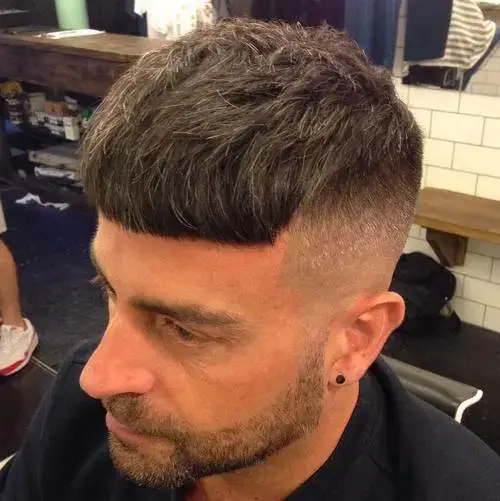
- Caesar Cut: The Caesar haircut is a great choice for minimizing the appearance of a large forehead. By featuring short, horizontal bangs that cover part of the forehead, this style helps create a more balanced look. Additionally, the Caesar haircut adds a sense of structure and frames the face effectively, drawing attention away from the forehead size.[2]
Via therighthairstyles.com
For Women
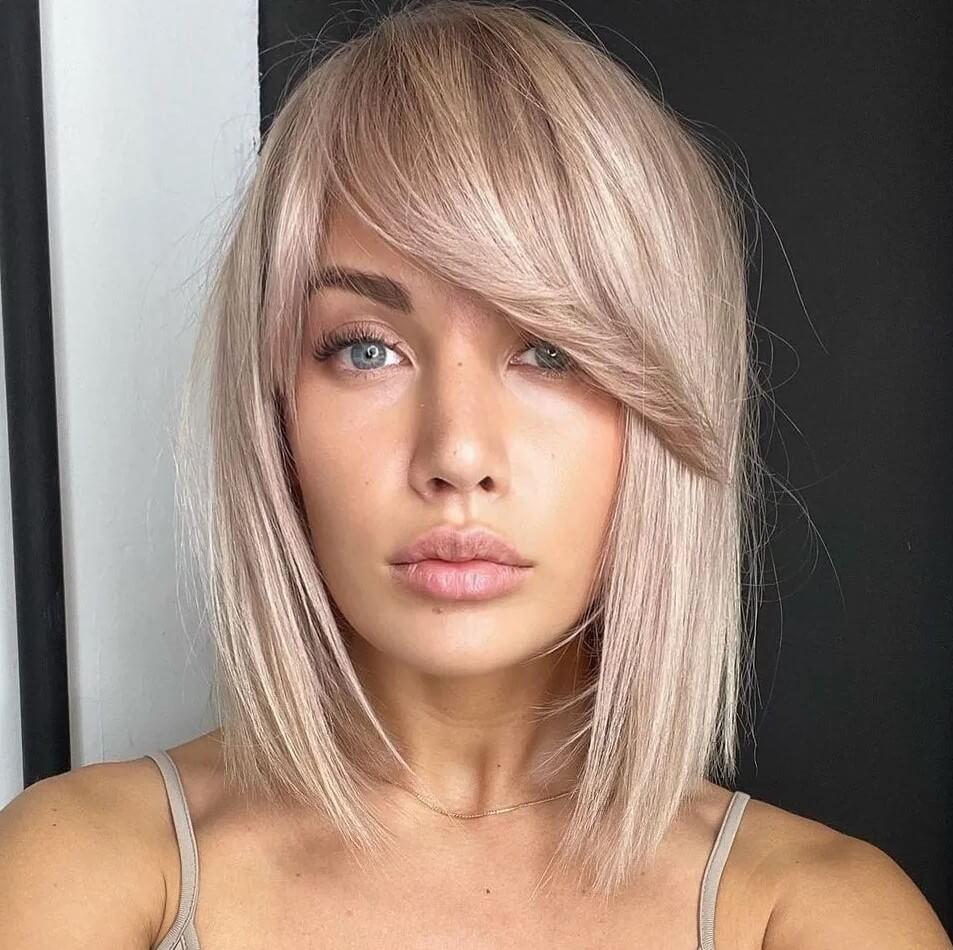
- Side-Swept Bangs: Soft, side-swept bangs help to frame your face and conceal a high hairline, creating a more balanced appearance.[3]
Via hadviser.com
- Layered Bob: A layered bob adds volume and texture to your hair, drawing attention away from the hairline while complementing your face shape.

Via garetsvisual / Freepik
CONCLUSION
In conclusion, understanding average forehead size and ideal proportions for different genders is essential for achieving a balanced appearance — and for identifying early signs of hair loss. The average forehead measures 2.4 inches (6 cm) tall for men and 2.3 inches (5.8 cm) tall for women, with the 4-finger rule offering a quick self-check. While strategic haircuts can conceal a large forehead to some extent, hair transplantation and hairline lowering surgery offer more permanent and effective solutions for those seeking long-lasting results.
At Hair of Istanbul, we are proud to be known for our four-specialist medical team and exceptional service in the hair restoration field. Led by Dr. Ahmet Dilber (Plastic Surgery) and supported by anesthesiology, medical aesthetics, and cardiology specialists, we’ve helped over 3,000 patients in 2024-2025 alone achieve their ideal hairline. Our approach starts with a full medical consultation that evaluates your facial proportions, hair density, and goals before any procedure is recommended. Take the first step by scheduling a free consultation today.
Sources:
- [1] The Rachael Ray Staff, Jul 23, 2015 – Learn How to Measure Your Face Shape
- [2] Trhs, Dec 21, 2022 – 20 Best Men’s Caesar Haircut Ideas for 2023
- [3] By Editors – 40 Startling Side Swept Bangs Ideas to Suit Any Taste
- [4] American Academy of Dermatology, 2024 – Male Pattern Hair Loss