












Medically reviewed by Dr. Mahmut Satekin, Medical Aesthetics Physician.
An M shaped hairline is not a diagnosis. It is a shape, and two completely different things produce it. One is normal hairline maturation, which finishes in the late teens or twenties and then holds its position for years. The other is androgenetic alopecia — male pattern hair loss — which produces the same outline and does not stop. Everything that matters here, including whether you need any treatment at all, depends on which of the two you are looking at.
This page settles that question first, using the same three tests a clinician uses, and comes to haircuts afterwards.
M Shaped Hairline: The Short Answer
- What it is. Both temporal corners have moved back while the central hair stays forward, so the frontal line reads as a wide letter M.
- If it has settled. A symmetrical, roughly one-centimetre step back that stopped and has not moved in a year is hairline maturation — Norwood stage 2. Nothing needs treating.
- If it is still moving. Recession that deepens, becomes uneven, or is joined by thinning behind the line is androgenetic alopecia. From Norwood stage 3 onwards this is classified as balding.
- The test is time, not shape. One photograph cannot tell you which you have. Two photographs twelve months apart can.
- Order of treatment. Diagnosis, then medical stabilisation, then — only once the pattern has declared itself — surgery.
What an M Shaped Hairline Is
Everyone is born with a low, rounded, concave hairline sitting close to the brow. Research on hairline development records that all children start with this concave shape, and that in men the frontal hairline changes from concave to convex between the ages of 18 and 29. As the temporal corners retreat and the central hair remains forward, the line acquires the M outline.
So an M shaped hairline is, in itself, one of the most ordinary adult male hairline shapes. It becomes clinically meaningful only when it keeps going.
The Two Things an M Shape Can Mean
| Hairline maturation | Androgenetic alopecia | |
|---|---|---|
| Movement | Stops; holds position for years | Continues; measurably further back after 12 months |
| Symmetry | Both temples similar | Often uneven, one side ahead |
| Depth | Roughly a centimetre | Deepening triangular notches |
| Edge quality | Sharp; full-calibre hair right up to the line | Wispy; fine pale miniaturised hairs in front |
| Rest of scalp | Crown and mid-scalp unaffected | Thinning at the crown or mid-scalp |
| Age at onset | Late teens to late twenties | Any age, including before 20, and keeps going |
| Norwood stage | 2 | 3 and above |
| Treatment needed | None | Yes — earlier is better |
M Shaped Hairline vs Mature Hairline
These are not opposites. A mature hairline frequently is M shaped — that is what maturation produces. The distinction is not the shape but whether the shape is final.
A mature hairline is Norwood stage 2: symmetrical, about a centimetre back, clean-edged, crown untouched, and stable. A receding hairline passes through exactly the same appearance on its way somewhere worse. This is why being told “it’s just a mature hairline” after a single glance is the most over-used reassurance in hair loss, and why our guide to mature vs receding hairline sets out the six tests that separate them.
M Shaped Hairline vs V Shaped Hairline (Widow’s Peak)
The two are often confused. An M shaped hairline has two receded temporal corners with the central hair still forward, so the whole frontal line reads as a wide letter M. A V shaped hairline, usually called a widow’s peak, is a narrow downward point in the middle of the forehead.
A widow’s peak is an inherited trait, visible from an early age, and is not a sign of recession — which is why it can sit on an otherwise completely stable hairline. The two get reported together because receding temples make an existing peak more prominent. The peak did not appear; the hair beside it left.
Where the M Fits Among Hairline Shapes
Frontal hairlines are usually grouped into a small number of outlines: straight or juvenile, low, high, rounded, M shaped, V shaped, uneven, and — in the advanced stages — the horseshoe pattern. Which outline a person has is determined mainly by inherited follicle distribution, and how it reads depends on forehead height and temple width, so the same outline looks different on different faces — a naturally high hairline is a different finding from a receding one, which our page on forehead height and hairline position covers.
The M is one of the most frequently observed adult patterns in men. It also occurs in women, though female pattern hair loss more often preserves the frontal line and thins diffusely behind it.
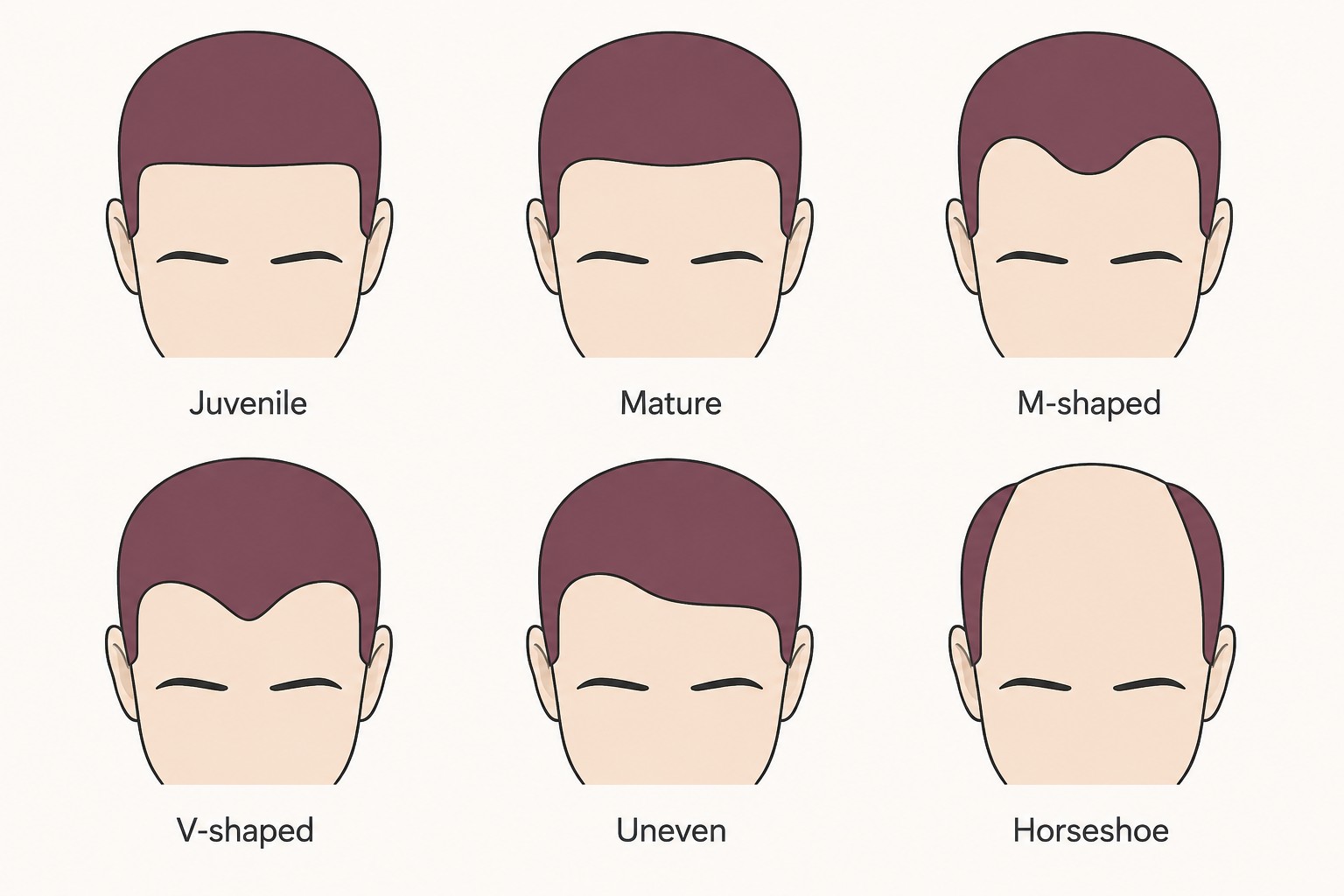
The same six outlines, drawn on an identical head so only the hairline differs. The M is one of the most common adult male shapes; what matters clinically is not which outline you have but whether it is still moving.
What Causes an M Shaped Hairline?
- Hairline maturation. A normal adult change that produces an M outline and then stops. No cause for concern and no treatment.
- Androgenetic alopecia. Follicles sensitive to dihydrotestosterone miniaturise with each growth cycle, most visibly at the temporal corners. Clinical reference sources describe the male pattern as beginning with bitemporal thinning of the frontal scalp, followed by involvement of the vertex.
- Genetics. Inherited follicle sensitivity and family history are the strongest predictors of both timing and final pattern.
- Telogen effluvium. Stress, illness, surgery or rapid weight change pushes follicles into the resting phase; the shedding that follows exposes the temples. This one recovers.
- Nutritional deficiency. Low iron, protein, zinc or vitamin D is associated with increased shedding.
- Medical treatment. Chemotherapy and some medications cause hair loss that alters the hairline.
- Smoking. Associated in the literature with earlier and more severe androgenetic hair loss.
Because the causes differ, so does the response. A hairline that has matured and stopped needs nothing. One that is still receding is assessed medically before anything surgical is discussed.
How to Tell If Yours Is Still Progressing
This is the only question worth answering, and it is answered at home with a camera rather than in a mirror.
| Step | How | Why it matters |
|---|---|---|
| 1. Standardise | Dry unstyled hair, indirect daylight, no flash, hair pushed back, same distance | Lighting changes apparent density more than a year of loss does |
| 2. Five angles | Front, both temples in profile, top-down, crown | The crown is where pattern loss hides |
| 3. Fixed landmark | Relaxed eyebrows; measure from the outer brow corner | The brow crease moves with expression; the brow corner does not |
| 4. Inspect the edge | Look at the first centimetre of hair at the line | Fine, pale, uneven hairs in front of thicker ones indicate miniaturisation |
| 5. Repeat at 12 months | Identical conditions; overlay the two front photographs | Movement over a year is the actual diagnostic test |
In a clinic the same question is answered faster: trichoscopy measures miniaturisation directly and does not need a year to do it.
How Common Is an M Shaped Hairline?
Frontal recession is common, and it becomes more common with age. In a community-based sample of men aged 18 to 49, 42% had moderate to extensive hair loss — Norwood type III or greater — rising from 16% of men aged 18 to 29 to 53% of men aged 40 to 49.
Looking specifically at the frontal hairline rather than at baldness overall, a receding frontal hairline was recorded in 25% of men aged 40 to 55 and 31% of men aged 65 to 69. Across a lifetime, 30% to 50% of men develop androgenetic alopecia by the age of 50, and fewer than 15% reach 70 with little or no baldness.
Two things follow. Frontal recession is normal in the statistical sense — most men experience some. And it is also progressive in most of those men, which is why “common” is not the same as “nothing to do about it”.
Where the M Sits on the Norwood Scale
| Stage | Hairline | What it means |
|---|---|---|
| Norwood 1 | Juvenile line retained, no recession | Reference point, not a stage of balding |
| Norwood 2 | Symmetrical temporal recession, ~1 cm, gentle V or M | The mature hairline. Not evidence of progressive loss |
| Norwood 3 | Deep temporal recessions, M pronounced | The first stage classified as baldness |
| Norwood 3 vertex | As above, plus crown thinning | Two areas now involved |
| Norwood 4+ | Front and crown separated by a band of hair | Planning changes; donor supply becomes the constraint |
The clinically important line is between 2 and 3 — it is where Norwood’s own classification stops calling the change maturation and starts calling it balding. Our full guide to the Norwood scale covers all seven stages and what each means for planning.
When It Needs Treating — and When It Does Not
A settled M shaped hairline at Norwood 2 needs no medical treatment, no supplements and no surgery. Treating a stable hairline achieves nothing and, in the case of surgery, spends a finite donor supply on a problem that does not exist.
A hairline that is still moving is a different situation, and the value of acting early is specific: medical therapy is far better at keeping hair than at bringing it back. The hair you still have at the moment of diagnosis is roughly the hair you can expect to protect.
Medical Treatment Comes Before Surgery
Two things make an early-stage M shaped hairline worse than it needs to be: waiting until the pattern is obvious, and operating on a hairline that is still receding.
- Get a diagnosis rather than an opinion. Trichoscopy distinguishes androgenetic alopecia from telogen effluvium and other causes that look identical at the temples but behave completely differently.
- Stabilise first. Medical therapy protects the untransplanted hair. Grafts placed into an area that continues to thin around them produce a result that looks worse each year while the surgery itself was technically fine.
- Let the pattern declare itself. Hairline surgery in the early twenties, before the eventual Norwood stage is clear, is the most common reason a hairline looks wrong at forty. Our page on revision hair transplant covers what is involved when that decision was made too early.
When a Hair Transplant Becomes the Right Answer
Surgery is appropriate when the recession is established rather than active, the donor area can supply what the plan requires, and the patient understands that the transplant treats the area operated on and not the hair loss itself. In practice that usually means a stable Norwood 3 or beyond, on medical therapy, in a patient old enough for the eventual pattern to be predictable — the timing decision is set out in full on our page about hair transplant for a receding hairline.
Technique — FUE or DHI — determines how grafts are extracted and placed, not whether the timing is right. Graft numbers follow from the plan rather than the other way round; our page on large-session graft counts explains why a high number is not a goal in itself, and verified outcomes are published on our before and after page.
Why a Transplanted Hairline Is Not Simply Filled In
Restoring an M shaped hairline does not mean drawing a straight line across the forehead. Three things are decided before a single graft is placed:
- Height. The new line is placed at the mature position, not the juvenile one. A line lowered to where it sat at fifteen looks wrong on a face of forty and consumes donor hair that will be needed elsewhere.
- Shape. Temporal recession is softened rather than erased. A hairline with no temporal recession at all reads as artificial on an adult male face.
- Irregularity. Natural hairlines are not straight. Single-hair grafts are placed in a deliberately irregular transition zone, which is what separates a hairline that survives close inspection from one that does not — see micro-irregular hairline design.
Haircuts That Suit an M Shaped Hairline
Whichever of the two situations you are in, you have to wear your hair in the meantime. These ten cuts work with an M outline rather than against it. Each is matched to face shape and, where it matters, to the Norwood stage at which it stops working.
1. Buzz Cut
Clean, uniform and entirely without pretence — the buzz cut stops trying to hide the hairline, which is precisely why it works. When recession is advanced enough that concealment fails, removing the contrast between hair and scalp is more effective than any styling.
Best for: oval, square and diamond faces. Works especially well for advanced M recession (Norwood 3–4) where hiding is no longer possible. Maintenance: trim every 2–3 weeks.
2. Short Fade with Styled Side Bangs
Bangs swept over and back, with a fade that integrates cleanly into the shorter length. The eye follows the sweep across the forehead rather than settling on the temples.
Best for: round and oval faces. Effective for early-stage M hairlines (Norwood 2–3). Styling time: 3–5 minutes daily.
3. Mid Drop Fade with a Long, Tousled Top
The drop fade begins just below the temples, and the longer tousled top provides genuine coverage rather than the illusion of it. The precise fade line does the disguising work at the sides.
Best for: square and rectangular faces — the volume on top balances an angular jawline.
4. 90’s Heartthrob Long Taper
A long taper in the 1990s idiom, needing at least 5–6 inches on top. Length gives the most coverage of any cut here, but it depends entirely on what is behind the hairline.
Best for: oval and heart-shaped faces, and only when the hair on top is naturally thick. Important: requires healthy crown density — not suitable at Norwood 4 and beyond, where the length exposes the crown instead of covering the front.
5. High Top Bald Fade
Height on top and a bald fade at the sides move the focal point upward and away from the frontal line. Because the fade itself becomes the feature, this cut is unusually stage-independent.
Best for: oval and square faces. Works at any stage of recession.
6. Styled-Forward Long Top Crop
Short tapered sides with length kept at the top and front, styled forward. The fringe sits over the recessed corners instead of beside them.
Best for: round and oval faces. The forward fringe covers early-stage M recession effectively; it stops working once the recession passes the mid-scalp.
7. Quiff Taper
Shorter sides against a voluminous top. Volume at the front is the single most useful property in a haircut for thinning hair, because density reads as height as much as it reads as coverage.
Best for: all face shapes — one of the most universally flattering options here. Requires at least 3–4 inches of hair on top.
8. Brushed-up Quiff
The front hair is brushed upward rather than forward, which maximises apparent thickness along the hairline itself.
Best for: square and oblong faces. Products: sea salt spray for grip, matte clay to hold without shine — shine makes a thinning scalp more visible, not less.
9. Slicked Back
Close-cropped sides with elongated top swept back. It does not hide the hairline; it presents it deliberately, which reads as confidence rather than concealment.
Best for: oval, square and diamond faces, and business settings. Suits those comfortable showing a deeper hairline.
10. Taper Fade
Precision at the sides and back draws attention to the cut rather than the line. The most adaptable option on this list and the easiest for a barber to adjust as things change.
Best for: any face shape, at any stage.
What Changes as Recession Progresses
Cuts that rely on covering the corners stop working before cuts that rely on removing contrast. As a rough guide: fringe-forward and long-taper styles serve Norwood 2–3; volume-and-fade styles serve Norwood 3–4; uniform short lengths serve everything beyond that. The mistake to avoid is growing hair longer to compensate — longer hair separates and exposes scalp, so past a certain point length works against you.
Can You Hide an M Shaped Hairline?
Partly, and honestly it is worth saying where the limit is. Haircuts change how the hairline reads; they do not change the hairline. Styling, fibres and pigments manage appearance day to day. Medical therapy changes what happens next. Surgery changes the line itself. Choosing between them is a matter of what you want the outcome to be, and the first step in all three is knowing whether the line is still moving.
Frequently Asked Questions
Is an M shaped hairline normal?
Common and normal are not the same thing. The M outline is produced by normal hairline maturation, which usually finishes between 17 and 29 and then holds. It is also produced by androgenetic alopecia, which continues. If the line has not moved in a year, it is normal maturation.
Is an M shaped hairline the same as a receding hairline?
Not necessarily. A receding hairline is one that is actively moving back. An M shaped hairline describes only the shape, which may be the settled end point of maturation.
At what age does an M shaped hairline typically appear?
Most often between 18 and 29, as the frontal hairline changes from concave to convex. Recession that begins before about 17, or new movement after 30, points to pattern loss rather than maturation.
Can an M shaped hairline reverse naturally?
Maturation does not reverse; it is a permanent developmental change. Recession caused by telogen effluvium recovers once the trigger resolves. Androgenetic recession does not reverse on its own, though medical therapy can slow or partly reverse miniaturisation at an early stage.
Can women have an M shaped hairline?
Yes, but it is less typical. Female pattern hair loss more often widens the part and thins the crown while preserving the frontal line. Marked bitemporal recession in a woman warrants assessment for hormonal and other causes rather than reassurance — see female M-shaped hairline.
How many grafts do I need to fix an M shaped hairline?
It depends on the depth of the recession, the density required and the donor supply available, and it is measured rather than estimated from a photograph. Frontal hairline work commonly falls in the 1,500–3,000 graft range, but the number is an output of the plan, not an input.
Will a hair transplant completely restore my original hairline?
It should not try to. The goal is a hairline appropriate to an adult face that will still look right in twenty years, which means the mature position with softened temporal recession — not the juvenile line.
How much does it cost to treat an M shaped hairline in Turkey?
Cost depends on the technique, the graft count and what is included. Our hair transplant cost in Turkey page sets out what determines the figure.
References
- Rhodes T, Girman CJ, Savin RC, et al. Prevalence of Male Pattern Hair Loss in 18–49 Year Old Men. Dermatologic Surgery, 1998 — 42% of men aged 18–49 had moderate to extensive loss (Norwood type III or greater); 16% of men aged 18–29 and 53% of men aged 40–49. pubmed.ncbi.nlm.nih.gov/9865198
- Ellis JA, Sinclair RD, Harrap SB. Male Androgenetic Alopecia. Endotext, National Center for Biotechnology Information — receding frontal hairline recorded in 25% of men aged 40–55 and 31% of men aged 65–69; 30–50% of men develop androgenetic alopecia by age 50; fewer than 15% have little or no baldness by 70. ncbi.nlm.nih.gov/books/NBK278957
- Nusbaum BP, Nusbaum AG. Phenotype of Normal Hairline Maturation. Dermatologic Surgery, 2013 — all children begin with a concave hairline; in men the frontal hairline changes from concave to convex between ages 18 and 29. pubmed.ncbi.nlm.nih.gov/24017973
- StatPearls, Androgenetic Alopecia (National Center for Biotechnology Information) — in men the pattern typically begins with bitemporal thinning of the frontal scalp followed by involvement of the vertex. ncbi.nlm.nih.gov/books/NBK430924
- American Academy of Dermatology, Hair loss: male pattern — patient information on causes and treatment. aad.org
In Short
An M shaped hairline is a shape, not a diagnosis. Produced by normal maturation it is symmetrical, about a centimetre deep, sharp-edged, leaves the crown alone, and stops — that is Norwood 2 and it needs nothing. Produced by androgenetic alopecia it deepens unevenly, the edge softens as hairs miniaturise, the crown eventually joins in, and it is classified as balding from Norwood 3. Twelve months between two identical photographs tells you which one you have; trichoscopy tells you the same thing in minutes.
If it has settled, choose a haircut and stop worrying about it. If it is moving, the order is diagnosis, then medical stabilisation, then surgery only once the pattern is predictable. Hair of Istanbul is a licensed clinic operating in Ataköy, Bakırköy, Istanbul since 2013; you can read about our medical team or send photographs for an assessment before deciding anything.