
 en
en TR
TR  SK
SK  ITA
ITA  FR
FR  DE
DE  ES
ES  BG
BG  RO
RO 
What a Dislodged Hair Graft Looks Like — and What It Does Not
A dislodged hair graft is not a hair. It is a small piece of tissue. That single distinction answers most of the panic in the first week after a hair transplant: a hair lying on your pillow is almost always normal shedding, while a genuinely dislodged graft is a pale, soft, one-to-two-millimetre fragment of skin with one to three hairs still attached to it — and it usually leaves a pinpoint of bleeding behind.
This page explains what a dislodged hair graft looks like, how to tell one from ordinary shedding and scabbing, how long grafts stay vulnerable, and the small number of situations in which you should stop reading and call your clinic.
What a Dislodged Hair Graft Looks Like
People search for a photograph because the description they have been given is too vague to use at two in the morning. Here is the description in usable detail.
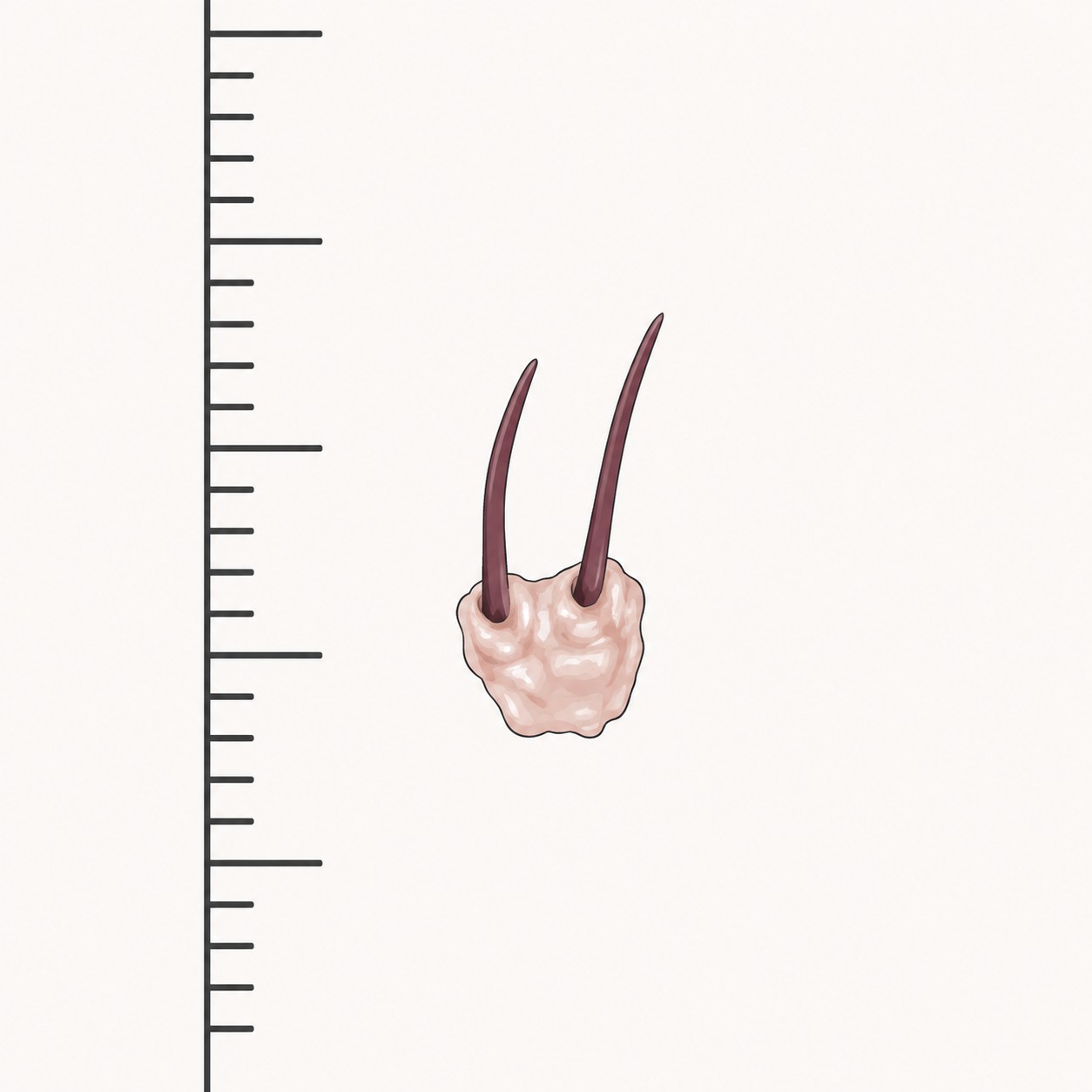
A dislodged graft is a fragment of tissue, roughly one to two millimetres across, with one to three short hairs still attached to it.
| Feature | Dislodged graft | Normal shed hair |
|---|---|---|
| What you are holding | A soft fragment of tissue, roughly 1–2 mm, pale pink or whitish | A hair shaft only, no tissue |
| Hairs attached | Usually 1–3 short hairs growing out of the fragment | A single hair |
| The end of the hair | Embedded in the tissue; you cannot see a clean root | A small white or clear club at the end, or nothing |
| The site it came from | Pinpoint bleeding, or a small open dot | No bleeding; the site looks unchanged |
| When it happens | Almost always after a knock, a scratch, or a rubbing accident | Spontaneously, especially days 5–20 |
| Feel | Slightly moist and soft between the fingers | Dry, like any other hair |
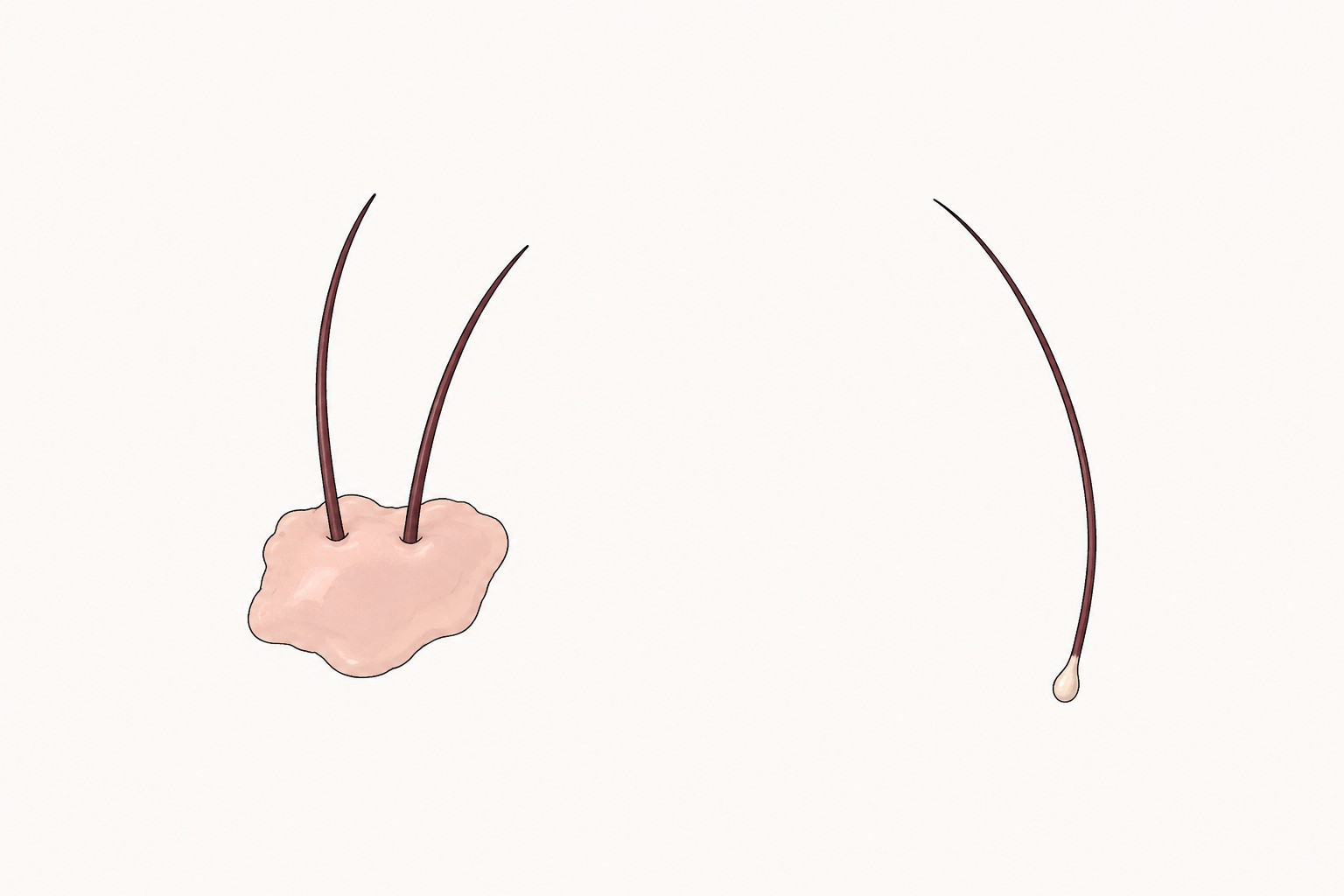
Left: a dislodged graft — soft tissue with hairs growing out of it. Right: an ordinary shed hair — the shaft alone, with a small pale club at the end and no tissue whatsoever. This is the distinction that matters.
If what came away is a hair with a tiny dry crust stuck to it, that is a scab releasing a hair — not a graft. The presence of living tissue and the pinpoint bleed are what separate the two.
Dislodged Hair Graft vs Normal Shedding
Between roughly the second and the eighth week, the transplanted hairs shed. Clinical reference sources describe this plainly: shedding of the implanted hairs occurs after several days, and new hairs typically appear only after 3 to 6 months. The follicle stays; the shaft goes. This is expected, it happens to almost everyone, and it is not graft loss.
The practical consequence is that most of what patients find on the pillow in weeks two to eight is normal. A dislodged hair graft is an accident with a mechanical cause, not something that happens quietly overnight. If you cannot remember what would have knocked it out, it probably was not one.
The Five Signs of a Dislodged Hair Graft
Taken together, five findings describe a dislodged hair graft. Taken separately, each of them has an innocent explanation.
- A mechanical trigger. A towel caught the scalp, a pillow rubbed, a hat was pulled off, a scab was scratched. Grafts do not fall out on their own in the first week.
- Pinpoint bleeding at one specific spot, immediately after that trigger, rather than diffuse oozing.
- Tissue, not just hair, on the towel, pillow or fingertip — soft, pale, a millimetre or two across.
- A visible gap in an otherwise even row of implanted grafts when you look closely in a mirror.
- A distinct small dent or open dot at that site instead of a healing crust.
One or two of these can have other explanations. All five together, after a knock, describe a lost graft.
How Long Do Grafts Stay Vulnerable?
A dislodged hair graft becomes progressively harder to produce as the days pass, because anchoring is progressive rather than instant. The graft is held first by fibrin and clot, then by ingrowing tissue, and the risk of dislodgement falls steeply across the first week. Bernstein and Rassman examined this directly in Graft Anchoring in Hair Transplantation (Dermatologic Surgery, 2006), and it remains the reference study on how quickly grafts become fixed.
Rather than a single “safe” date, the standard postoperative restrictions describe the risk window in practice:
| Time after surgery | What is permitted | Risk level |
|---|---|---|
| First 24 hours | No washing at all | Highest — any friction can displace a graft |
| From 24 hours | Wash the scalp without rubbing; daily neutral shampoo through the first week | High |
| Days 5–7 | Donor crusts can be gently rubbed away | Falling |
| Week 1 | Heavy lifting and strenuous activity resume; brushing resumes | Low |
| Week 2 | Hairstyling products permitted | Low |
| Weeks 2–4 | Full immersion of the head in water permitted | Minimal |
These are the intervals published in the StatPearls chapter on hair transplantation. Your surgeon’s instructions take precedence over any general schedule, and clinics differ.
How Easy Is It to Dislodge a Graft?
Producing a dislodged hair graft is harder than the anxiety suggests, and easier than complacency assumes. In the first two or three days a deliberate rub with a towel, a fingernail dragged across the recipient area, or a hat pulled off over the front hairline can take grafts out. Light contact — a pillowcase, a loose hood, water falling gently on the scalp — will not.
After the first week, dislodging a graft by ordinary handling is genuinely difficult. What continues to cause avoidable losses in that period is not accident but impatience: picking at crusts. Crusts form in the first days and separate over the following week, and pulling one off early can take the graft under it with it.
Bleeding After a Hair Transplant: When It Means a Lost Graft
Bleeding is the sign patients rely on most, but not all post-operative bleeding indicates a dislodged hair graft. Three patterns carry three different meanings:
- Light diffuse oozing in the first 24–48 hours. Normal. Hundreds of tiny incisions are still sealing.
- A single pinpoint bleed straight after a knock. This is the pattern that suggests a graft has come out. Apply light pressure with clean gauze for a few minutes without rubbing.
- Bleeding that restarts, spreads, or comes with pain, warmth, swelling or discharge. This is not a graft question. Contact your clinic — our page on infection after hair transplant sets out what to look for.
Do Hair Grafts Fall Out With Scabs?
Usually not. By the time crusts separate — the donor crusts can normally be rubbed away gently from day 5 to 7 — the grafts beneath them are anchored, and what comes away with the crust is generally the transplanted hair shaft, not the follicle. Seeing hairs embedded in a falling crust is the single most common cause of unnecessary alarm after a transplant.
The exception is forcing them. A crust removed before it is ready is removed along with whatever it is still attached to. Let them lift with gentle washing.
What Happens If a Graft Is Dislodged?
Honestly: in most cases a single dislodged hair graft changes nothing you will ever see. A session commonly places two to four thousand grafts. Losing one, or five, changes density by a fraction of a percent in an area where the eye cannot resolve the difference. There is no procedure to put a lost graft back — once it is out and out of the body, it is not viable.
What matters is the pattern, not the incident. A single graft after a knock is bad luck. Repeatedly finding tissue over several days points to something ongoing — sleeping position, a hat, a habit of touching — and that is worth changing immediately, because that is the scenario where losses accumulate to a visible amount. Our encyclopedia entry on poor graft growth covers the causes of a genuinely disappointing result, which are almost never a handful of dislodged grafts.
What to Do Right Now
- Do not touch the site again to check it. Repeat inspection with fingertips is how one lost graft becomes three.
- Apply gentle pressure with clean gauze if it is bleeding — pressure, not wiping.
- Photograph it in good light, both what came away and the site it came from. Your clinic can tell from a photograph what you cannot.
- Do not attempt to reinsert anything. It will not take, and probing the site risks the neighbouring grafts.
- Message your clinic with the photographs rather than searching for more images. One clear answer from the team that placed the grafts is worth more than an evening of comparison.
Can Wind, a Hat or Sleeping Dislodge Grafts?
- Wind: no. Air movement, however strong, does not exert the shearing force needed to displace a graft. Wind carrying grit or dust is a hygiene issue, not a mechanical one.
- Hats: the hat itself is not the problem; putting it on and taking it off is. A loose hat lowered straight down and lifted straight up is generally safe after the first days; anything pulled on or dragged off across the hairline is not.
- Sleeping: the reason for elevating the head and sleeping on the back in the first week is friction, not gravity. A travel pillow is the simplest way to keep the recipient area off the fabric.
- Showering: falling water is safe from 24 hours; a direct high-pressure jet on the recipient area is not.
Graft Survival: What the Number Actually Means
Graft survival describes the proportion of transplanted follicular units that go on to produce hair. It is determined mainly at the operating table and in the hours around it — how the follicles are extracted, how long they spend outside the body, how they are stored, and how atraumatically they are placed — not by whether a patient dislodged one or two afterwards.
Two clarifications worth making. First, “graft failure” in hair restoration means transplanted follicles that do not grow; it has nothing to do with the blood-cell complications of a bone marrow or stem cell transplant, which is a different procedure entirely. Second, a disappointing result at 12 months is far more often a planning or handling problem than an aftercare one. The techniques themselves — FUE and DHI — differ in how grafts are placed, and both depend on the same fundamentals of handling time and gentleness.
When to Contact Your Clinic
| What you are seeing | What it usually is | What to do |
|---|---|---|
| Hairs on the pillow, weeks 2–8 | Normal post-transplant shedding | Nothing; expected |
| Hairs coming away inside crusts | Shafts separating with the crust | Nothing; do not pick |
| One tissue fragment after a knock | A single dislodged graft | Pressure, photograph, message the clinic |
| Tissue fragments on several days | An ongoing mechanical cause | Contact the clinic the same day |
| Spreading redness, pain, warmth, pus | Possible infection | Contact the clinic promptly |
| Bleeding that will not stop with pressure | Needs assessment | Contact the clinic immediately |
Frequently Asked Questions
What does a dislodged hair graft look like?
A soft, pale, one-to-two-millimetre fragment of tissue with one to three short hairs attached, usually accompanied by a pinpoint bleed at the site it came from. A hair on its own, with no tissue and no bleeding, is normal shedding.
How do I know if I have dislodged a graft?
There is nearly always a mechanical trigger you can remember, followed by pinpoint bleeding and tissue rather than a hair alone. Without a trigger and without tissue, it is almost certainly shedding.
How long until grafts are secure?
Anchoring strengthens steeply over the first week. The standard restrictions reflect this: no washing for 24 hours, no rubbing through the first week, strenuous activity from week one, styling products from week two, and no full immersion of the head in water for two to four weeks.
Can transplanted grafts fall out?
The transplanted hairs fall out in almost every case — this is expected shedding and the follicle remains. The graft itself coming out is uncommon and requires physical force.
Can wind dislodge hair grafts?
No. Wind does not generate the shearing force needed. Protect against dust and sun rather than against air movement.
When can I touch my grafts?
Deliberate touching should wait until the crusts have separated, generally after the first week. Even then there is no reason to press or probe the recipient area.
Do hair grafts fall out with scabs?
The hair shafts often do; the grafts generally do not, provided the crusts are allowed to lift with gentle washing rather than being picked off early.
Does one dislodged hair graft affect the result?
No. Against the two to four thousand grafts of a typical session, the difference is not visible. Repeated loss over several days is the situation that matters.
Can a dislodged graft be put back?
No. Once a graft has come out and been outside the body it is not viable, and probing the site would put the surrounding grafts at risk.
References
- StatPearls, Hair Transplantation (National Center for Biotechnology Information): postoperative instructions — wash without rubbing 24 hours after the procedure and daily with a neutral shampoo for the first week; gently rub the donor area to remove crusts 5 to 7 days after surgery; avoid heavy lifting and strenuous activity for 1 week; wait 1 week before brushing; avoid hairstyling products for 2 weeks; avoid fully immersing the head in water for 2 to 4 weeks. Graft dislodgement and folliculitis are listed among the recognised complications. ncbi.nlm.nih.gov/books/NBK547740
- Bernstein RM, Rassman WR, Graft Anchoring in Hair Transplantation, Dermatologic Surgery (2006): the reference study on how quickly transplanted grafts become fixed in the recipient site. pubmed.ncbi.nlm.nih.gov/16442039
- NHS, Hair loss: general patient information on hair loss and its treatment. nhs.uk/conditions/hair-loss
In Short
A dislodged hair graft is a small piece of tissue with hairs attached, not a loose hair, and it follows a knock rather than appearing on its own. Pinpoint bleeding at one spot is the confirming sign. Shedding in weeks two to eight, and hairs releasing inside crusts, are normal and are not graft loss. The risk window is steepest in the first 24 hours and falls sharply across the first week, with full water immersion the last restriction to lift at two to four weeks. Losing one graft does not change the result; finding tissue on several consecutive days means something mechanical is still happening and should be fixed the same day.
If you are unsure, photograph both the fragment and the site and send them to the clinic that performed the procedure. If you want to see what a normal early recovery actually looks like, our documented hair transplant journey records one patient day by day from the day before surgery, with the first weeks photographed almost daily. Hair of Istanbul is a licensed clinic operating in Ataköy, Bakırköy, Istanbul since 2013; our medical team answers post-operative questions from patients directly, and the full course of recovery is set out in our hair transplant recovery timeline and hair transplant growth stages guides.