
 en
en TR
TR  SK
SK  ITA
ITA  FR
FR  DE
DE  ES
ES  BG
BG  RO
RO 
Mature Hairline vs Receding Hairline: How to Tell the Difference
A mature hairline is the small, even, permanent step backwards that most men’s hairlines take in their twenties. A receding hairline keeps going. That single difference — settled versus still moving — is what separates the two, and it is the reason no photograph taken on one afternoon can tell you which one you have.
This page sets out what a mature hairline actually is, what it looks like, how it differs from early male pattern hair loss, why the popular “one to one and a half centimetres” rule is unreliable on its own, and how to check your own hairline properly at home.
Mature Hairline vs Receding Hairline: The Short Answer
- Mature hairline. A symmetrical, roughly one-centimetre step back at both temples, leaving a gentle V in the middle. It corresponds to Norwood stage 2. It happens once, in the late teens to late twenties, and then stops.
- Receding hairline. The same recession, but it does not stop. The temples keep opening, the V deepens, and the line keeps travelling backwards. From Norwood stage 3 onwards this is classified as balding, not maturation.
- The test is time, not distance. A mature hairline holds its position for years. A receding one is measurably further back a year later.
- What is not a mature hairline. Asymmetry, thinning behind the line, a diffusely thinner crown, or recession that began before about 17.
What Is a Mature Hairline?
Everyone is born with a low, rounded hairline that sits close to the eyebrows. Dermatologic research on hairline development describes it precisely: all children start with a concave hairline, and the leading central edge of that juvenile hairline sits at the highest wrinkle of the furrowed brow. During adolescence and early adulthood this changes. In men, the concave shape of the frontal hairline transitions to a convex shape between the ages of 18 and 29.
That transition is the mature hairline. It is a normal developmental event, not a disease, and it is the reason a man of 27 does not have the hairline he had at 14. On the Hamilton–Norwood classification it is stage 2 — a small symmetrical recession at both temples that moves the line back by roughly a centimetre and leaves a gentle V in the middle. Our guide to the Norwood scale sets out all seven stages and where stage 2 sits among them.
What a Mature Hairline Looks Like
Four features together describe a mature hairline. One or two on their own are not enough:
- Symmetry. Both temples move back by a similar amount. A mature hairline is even; male pattern loss is frequently asymmetric.
- Shape. The line changes from concave (curving down toward the brow) to convex or gently V-shaped in the centre. The corners soften rather than carving out deep triangular notches.
- A clean, defined edge. The hair immediately behind the new line is full-calibre and dense. There is a clear boundary between hair and forehead.
- Nothing else changes. The crown, the mid-scalp and the density behind the hairline are unaffected. Maturation is confined to the frontal line.
A receding hairline usually breaks at least one of these: the notches deepen unevenly, the edge becomes wispy and indistinct as fine miniaturised hairs sit in front of thicker ones, and thinning appears elsewhere.
What Is a Receding Hairline?
A receding hairline is the frontal expression of androgenetic alopecia — male pattern hair loss. Clinical reference sources describe the pattern in men as beginning with bitemporal thinning of the frontal scalp, followed by involvement of the vertex, with loss most prominent in the vertex and frontotemporal regions.
The mechanism is miniaturisation. Under the influence of dihydrotestosterone, susceptible follicles produce a progressively finer, shorter, less pigmented hair with each growth cycle, until the hair is too fine to provide cover. This is why a receding hairline looks thin before it looks bare — and why an edge made of soft, colourless, uneven hairs is a more reliable warning sign than the position of the line itself.
Mature Hairline vs Receding Hairline: The Six Tests
No single feature is diagnostic. Assessed together, these six separate maturation from early pattern loss:
| Test | Mature hairline | Receding hairline |
|---|---|---|
| Movement over time | Stops and holds for years | Continues; measurably further back after 12 months |
| Symmetry | Both temples similar | Often uneven; one side ahead of the other |
| Shape | Concave becomes convex or a gentle V | Deep triangular notches; sharp M shape |
| Edge quality | Defined; full-calibre hair right up to the line | Wispy and blurred; fine pale hairs in front |
| Rest of the scalp | Crown and mid-scalp unaffected | Thinning at the crown or through the mid-scalp |
| Age at onset | Late teens to late twenties | Can begin at any age, including before 20, and keeps going |
The sharp M shape in the right-hand column is the one most often noticed first; our guide to haircuts for an M-shaped hairline covers how to wear it while you work out which of the two you have.
If five of six point one way, you have your answer. If they are split — particularly if the edge is wispy or the crown is involved — treat it as pattern loss until a clinician says otherwise.
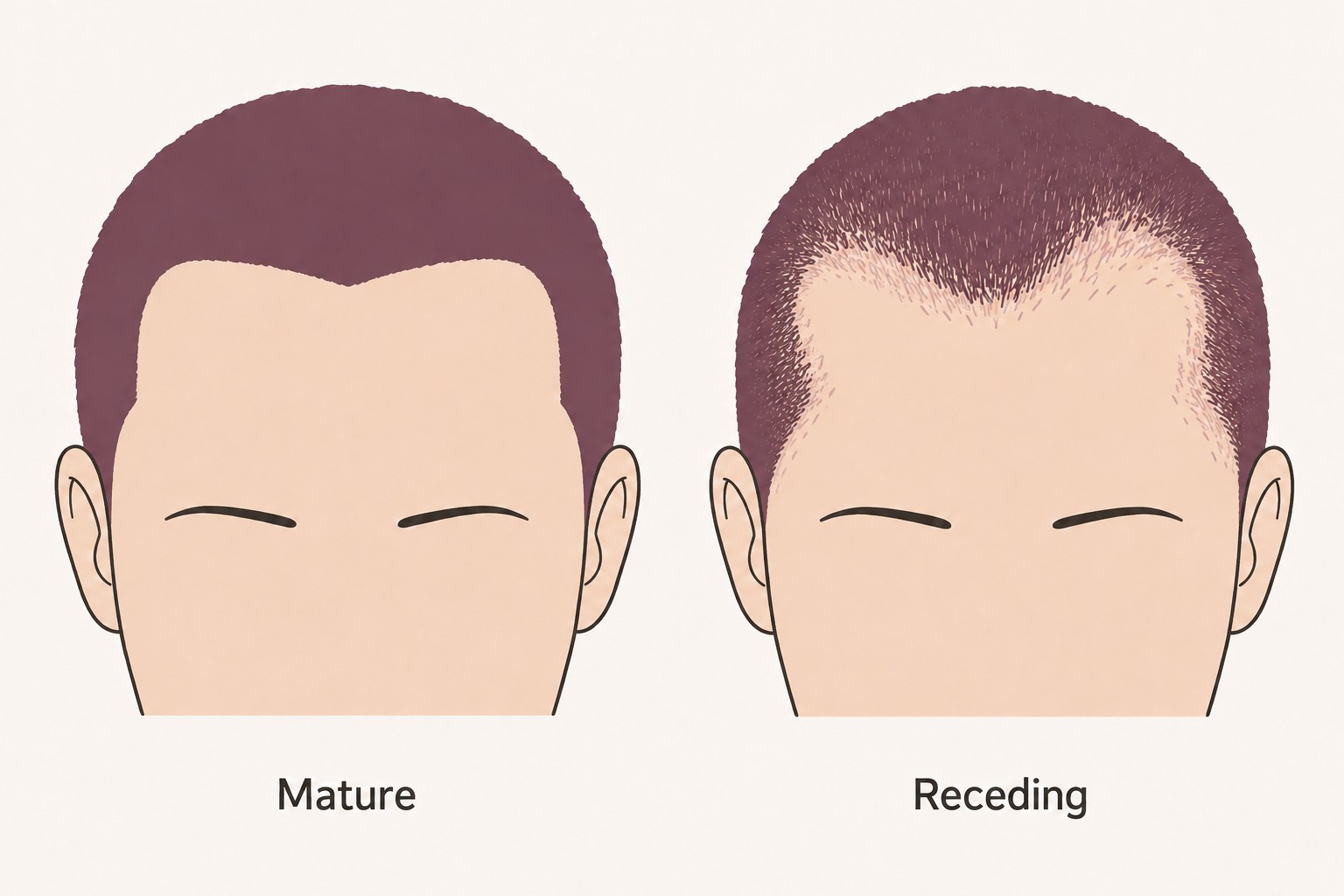
The distance back is the least reliable difference. What separates the two is the edge: on the left, full-calibre hair right up to a sharp line; on the right, a soft broken edge with fine pale hairs scattered in front of it.
The Juvenile Hairline: Where Everyone Starts
The juvenile hairline is the childhood hairline: low, rounded, concave, sitting at the highest crease of the furrowed brow. It is the baseline that both maturation and recession are measured from, and it is why comparing your hairline to a childhood photograph is misleading. Almost every adult man has lost his juvenile hairline, and that alone means nothing.
On the Norwood scale, stage 1 is the retained adolescent hairline — the reference point, not a stage of balding. Stage 2 is the mature hairline. The clinically important line is drawn at stage 3, which is where Norwood’s own classification stops calling the change maturation and starts calling it balding.
Is the Mature Hairline Real, or a Myth?
It is real, and it is documented. A study of hairline development in over a thousand children established the concave-to-convex transition as a normal phenotype of male adolescence and early adulthood, independent of hair loss. The concept is not clinic marketing.
The scepticism it attracts is nevertheless earned, because the label is frequently misapplied. A man in early Norwood 3 is often told he has “just a mature hairline” — by a barber, a forum, or a clinic with no interest in a difficult conversation. Both things are true at once: the mature hairline is a genuine phenotype, and it is the most over-diagnosed reassurance in hair loss. The only way to tell them apart is to watch what the line does over 12 months, not to accept a label applied in a single glance.
At What Age Does a Hairline Mature?
Maturation happens over a window, not on a birthday. The documented transition from concave to convex in men occurs between roughly 18 and 29. Most men who go through it do so in their early to mid twenties.
Age is also the strongest clue when maturation is the wrong explanation:
| Age | What is usually happening | What should raise concern |
|---|---|---|
| Under 17 | Juvenile hairline still present | Any clear temple recession is early — get it assessed |
| 18–24 | Maturation typically beginning | Recession past a centimetre, or crown thinning |
| 25–29 | Maturation usually complete and settled | A line still moving year on year |
| 30+ | Hairline should be stable | New movement is pattern loss, not late maturation |
For scale: in a community-based sample of men aged 18 to 49, 42% had moderate to extensive hair loss — Norwood type III or greater — rising from 16% of men aged 18 to 29 to 53% of men aged 40 to 49. Maturation is common, but so is genuine pattern loss, and the second is more common than most men at 25 assume.
Mature Hairline vs Balding: Where Norwood Draws the Line
“Mature hairline vs balding” is really a question about one boundary: stage 2 versus stage 3. Stage 2 is a settled, symmetrical, roughly one-centimetre recession with a clean edge and an untouched crown. Stage 3 is the first stage the classification calls baldness — the temples have opened into deep recessions and the process is visibly continuing.
The practical consequence matters. At stage 2 there is nothing to treat. At stage 3 the decision is whether to stabilise medically, whether to plan surgically, or both — and the value of catching it early is that medical therapy preserves what is still there far more effectively than it recovers what is gone.
Normal Hairline vs Receding Hairline
Many men search for “normal hairline vs receding” because they suspect their hairline has always been unusual. Two situations are commonly confused with recession and are not:
- A naturally high hairline. Some people simply have a high anterior hairline and a longer forehead. It has been there since childhood, it is symmetrical, the edge is sharp, and it has not moved. Our page on average forehead size covers where the normal range actually sits.
- A widow’s peak. A central point of hair extending down the forehead is an inherited shape, not a sign of loss. It becomes more visible after maturation, which is why it is often mistaken for new recession.
Neither is progressive. Both stay where they are. The distinguishing question is the same one as always: is it moving?
Why the “1 to 1.5 cm Rule” Fails on Its Own
The most repeated test online is to measure whether your hairline sits about a finger’s width — one to one and a half centimetres — above the highest crease of your furrowed brow, and to call anything beyond that recession. The measurement has a real origin: the juvenile hairline genuinely sits at that highest crease, so the distance does describe how far maturation has moved the line.
It fails as a standalone test for three reasons:
- Starting points differ. A man whose juvenile hairline was naturally high will exceed the threshold without having lost anything.
- The crease is not a fixed landmark. How hard you raise your eyebrows changes where the highest wrinkle appears, and with it your reading.
- It measures the wrong thing. Early pattern loss shows up as miniaturisation and asymmetry long before the line has travelled a measurable distance. A man can be firmly in Norwood 3 at a “normal” measurement.
Use the distance as one observation among six, never as the verdict.
Do Women Get a Mature Hairline?
Women’s hairlines change with age too, but not in the male pattern. The female hairline tends to move upward while preserving the frontal fringe, and research on hairline development records a widow’s peak remaining in 81% of women. Deep bitemporal recession of the male type is uncommon in women.
Because of that, frontal recession in a woman should not be filed under “maturation”. Female pattern hair loss usually presents as widening of the part and diffuse thinning over the crown with the frontal line preserved, and other causes — thyroid disease, iron deficiency, telogen effluvium, traction from tight styling — are more likely than in men. It warrants assessment rather than reassurance.
How to Check Your Own Hairline at Home
The only reliable home test is a controlled comparison over time. One session tells you almost nothing; two sessions twelve months apart tell you most of what you need.
| Step | How to do it | Why |
|---|---|---|
| 1. Standardise the photo | Dry unstyled hair, indirect daylight, no flash, hair pushed back, same distance | Lighting and styling change apparent density more than a year of loss does |
| 2. Take five angles | Front, both temples in profile, top-down, crown | The crown is where pattern loss hides |
| 3. Use a fixed landmark | Relaxed eyebrows; measure from the outer brow corner, not the wrinkle | The brow crease moves with expression; the brow corner does not |
| 4. Inspect the edge | Look closely at the first centimetre of hair at the line | Fine, pale, uneven hairs in front of thicker ones indicate miniaturisation |
| 5. Compare at 12 months | Repeat identically and overlay the two front photos | Movement over a year is the actual diagnostic test |
If the line has not moved and the edge is sharp, it has matured. If it has moved, or the edge has softened, it is receding.
What to Do If It Is Receding
Early pattern loss is the stage at which intervention works best, and the order matters:
- Get a diagnosis, not an opinion. Trichoscopy measures miniaturisation directly and distinguishes androgenetic alopecia from telogen effluvium and other causes that look similar at the hairline.
- Stabilise before you rebuild. Medical therapy protects the hair you still have. Surgery on an unstable hairline moves grafts into an area that continues to thin around them.
- Wait for the pattern to declare itself. Hairline surgery in the early twenties, before the eventual Norwood stage is clear, is the most common cause of a hairline that looks wrong at forty. Our page on hair transplant for a receding hairline explains how the timing decision is made, and revision hair transplant covers what is involved when it was made too early.
- Design matters more than graft count. A restored hairline should be placed at the mature position, not the juvenile one, and built with the irregularity of a natural line rather than a straight edge. Graft numbers follow from that decision, not the other way round — our page on large-session graft counts explains why a high number is not a goal in itself, and verified outcomes are published on our before and after page.
Frequently Asked Questions
Is my hairline maturing or receding?
If the recession is symmetrical, about a centimetre, has a sharp edge with full-calibre hair behind it, leaves the crown untouched, and has not moved in a year, it has matured. If any of those fails — especially a wispy edge or crown thinning — treat it as receding and have it assessed.
Is a mature hairline a sign of balding?
No. A mature hairline is Norwood stage 2 and is not classified as baldness. Balding begins at stage 3. However, a mature hairline does not protect you from later pattern loss; it simply is not evidence of it.
Does a mature hairline stop receding?
Yes — that is its defining feature. It settles and holds for years. A line that keeps moving is not maturing.
At what age does a hairline mature?
Typically between 18 and 29, most often in the early to mid twenties. Recession beginning before about 17, or new movement after 30, points to pattern loss rather than maturation.
Is a mature hairline a myth?
No. The concave-to-convex transition of the male frontal hairline is a documented developmental phenotype. The label is nevertheless often misapplied to early pattern loss, which is why the twelve-month movement test matters more than the label.
Can a mature hairline be uneven?
Slight asymmetry is common in any hairline. Marked or increasing asymmetry, with one temple clearly ahead of the other, is more typical of pattern loss.
What does a healthy hairline look like?
Stable position, symmetrical shape, a defined edge with full-calibre hair immediately behind it, and no thinning at the crown or mid-scalp. “Healthy” describes those qualities, not a particular height on the forehead.
Does everyone’s hairline mature?
Not everyone. Some men keep an essentially adolescent hairline — Norwood stage 1 — throughout life. Retaining a juvenile hairline into the thirties is normal and is not a sign of anything.
Can a mature hairline be restored surgically?
It can, but in most cases it should not be. Lowering a stable mature hairline to the juvenile position uses a finite donor supply for a line that will look out of place as the rest of the scalp ages, and it commits a young patient to maintaining an unnatural position for decades.
References
- Nusbaum & Nusbaum, Phenotype of Normal Hairline Maturation, Dermatologic Surgery (2013): hairline development in 1,051 children; all children begin with a concave hairline whose leading central edge sits at the highest wrinkle of the furrowed brow; in men the frontal hairline transitions from concave to convex between 18 and 29 years; a widow’s peak persists in 81% of women. pubmed.ncbi.nlm.nih.gov/24017973
- Rhodes et al., Prevalence of Male Pattern Hair Loss in 18–49 Year Old Men, Dermatologic Surgery (1998): 42% of men aged 18–49 had moderate to extensive loss (Norwood type III or greater); 16% of men aged 18–29 and 53% of men aged 40–49. pubmed.ncbi.nlm.nih.gov/9865198
- StatPearls, Androgenetic Alopecia (National Center for Biotechnology Information): in men the pattern typically begins with bitemporal thinning of the frontal scalp followed by involvement of the vertex. ncbi.nlm.nih.gov/books/NBK430924
- Penn Medicine, Male Pattern Baldness: patient information on causes, pattern and management. pennmedicine.org
In Short
A mature hairline is a normal, one-off, symmetrical step back of about a centimetre at the temples, completed between the ages of 18 and 29, corresponding to Norwood stage 2, with a clean edge and an untouched crown. A receding hairline is the same recession that does not stop: it deepens unevenly, the edge softens as hairs miniaturise, the crown eventually joins in, and it is classified as balding from Norwood stage 3. Distance from the brow is a weak test on its own. Movement over twelve months, symmetry, edge quality and the state of the crown are the reliable ones.
If you are unsure which one you are looking at, a trichoscopic assessment settles it in minutes by measuring miniaturisation directly. Hair of Istanbul is a licensed clinic operating in Ataköy, Bakırköy, Istanbul since 2013; you can read about our medical team or send us photographs for an opinion before deciding anything.