
 en
en TR
TR  SK
SK  ITA
ITA  FR
FR  DE
DE  ES
ES  BG
BG  RO
RO 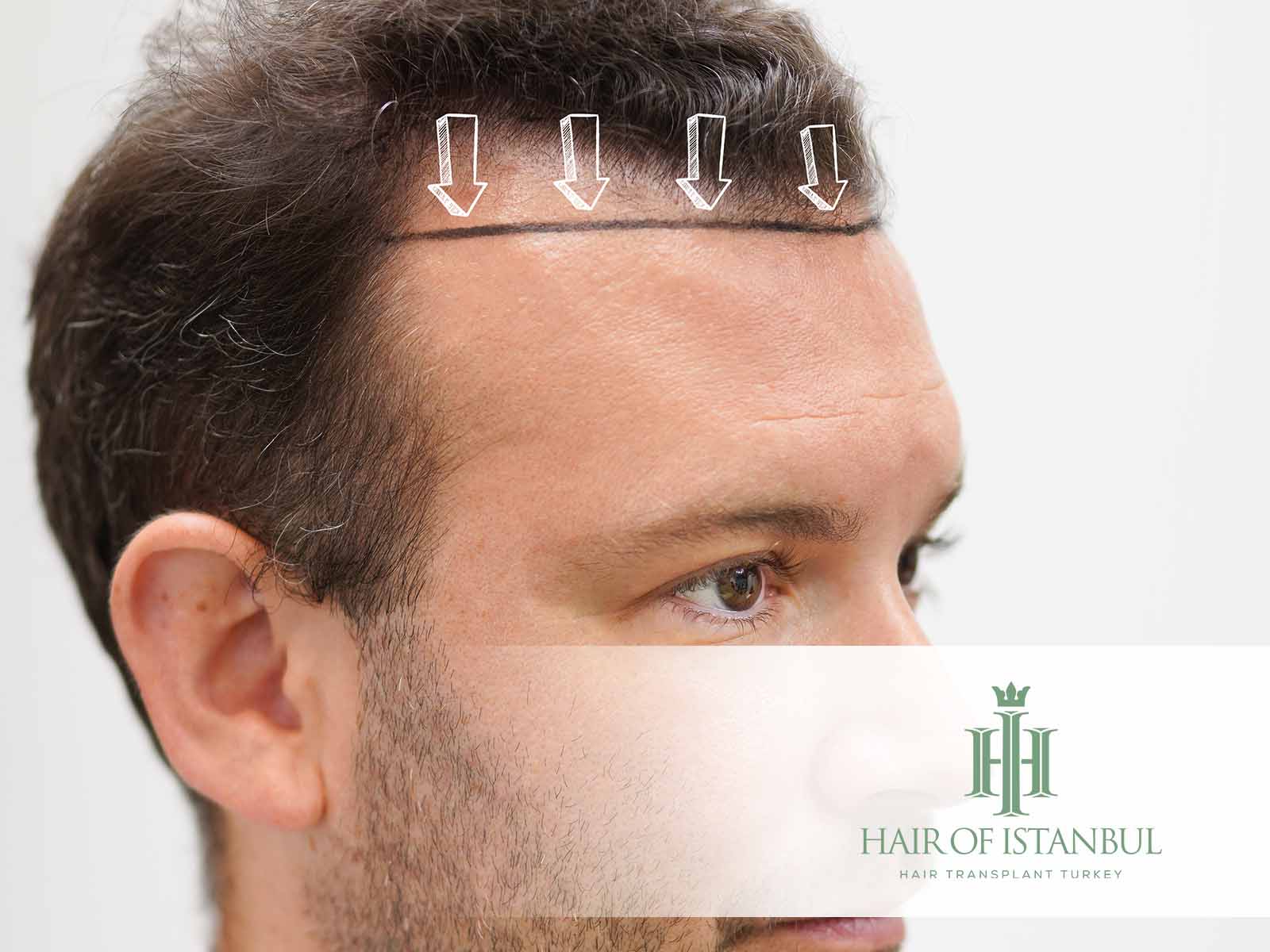
Receding Hairline Surgery: Planning, Grafts and Realistic Results
A receding hairline is the most common reason men come to a clinic, and it is also the area where a poorly planned operation is hardest to hide. The frontal hairline sits in the middle of the face, it is the first thing anyone sees, and unlike the crown it cannot be covered by a different haircut. This page explains when a hair transplant for receding hairline correction is the right answer, how the planning actually works, what the recovery looks like, and what can go wrong.
Hair Transplant For Receding Hairline: Is It Right For You?
Surgery is not the automatic answer to recession. A hair transplant for receding hairline correction makes sense when three things are true at once: the loss has an established pattern rather than being a temporary shed, the donor area at the back and sides can supply enough grafts for the area you want covered and for the loss still to come, and you understand that the operation moves existing hair rather than creating new hair.
That third point is the one most often glossed over. A transplant redistributes a finite resource. Every graft placed at the hairline is a graft that is no longer available for the mid-scalp or crown later on, which is why an honest consultation talks about your donor supply before it talks about your hairline.
What Counts As A Receding Hairline
Recession in male pattern hair loss typically begins at the temples, leaving the central forelock in place and producing the M-shape most men recognise. It is graded with the Hamilton-Norwood scale, which most people have seen as a row of illustrated heads.
The scale is useful shorthand, but it is worth knowing how imprecise it is. When 23 dermatologists and dermatology residents classified 43 photographs, agreement between them was unsatisfactory, with an intra-class correlation coefficient of 0.63 to 0.68; when eight of them repeated the exercise three months later, repeatability was poor, and experienced dermatologists did no better than residents. [1] If specialists cannot reliably agree on a stage from a photograph, matching yourself to a chart online is not a diagnosis. It is a rough orientation, and no more.
Two things are commonly mistaken for recession. A maturing hairline is a normal one-off shift backwards that most men go through in their late teens and twenties and which then stops; we cover how to tell them apart in mature vs receding hairline. A naturally high hairline is a proportion of the face, not a loss. Neither needs surgery, and operating on either is a decision that cannot be undone.
Why Hairline Design Matters More Than Graft Count
Creating a natural hairline is described in the surgical literature as one of the most important elements of a successful hair transplant. It involves locating the borders of the hairline, and then mimicking the visual characteristics of a real one, zone by zone, using follicular unit grafting. Crucially, the standard reference on the subject states that those borders should be adjusted according to the donor-to-recipient ratio — that is, according to how much hair you have available, not according to how low you would like the line to sit. [2]
A real hairline is not a line. It is an irregular transition zone: single-hair grafts at the very front placed in an irregular micro-pattern, then two- and three-hair units behind them to build density. Grafts are angled forward and low to the scalp, following the direction the original hair grew. Getting the angle wrong is what produces the doll-like look that people recognise instantly even if they cannot say why. We go into the difference in more detail in our note on natural vs artificial hairline.
How Many Grafts Does A Receding Hairline Need?
Graft numbers depend on how far the recession has progressed, how coarse your hair is, and how much contrast there is between your hair and your scalp. Fine blond hair on pale skin covers more convincingly per graft than coarse black hair on pale skin. The ranges below are typical planning figures rather than a quotation; the number for you comes from an examination of the donor area, not from a photograph.
| Degree of recession | Typical graft range | What it covers |
|---|---|---|
| Mild temple recession | 800–1,200 grafts | Rebuilding the corners, hairline left largely as it is |
| Moderate recession | 1,200–1,800 grafts | Temples plus the frontal zone behind them |
| Advanced recession | 1,800–2,500+ grafts | Full frontal reconstruction, often staged |
Donor capacity is the limit on all of this, and it is assessed before anything is designed. Our donor area guide explains what is being measured and why a strong-looking donor area is not always a large one. If the crown is also thinning, the frontal and crown priorities have to be weighed against each other from the start — see crown vs frontal hair transplant.
What Happens During The Procedure
Modern hairline work is built on follicular unit extraction, in which individual follicular units are harvested one at a time from the donor area rather than as a strip. Extraction is the same step in every case; what varies is how the grafts are then placed.
- FUE with channel opening. Recipient sites are opened first, then grafts are placed into them. The surgeon controls angle, direction and density through the channels.
- DHI. A Choi implanter pen opens the site and places the graft in one motion. It is often chosen for hairline work and for placing between existing hairs.
- Sapphire blades. A blade material used for opening channels, rather than a separate operation.
These are tools, not competing procedures, and no single one produces a better hairline on its own. The variable that matters is the plan and the hands carrying it out, which is why we publish our medical team rather than a technique name.
Recovery And Growth Timeline
| Period | What to expect |
|---|---|
| Days 1–10 | Crusting around the grafts, swelling of the forehead in the first days, first wash as instructed |
| Weeks 2–6 | Transplanted hairs shed and the follicles enter a resting phase beneath the skin. This is expected, not a failure |
| Months 3–6 | Fine, soft hairs begin to emerge; density is still patchy and uneven |
| Months 6–9 | Hairs thicken and the shape of the new hairline becomes readable |
| Months 12–18 | Final texture and density; the hairline is judged at this point, not before |
The shedding phase at weeks two to six is the stage that alarms people most, and it catches almost everyone out despite being explained beforehand. We look at that period in detail in hair transplant after 3 months, and the washing, sleeping and sun rules that apply throughout are set out in our aftercare guide.
Risks And Side Effects
Hairline transplantation is a low-risk procedure, but it is still surgery and the honest figures are worth seeing. In a prospective study of 73 patients undergoing follicular unit extraction, the most frequent complications were oedema in 42.47%, sterile folliculitis in 23.29% and numbness in 10.96%. [3] These are common but self-limiting; serious complications were not the pattern.
Shock loss — temporary shedding of existing native hair around the transplanted area — is the risk most relevant to hairline work, because a receding hairline still has native hair in it. In a study of 621 patients, shock loss was strongly associated with the procedure (odds ratio 30.18) and occurred far more often in women, in 14 of 67 female patients compared with 9 of 554 male patients. [4] It is temporary in the great majority of cases.
On pain, patient-reported data is more reassuring than most people expect: in a survey of 88 patients, 68% reported no pain or very little pain during the procedure. [5]
The Mistakes That Ruin Hairline Transplants
Almost every bad hairline result traces back to one of the following, and all of them are planning failures rather than technical ones.
- A hairline placed too low. It looks impressive at twelve months and wrong at forty-five, when the face has aged around a line that has not moved. This is the single most common regret.
- Ignoring that the loss continues. Male pattern hair loss is progressive. A transplant does not stop it. If the native hair behind a new hairline keeps thinning and no donor supply has been reserved, the result is a dense front strip with a bare area behind it — an outcome that is very difficult to correct.
- Spending the donor area on one operation. Donor hair is finite and does not regenerate. Planning for a possible second session years later is not pessimism; it is the reason the first result still looks right a decade on.
- Over-packing the temple points. Aggressive density in the temples is what most often reads as artificial from a distance.
- Judging the result too early. A hairline at month six is not a finished hairline. Twelve to eighteen months is the honest assessment point, and comparing yourself with published before and after photographs is only fair at that stage.
If your recession is specifically the M-shaped pattern and you are weighing surgery against simply working with it, our guide to haircuts for an M-shaped hairline covers the non-surgical route.
Non-Surgical Treatments
Medical treatment does not rebuild a hairline that has already receded, but it does work on the hair you still have, and it is what protects a surgical result over time. A meta-analysis of randomised controlled trials found that 5% minoxidil, 2% minoxidil and 1 mg finasteride in men, and 2% minoxidil in women, were all superior to placebo for promoting hair growth, as was low-level laser light therapy. [6]
The practical implication for anyone considering surgery is that medication and surgery are not alternatives. Medication holds the native hair behind the hairline; surgery restores the hairline itself. Used together they are what keeps a result stable. Finasteride is a prescription medicine with a side-effect profile that should be discussed with a doctor before starting.
When Recession Needs Medical Assessment First
Some recession is not male pattern hair loss, and transplanting into an undiagnosed condition can waste donor hair permanently. Seek a medical opinion before considering surgery if the recession progresses rapidly over weeks rather than years, is markedly uneven or patchy, is accompanied by redness, scaling, itching, pain or visible scarring, or follows major physical or emotional stress. Scarring alopecias in particular must be diagnosed and stabilised before any transplant is contemplated, because grafts placed into active scarring disease do not survive well. Background information on the range of causes is available from the NHS hair loss resource and in our entry on androgenetic alopecia.
Frequently Asked Questions
Is a hair transplant for a receding hairline permanent?
The transplanted follicles are taken from the back and sides, which are typically unaffected by male pattern hair loss, and they keep those characteristics after being moved. What is not permanent is the rest of your scalp: the native hair around and behind the new hairline can continue to recede, which is why long-term planning and medical treatment matter as much as the operation.
How many grafts do I need for my receding hairline?
Typical planning ranges run from around 800 grafts for mild temple recession to 2,500 or more for advanced frontal loss, but the figure for you depends on your donor capacity, hair calibre and hair-to-skin contrast, and can only be set after an examination.
What age should I get a hairline transplant?
There is no fixed age, but operating early in an aggressive, still-progressing pattern is the situation most likely to end badly, because neither the final extent of the loss nor the donor demand it will create is yet known. Many surgeons prefer to stabilise the loss medically first.
Will people be able to tell?
A well-designed hairline is not detectable, because it reproduces the irregularity, angle and single-hair front of a natural one. [2] A detectable result usually means the line was placed too low, too straight, or at the wrong angle.
Does a receding hairline mean I will go bald?
Not necessarily. Recession can stabilise at any stage, and a maturing hairline in a young man is a normal event rather than the start of baldness. The rate of change over one to two years is more informative than any single photograph.
How much does a receding hairline transplant cost?
Cost is driven mainly by graft count and by where the procedure is performed. Our overview of hair transplant cost in Turkey sets out what is and is not included in a quoted price.
References
- [1] Guarrera M, Cardo P, Arrigo P, Rebora A. Reliability of Hamilton-Norwood classification. Int J Trichology. 2009;1(2):120–122. pubmed.ncbi.nlm.nih.gov
- [2] Shapiro R, Shapiro P. Hairline design and frontal hairline restoration. Facial Plast Surg Clin North Am. 2013;21(3):351–362. pubmed.ncbi.nlm.nih.gov
- [3] Loganathan E, Sarvajnamurthy S, Gorur D, Suresh DH, Siddaraju MN, Narasimhan RT. Complications of hair restoration surgery: a retrospective analysis. Int J Trichology. 2014;6(4):168–172. pubmed.ncbi.nlm.nih.gov
- [4] Okochi H, Okochi Y, Sato T, et al. Shock loss after hair transplantation. J Cosmet Dermatol. 2024. pubmed.ncbi.nlm.nih.gov
- [5] True RH, Dorin RJ. A demonstration of the efficacy of a topical anesthetic in hair restoration surgery. Dermatol Surg. 2002;28(6):463–468. pubmed.ncbi.nlm.nih.gov
- [6] Adil A, Godwin M. The effectiveness of treatments for androgenetic alopecia: A systematic review and meta-analysis. J Am Acad Dermatol. 2017;77(1):136–141.e5. pubmed.ncbi.nlm.nih.gov
- [7] National Health Service. Hair loss. nhs.uk
In Short
A hair transplant for a receding hairline works, and it works well, when the plan respects two limits: the amount of donor hair you have, and the fact that the loss around the new hairline will carry on. Design decided by donor supply rather than by how low the line could go, medical treatment to hold the native hair, and judgement of the result at twelve to eighteen months are what separate a hairline that still looks right in ten years from one that does not.
If you want an assessment of your own donor area and what it can realistically cover, contact our team, or read more about Hair of Istanbul.

Mainly genetics and DHT-related miniaturisation, but stress and traction can also play a role.
Usually 800–2,500 grafts depending on recession degree.
Yes. Donor follicles are genetically resistant to DHT.
Early growth begins at Months 3–4, full results at 12–18 months.
Mild cases may improve with medications, but moderate-to-severe recession typically requires transplantation.
