
 en
en TR
TR  SK
SK  ITA
ITA  FR
FR  DE
DE  ES
ES  BG
BG 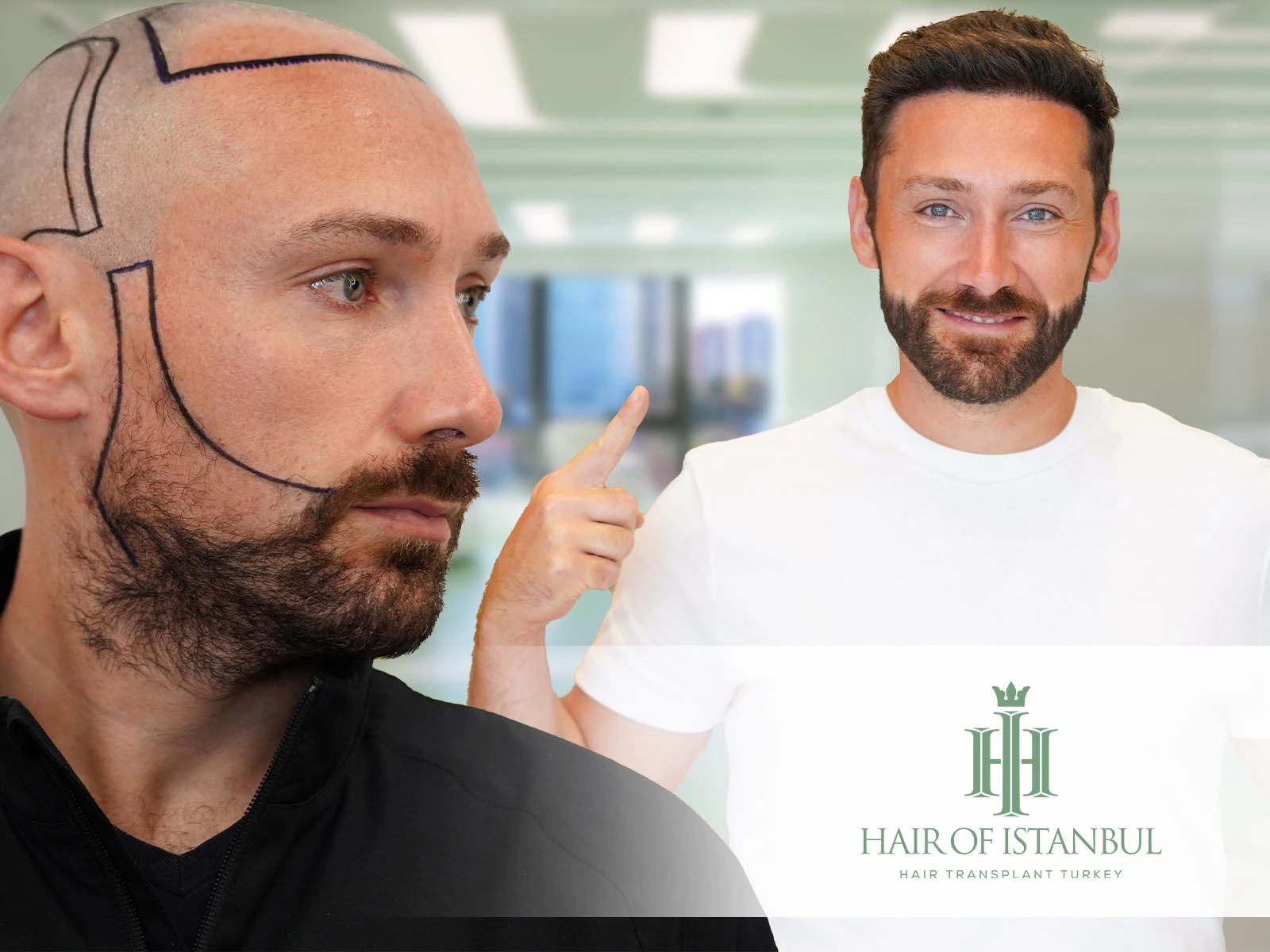
Beard Transplant Facts
Beard Transplant Facts: Complete 2025 Guide
A full, natural-looking beard is now one of the most demanded aesthetic procedures among men. This comprehensive guide outlines the essential beard transplant facts, including donor harvesting, beard-line design, suitable candidates, alopecia barbae , density planning, healing expectations and long-term outcomes. The goal is to provide a medically accurate, non-promotional resource aligned with Hair of Istanbul’s patient-first communication principles.
A beard transplant is a minimally invasive procedure in which healthy follicular units are extracted from the occipital scalp and implanted into the beard, moustache, goatee or sideburn areas. The procedure aims to correct congenital patchiness, trauma-related gaps, surgical scars or fully absent beard regions.
Donor Area: Why Scalp Hair Is Used
Anatomical and Physiological Compatibility
One of the most important beard transplant facts is that the donor supply comes exclusively from the safe donor zone of the scalp, not from existing beard hair.
The reasons include:
– Scalp follicles provide a stable, permanent genetic profile.
– Donor density is higher on the scalp than in the beard area.
– Extraction from the beard would leave visible gaps and is not medically appropriate.
Extraction Technique
At Hair of Istanbul, follicles are extracted using FUE, the standard method for harvesting individual follicular units without creating a linear scar. Punch selection, angulation and depth control are planned according to hair thickness and curl-pattern to ensure natural beard texture after growth.
Candidate Selection: Who Qualifies?
Patchy Beard and Alopecia Barbae
Men experiencing alopecia barbae often ask whether a beard transplant is possible. This condition presents as circular or irregular patches where hair fails to regrow.
If a patch has remained hairless for 2–3 years and dermatological evaluation confirms stability, then beard transplantation is considered a safe option.

Beard Alopecia
Minimal or No Natural Beard
Candidates with congenital absence or very sparse beard distribution can greatly benefit. Beard transplantation allows full redesign of the lower face by building lines such as cheek borders, goatee shape or jawline structure.
Scar-Related Beard Loss
Surgical scars, burns, acne scars or trauma-related tissue loss can be successfully camouflaged using targeted follicular implantation.
Beard-Line Design: One of the Most Critical Beard Transplant Facts
Principles of Natural Beard-Line Architecture
A realistic beard transplant requires detailed mapping of the cheek line, jawline, upper boundary and moustache transitions. The golden rule is natural softness and asymmetry. Natural beards never grow in perfectly straight, sharp lines.

Beardline Design
Visual Example
Natural beard-line planning example:
Beard-line Design Example – Instagram
Implantation Techniques and Density Strategy
Implantation Methods
All follicles are harvested using FUE. Implantation is performed via:
– DHI for precise angle control
– Sapphire or Slit methods for dense packing of larger areas

Density Mapping
A natural beard requires strategic density distribution:
– Cheek area: medium density for a natural fade
– Jawline: highest density for structure
– Moustache: density following lip curvature
– Goatee: typically the densest region
Uniform density is not natural. Each area has its own optimal threshold.
Beard Thickening vs. Full Construction
Beard Thickening
For patients who already have a beard but wish to increase density, the procedure focuses on blending grafts among native hairs and preserving natural direction patterns.
Full Beard Construction
For individuals with almost no beard, a full construction plan is developed. This typically requires 2,500–4,000 grafts depending on facial size and desired beard type.
Beard Transplant and Healing Facts
Immediate Post-Procedure (First 7–10 Days)
Redness, micro-crusting and mild swelling are expected. Proper washing protocol must be followed.
Detailed aftercare guide:
Beard Transplant After-Care
Shedding Phase (4–8 Weeks)
Most implanted hairs fall out temporarily. This is part of the normal growth cycle.
Growth Phase (3–6 Months)
New beard hair emerges gradually. Texture begins to blend with existing beard characteristics.
Full Maturation (9–12 Months)
Final density, diameter and angulation stabilize within one year.

Beard Transplant Results
Common Misconceptions: Beard Transplant Facts vs. Myths
Myth: Donor Hair Will Not Match Beard Texture
Scalp hair chosen from specific zones closely aligns with beard thickness. Over time, the texture blends naturally.
Myth: Results Look Artificial
Artificial outcomes occur only with poor design. When natural asymmetry and angulation are respected, results are indistinguishable from natural beard growth.
Myth: Transplanted Beard Hair Cannot Be Shaved
Transplanted follicles behave like native beard hair. They can be shaved, trimmed and shaped normally.
Risks and Safety Considerations
While safe, certain risks exist:
– Over-extraction of donor hair
– Incorrect angulation
– Overly sharp cheek lines
– Folliculitis or ingrown hairs
– Uneven density due to poor planning
Experienced medical teams significantly reduce these risks.
Our Medical Team
Why Planning Matters: Key Beard Transplant Facts
Importance of Pre-Operative Evaluation
Successful planning includes donor density analysis, beard-line prediction, alopecia barbae stability, skin thickness assessment and measurement of facial symmetry.
Psychological and Aesthetic Impact
A well-designed beard reshape improves masculine definition, balance and personal confidence.
Booking and Next Steps
For consultation or photo assessment:
Beard Transplant Service Page
Contact
The essential beard transplant facts include understanding that donor hair is always taken from the scalp, beard-line design must follow natural asymmetry, and final results appear between 9–12 months. The procedure is minimally invasive and relies heavily on proper planning of angles, density and symmetry.
Yes. If alopecia barbae (patchy beard hair loss) has remained stable and hairless for 2–3 years with no signs of active inflammation, a beard transplant becomes a safe and predictable option. Stability must be confirmed during consultation.
Generally yes. When follicles are taken from the correct zone of the scalp, the texture, thickness and growth characteristics align well with natural beard hair. Over several months, the transplanted hairs adapt and blend seamlessly.
Initial growth begins around 3–4 months. Visible density increases between 6–9 months, and full maturation—including final thickness and direction—occurs at 9–12 months. These timelines are consistent with scientifically documented beard transplant facts.
Yes. A beard transplant provides permanent results because donor follicles come from a genetically stable area of the scalp. Transplanted hairs behave like normal beard hair: they can be shaved, trimmed, shaped and styled without limitations.
