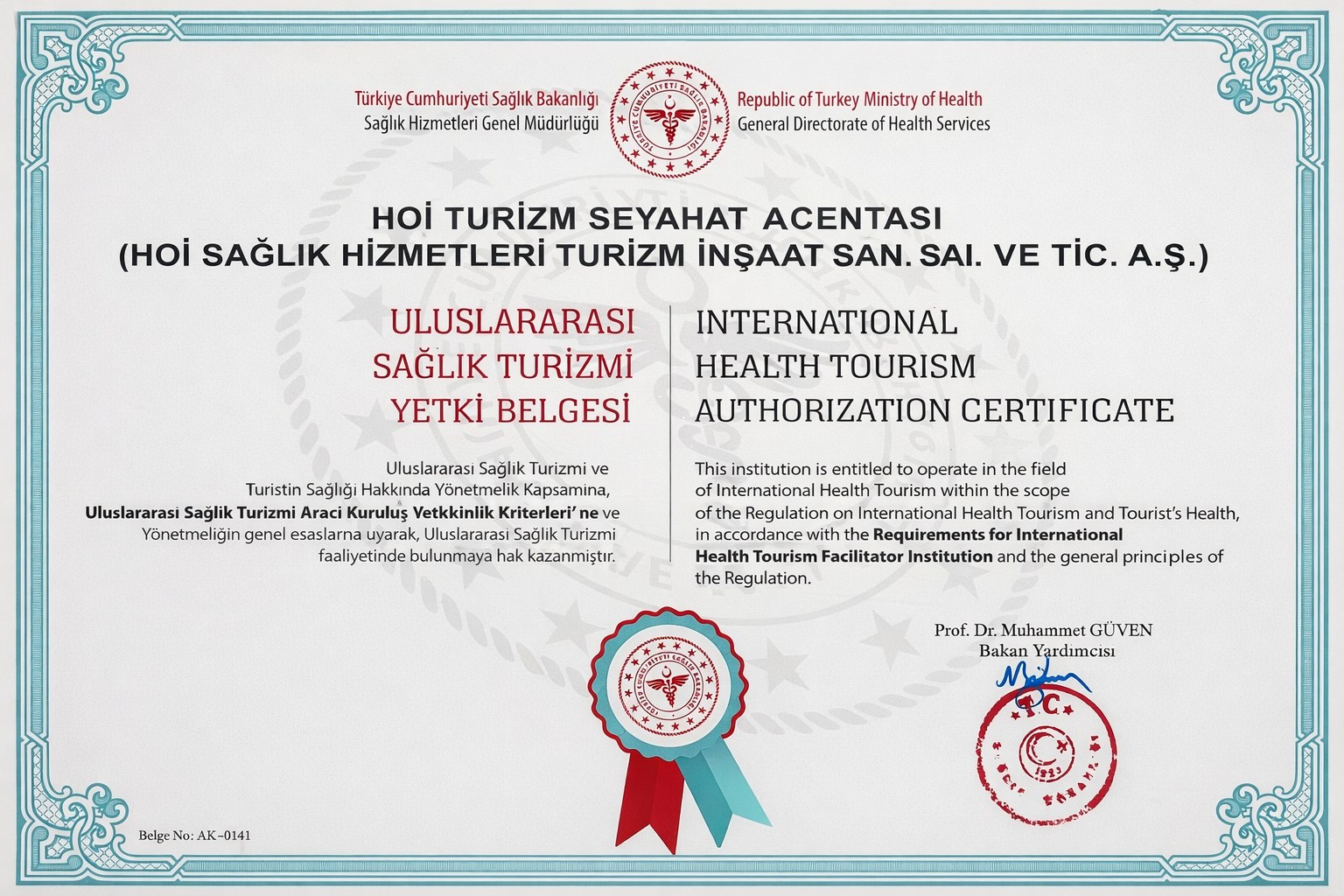
Medically reviewed by Dr Mahmut Satekin, Medical Aesthetics Physician, Hair of Istanbul. Last reviewed: August 2026. Content checked against peer-reviewed dermatology literature; sources listed at the end of this page.
PRP is a concentrate made from your own blood. Platelets are separated from the other blood components in a centrifuge, and the resulting platelet-rich plasma is injected into the areas of the scalp where hair is thinning.
You will see the same treatment described in several ways: PRP hair treatment, plasma hair treatment, PRP for hair loss, or simply hair growth injections. They all refer to this procedure.
Platelets are best known for clotting, but they also carry a store of signalling proteins — growth factors — released whenever tissue needs repair. Concentrating them and delivering them around the hair follicles is intended to improve the local environment in which those follicles are trying to work.
Nothing is added. No drug, no donor material, no synthetic carrier. What is injected came out of your arm twenty minutes earlier.
PRP — platelet-rich plasma — uses your own blood. Around 10–20 ml is drawn, spun in a centrifuge to concentrate the platelets, and the resulting plasma is injected into the thinning scalp. One session takes 30–45 minutes with no downtime. A pooled analysis of 14 randomised trials found an average gain of 27.6 hairs per cm² compared with placebo, though the certainty of that evidence is rated low because results varied widely between studies. A course is 3–6 sessions four to six weeks apart, at €250 per session. Like every non-surgical treatment, it supports follicles that are still alive; it does nothing on skin where the follicles have gone.
30–45 minutes
3–6 sessions, 4–6 weeks apart
Reduced shedding after 2–3 sessions
€250 per session
In androgenetic alopecia, follicles do not disappear overnight. They miniaturise: each successive growth cycle produces a finer, shorter, less pigmented hair, the growth phase shortens, and eventually the follicle stops producing anything visible. That process runs over years, and for most of it the follicle is still there.
PRP targets that period. The growth factors concentrated in platelets — among them platelet-derived growth factor, vascular endothelial growth factor and transforming growth factor beta — are involved in angiogenesis, cell proliferation and tissue repair. The working hypothesis is that delivering them into the perifollicular tissue improves blood supply and prolongs the growth phase in follicles that are still cycling.
PRP acts on follicles that still exist. Where the scalp is smooth and shiny and the follicles have been lost, there is nothing for growth factors to act on. No number of sessions changes that. Those areas need a hair transplant, and a clinic selling you PRP for a bald crown is selling rather than assessing.
The plasma is injected within minutes of preparation. It is not stored, frozen or sent elsewhere. Injection volume follows the dosing used in the published trials rather than being estimated by eye.
What happens: Trichoscopy of the thinning area, miniaturisation mapped, baseline photographs at standard angles
Duration: 10 min
What happens: 10–20 ml drawn from a vein in the arm, as for a routine blood test
Duration: 5 min
What happens: Blood spun in dedicated tubes to separate red cells, white cells and platelet-rich plasma. The plasma layer is drawn off
Duration: 8–10 min
What happens: Antiseptic preparation; topical anaesthetic applied where sensitivity requires it
Duration: 5–10 min
What happens: Plasma injected into the dermis across a grid, roughly 0.1–0.2 ml per cm² of treated scalp
Duration: 10–15 min
What happens: Aftercare explained. No dressing. Normal activity the same day
Duration: 5 min
The blood draw feels like any blood test. The scalp injections feel like a rapid series of small stings, with some pressure. Most patients tolerate this without topical anaesthetic, but it is available and used where the scalp is sensitive. Brief local discomfort is the most commonly reported effect in the published trials. You can drive afterwards.
What matters is not age or how long you have been losing hair, but what the trichoscope shows: how many follicles survive in the area, and what proportion of them are miniaturised rather than lost.
PRP has more genuine contraindications than most non-surgical hair treatments, because it depends on your platelets working normally.
Blood tests are reviewed before a first session where the history suggests any of the above. If your trichoscopy shows too few surviving follicles for PRP to work, we will say so before you book a course.
PRP has been studied more thoroughly than most treatments in this category, and the findings are genuinely mixed in an interesting way.
Source: Kieling et al., 2024 — a systematic review and meta-analysis of 14 randomised controlled trials, 431 patients (319 treated, 310 controls). Most trials used monthly injections at 0.1–0.2 ml/cm².
The density figure is large — and the uncertainty around it is also large. A gain of 27.6 hairs per cm² would be a substantial change, more than most patients expect from an injection. But the confidence interval runs from 14 to 41, and heterogeneity between the trials was very high. In plain terms: PRP worked in almost every trial, but by amounts that differed enormously depending on how it was prepared, how often it was given and who was treated.
The diameter finding did not reach significance. Individual hairs did not measurably thicken across the pooled data. The benefit, where it appears, is in how many hairs are growing rather than how thick each one is.
Protocols are not standardised. Half the trials used a platelet activator and half did not. Injection frequency varied. There is no single agreed PRP recipe, which is the main reason the results scatter and the reason the authors rated the certainty of the evidence as low despite a positive pooled effect.
What this means for you: PRP is well supported as a treatment that does something, with a good safety record, and poorly supported as a treatment with a predictable effect size. We think that is worth telling you before you pay for a course of six sessions.
Pooled result: +27.55 hairs/cm² (95% CI 14.04–41.06)
Certainty: Low — wide variation between trials
Pooled result: +2.02 μm (95% CI −0.85 to 4.88)
Certainty: Very low — not statistically significant
Pooled result: 13 of 14
Certainty: Consistent direction of effect
Pooled result: None reported
Certainty: Consistent across trials
Pooled result: Short-duration local pain
Certainty: Consistent across trials
PRP does not create new follicles. It supports the ones you have. A patient with widespread miniaturisation and a dense population of surviving follicles can see a striking difference; a patient whose thinning is already advanced will see very little, no matter how many sessions are given.
A course is 3–6 sessions. Which end of that range depends on the extent of the thinning and how the scalp responds after the first three. Photographs are taken at the same angles under the same lighting each time; without that, "it looks a bit better" is not an assessment.
Baseline trichoscopy and photographs, first treatment
Second treatment
Reduced shedding typically noticed around this point
Course completed according to response and severity
Trichoscopy and comparison photographs. The point at which the result is assessed
Single sessions, decided on the six-month measurements
| PRP | Regenera Activa | Minoxidil / finasteride | Hair transplant | |
|---|---|---|---|---|
| What it does | Supports miniaturising follicles | Supports miniaturising follicles | Slows or partly reverses miniaturisation | Moves living follicles to bald areas |
| Works on bald scalp | No | No | No | Yes |
| Course | 3–6 sessions, 4–6 weeks apart | 1 session, repeat at 6–12 months | Daily, indefinitely | One procedure |
| Source material | Your blood | Your scalp tissue | A drug | Your own follicles |
| Evidence base | 14 randomised trials, pooled; certainty rated low | Cohort studies and small series | Large randomised trials; both licensed | Established surgical practice |
| Price at Hair of Istanbul | €250 per session | €750 per session | Prescription cost | €3,500–5,000 |
These are not competitors. A typical plan is medical therapy as the foundation, PRP or Regenera Activa to support the thinning zone, and a transplant for areas where follicles have already been lost.
They act on the same patients and the same problem. The practical differences are the schedule and the source material: PRP is a course of three to six sessions drawn from your blood, Regenera Activa a single session taken from a small sample of your scalp. PRP has the larger randomised evidence base; Regenera Activa has the simpler schedule. Head-to-head comparative trials are lacking, so the choice is usually made on how often you can attend and what your scalp shows at assessment.
A transplant relocates hair; it does not stop the native hair around it from thinning. Where trichoscopy shows active miniaturisation in the zones surrounding the planned graft area, supporting that hair beforehand addresses the part of the result surgery cannot.
PRP is commonly given after a transplant to support the surrounding native hair. It is worth being clear about what it does not do: the survival of transplanted grafts is determined during the procedure itself — by time out of the body, temperature control and handling — not by injections afterwards. Those factors are covered on our FUE technique page.
Every hair transplant at Hair of Istanbul includes one PRP session in the all-inclusive price. Further sessions are €250 each and are recommended only where trichoscopy shows surviving follicular activity worth supporting.
Across 14 randomised trials, no serious adverse events were reported. Because the plasma comes from your own blood, there is no risk of immune rejection and no risk of an allergic reaction to a foreign substance.
That does not make the procedure free of risk. Any injection through the skin carries a small risk of infection, and the blood draw carries the ordinary risks of venepuncture.
| Effect | Frequency | Course |
|---|---|---|
| Local pain during injection | Common — most reported effect in trials | Brief, resolves immediately |
| Redness and mild swelling | Common | Hours |
| Tenderness of the scalp | Common | 24–48 hours |
| Bruising at the blood draw site | Occasional | Days |
| Headache after the session | Occasional | Hours |
| Infection at an injection site | Uncommon | Requires review and treatment |
| Fainting during the blood draw | Uncommon | Resolves with positioning |
PRP costs €250 per session at Hair of Istanbul. A course of three to six sessions therefore costs €750–1,500, and one session is already included in every hair transplant package.
| Treatment | Price | Typical course | Course total |
|---|---|---|---|
| PRP therapy | €250 per session | 3–6 sessions | €750–1,500 |
| Regenera Activa | €750 | 1 session | €750 |
| Hair transplant | €3,500–5,000 | One procedure | All-inclusive, includes one PRP session |
Assessment, trichoscopy and follow-up photographs are included. See the full 2026 price list.
“PRP is the most oversold treatment in this field and also one of the better studied. Both things are true. Used on the right scalp it earns its place in a plan; sold as a cure for a bald crown it is simply money taken from someone who needed different advice.”
— Dr Mahmut Satekin, Medical Aesthetics Physician, Hair of Istanbul
A treatment in which 10–20 ml of your own blood is drawn, spun in a centrifuge to concentrate the platelets, and the resulting platelet-rich plasma injected into the thinning areas of your scalp. Platelets carry growth factors involved in tissue repair. Nothing is added to what is injected.
A 2024 meta-analysis of 14 randomised controlled trials covering 431 patients found an average gain of 27.55 hairs per cm² compared with placebo, and 13 of the 14 trials showed improved density. However, the certainty of that evidence was rated low because results varied widely between trials and protocols are not standardised. The effect on individual hair thickness did not reach statistical significance.
A course is 3–6 sessions, four to six weeks apart, followed by maintenance sessions every six to twelve months. Where in that range you fall depends on the extent of the thinning and how your scalp responds to the first three sessions.
€250 per session at Hair of Istanbul, so a course of three to six sessions costs €750–1,500. Assessment, trichoscopy and follow-up photographs are included. One PRP session is already included in every hair transplant package.
The blood draw feels like any blood test. The scalp injections feel like a rapid series of small stings. Brief local pain is the most commonly reported effect in the published trials. Topical anaesthetic is available where the scalp is sensitive, and most patients do not need it.
30–45 minutes in total: about five minutes for the blood draw, eight to ten minutes of centrifugation, and ten to fifteen minutes of injections. There is no downtime and you can drive afterwards.
Reduced shedding is usually noticed after the second or third session. Measurable density change appears on trichoscopy from around month three, and the result is assessed at month six against baseline photographs taken under identical conditions.
No. Androgenetic alopecia is progressive, and no treatment supporting existing follicles halts that process. Maintenance sessions every six to twelve months, usually alongside medical therapy, determine whether a gain is held.
No. It acts on follicles that are still alive but underperforming. Where the scalp is smooth and shiny and the follicles have gone, there is nothing for growth factors to act on. A hair transplant is the appropriate treatment for those areas.
They treat the same patients and the same problem. PRP has the larger randomised evidence base; Regenera Activa has the simpler schedule of a single session rather than a course. Head-to-head comparative trials are lacking, so the choice is usually made on how often you can attend and what your assessment shows.
Patients with platelet or bleeding disorders, those on anticoagulant or antiplatelet therapy that has not been reviewed, anyone in active cancer treatment, patients with active infection or severe scalp disease, and anyone whose hair loss is advanced enough that the follicles have gone. Pregnancy and breastfeeding are reasons to postpone.
Not without review. PRP depends on normal platelet function, and antiplatelet drugs work directly against that. This is a conversation with the doctor who prescribed them. Never stop a prescribed medication on your own initiative.
Yes, and one session is included in every transplant package. Before surgery it supports the native hair around the planned graft area; afterwards it supports that hair as it continues to thin. It does not change the survival of transplanted grafts, which is determined during the procedure itself.
Yes. They work through different mechanisms and are frequently combined. Avoid applying minoxidil to the treated area for 24 hours after a session, and tell us about all medication at your assessment.
Mesotherapy injects vitamins, minerals and amino acids from an external preparation. PRP injects a concentrate made from your own blood, containing no added substances. They are sometimes used together, but they are different treatments with different evidence bases.
Yes. Female pattern hair loss with diffuse thinning and a preserved hairline is a common indication, because that pattern typically involves widespread miniaturisation rather than complete follicle loss. The underlying cause — thyroid function, ferritin, hormonal factors — is investigated first.
Trichoscopy measurements and photographs taken at standard angles before the first session, repeated at months three and six under identical lighting and camera settings. Without a baseline, there is no way to distinguish a real change from a better haircut.
Medically reviewed by Dr Mahmut Satekin, Medical Aesthetics Physician at Hair of Istanbul. Last reviewed August 2026. This page is general information about a medical treatment and does not replace individual assessment. Suitability and expected outcome are determined after examination and trichoscopy.
Get in touch for a free consultation. Our multilingual team is ready to answer your questions and guide you through the process.
Fill out the form and our team will contact you within 24 hours.