
 en
en TR
TR  SK
SK  ITA
ITA  FR
FR  DE
DE  ES
ES  BG
BG 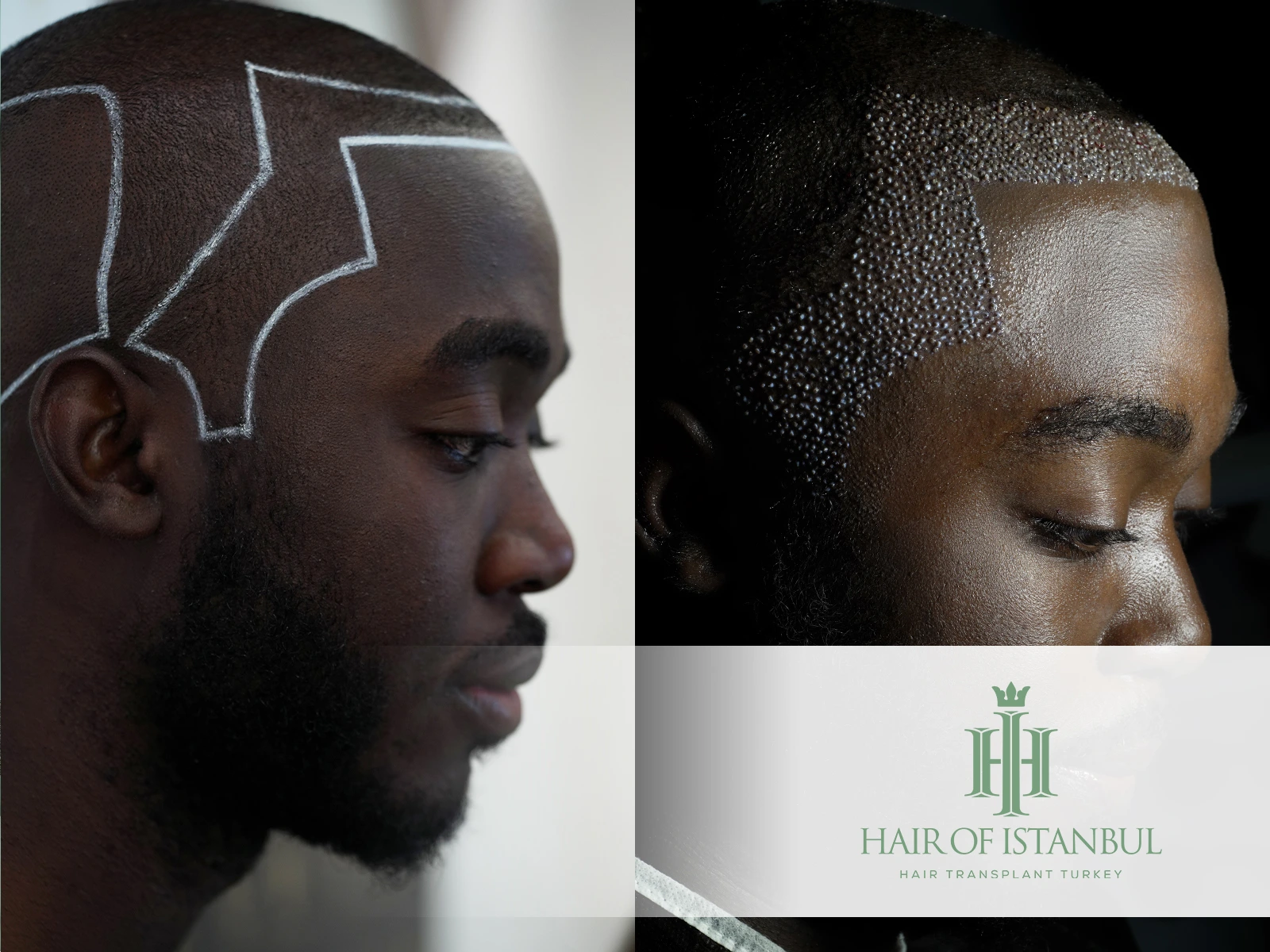
Guide For Afro Hair Transplant: Complete 2025 Medical Overview
The Guide For Afro Hair Transplant is designed to explain how advanced clinics like Hair Of Istanbul approach curly and tightly coiled hair types. Afro-textured hair is beautiful, but it presents unique surgical challenges such as curved follicle roots, increased transection risk, and deeper dermal structure. This guide provides everything you need to know about diagnosis, technique selection, healing, and natural design. Results vary by individual.
Understanding Afro Hair Anatomy
Each Guide For Afro Hair Transplant begins with recognising the biological difference: Afro hair follicles curve both above and below the skin. Under the microscope, each follicular unit follows an “S” or corkscrew path. This means extraction requires smaller, slower, and more precise movements than straight or wavy hair types. Curved roots sit deeper in the dermis, so conventional tools can damage grafts if not handled by experienced surgeons.
Why Afro Hair Requires A Specialised Approach
- Curved follicles: demand careful angling during FUE extraction.
- Thicker dermis: increases resistance to punch entry.
- Higher transection risk: without micro-control and magnification.
- Dense curl pattern: affects graft direction planning and implantation angle.
Because of these factors, the Guide For Afro Hair Transplant emphasises experience and technology over graft count. The goal is healthy extraction and natural alignment, not speed.
Techniques Used In Modern Afro Hair Transplants
| Feature | FUE (Extraction) | DHI (Implantation) | FUT (Strip) |
|---|---|---|---|
| Donor Scar | Pinpoint microdots | Same FUE donor | Linear scar, less common today |
| Ideal Candidate | Most Afro hair types | Small areas needing fine angle control | Limited use when donor laxity allows |
| Angle Precision | Surgeon creates channels manually | Implanter pen ensures uniform depth | Standard slit insertion |
Hair Of Istanbul primarily uses FUE for extraction and chooses DHI or Sapphire blades for implantation. This hybrid model gives better control over direction and density—key points in any Guide For Afro Hair Transplant.
Design Principles For Natural Afro Hairlines
Natural-looking results depend on respecting curl direction and scalp geometry. Afro hair grows in multidirectional spirals, so angles differ across regions. The frontal zone uses lower exit angles to match native curl pattern, while temporal peaks require slightly higher angles for frame symmetry. A well-balanced Guide For Afro Hair Transplant always includes these design parameters:
- Irregular, asymmetrical hairline edges for realism.
- Gradual density gradient from front to back.
- Use of single-hair grafts for borders, multi-hair units behind.
- Consistency of curl direction to preserve visual harmony.
Pre-Operative Evaluation
Before surgery, each patient undergoes detailed scalp analysis and follicular mapping. The doctor assesses donor density, elasticity, and curl depth using magnification and imaging systems. This pre-planning step ensures the Guide For Afro Hair Transplant adapts to each person’s scalp physiology. Medical screening for anaemia, thyroid issues, or hormonal imbalance is also recommended.
Post-Operative Care And Recovery
- Days 1–7: Gentle washing begins after 72 hours; avoid friction.
- Weeks 2–4: Temporary shedding phase; grafts settle.
- Month 3: Fine regrowth visible.
- Month 6: Noticeable curl reformation and volume.
- Month 12: Final density and texture achieved. Results vary by individual.
Post-surgical care influences success as much as the operation itself. Patients are advised to follow the aftercare instructions in our detailed After Care guide. Mild shampoos, hydration, and avoiding tight headwear protect graft integrity during early recovery.
Risk Awareness For Afro Hair Transplants
| Risk | How Common | Prevention |
|---|---|---|
| Follicle Transection | 5–8% with experienced surgeons | Low-speed extraction, micro punches |
| Folliculitis | Occasional | Warm compress, clinical follow-up |
| Swelling | Common, temporary | Sleep elevated, avoid salt & alcohol |
Hair Growth Timeline For Afro Hair
Because curly hair hides scalp visibility better than straight hair, results often look fuller earlier. Still, the same biological timeline applies:
- Month 1: Shock shedding.
- Month 3: Initial regrowth.
- Month 6: 50% density visible.
- Month 9–12: Curl texture matures.
Afro Hair In Women Vs Men
Women with Afro hair frequently seek transplant solutions for traction alopecia caused by tight hairstyles, or diffuse thinning from hormonal factors. The Guide For Afro Hair Transplant emphasises donor preservation and hairline femininity in such cases. Unlike male patients, women often require smaller graft numbers (1500–3000) and meticulous angle planning for part-line reinforcement.
Products And Medical Support
| Product | Purpose | Evidence |
|---|---|---|
| Minoxidil 5% | Stimulates native follicles around transplanted area | High (AAD/NICE) |
| Finasteride 1 mg | Prevents hormonal miniaturisation (men only) | High (NIH) |
| Ketoconazole 2% | Reduces inflammation, supports scalp balance | Moderate (supportive) |
Medical therapy complements surgery by supporting long-term follicle health. For more evidence, refer to the American Academy of Dermatology (AAD) and the National Institutes of Health (NIH). Both resources confirm that success depends on proper planning, not just technology.
Choosing The Right Clinic
In every Guide For Afro Hair Transplant, clinic selection defines outcomes. Look for:
- Doctor-led surgeries with Afro hair experience.
- Transparent packages, not per-graft pricing gimmicks.
- Dedicated aftercare support and multilingual coordination.
Hair Of Istanbul follows all these standards. Learn more about its philosophy on the About Hair Of Istanbul page and view diverse results in the Before After gallery.
Key Takeaways
- The Guide For Afro Hair Transplant must address curved follicles, scalp thickness, and curl pattern.
- FUE with DHI or Sapphire implantation gives precise, scar-minimal results.
- Density and direction are more important than raw graft count.
- Experienced surgeons and aftercare determine long-term success.
- Results vary by individual.
References
- American Academy Of Dermatology (AAD). Hair Transplant Overview, 2024.
Free Consultation
Free 5-Minute Assessment: Send your photos to Hair Of Istanbul’s medical team for a tailored plan following the Guide For Afro Hair Transplant. You’ll receive graft estimation, technique recommendations, and a transparent quote — no obligation, no marketing pressure.
Compliance Notes
- This educational content does not replace medical advice.
- No outcome is guaranteed; results vary by individual.
- External references are evidence-based and verified by medical authorities.
