
 en
en TR
TR  SK
SK  ITA
ITA  FR
FR  DE
DE  ES
ES  BG
BG  RO
RO Afro Hair Transplant: Why the Follicle Curves Under the Skin
An afro hair transplant is a hair transplant planned around one anatomical fact: in tightly coiled hair the follicle is curved below the skin as well as above it. The visible coil is only the part you can see. Under the surface the follicle follows a curved course, and the angle at which a hair leaves the scalp does not reliably show where its root is heading.
That single fact changes the whole operation of an afro hair transplant. It is why extraction — not placement — is the hardest step in an afro type hair transplant, why the instrument and the depth have to be chosen per patient rather than per procedure, and why a technique tuned for straight hair produces damaged grafts on coily hair even in careful hands.
This page on afro hair transplant surgery explains what happens beneath the skin, what the published evidence actually reports about graft damage in afro-textured hair, how candidacy is assessed when traction alopecia or a scarring alopecia is present, and what the recovery looks like. Where the evidence is thin, that is stated rather than filled in.
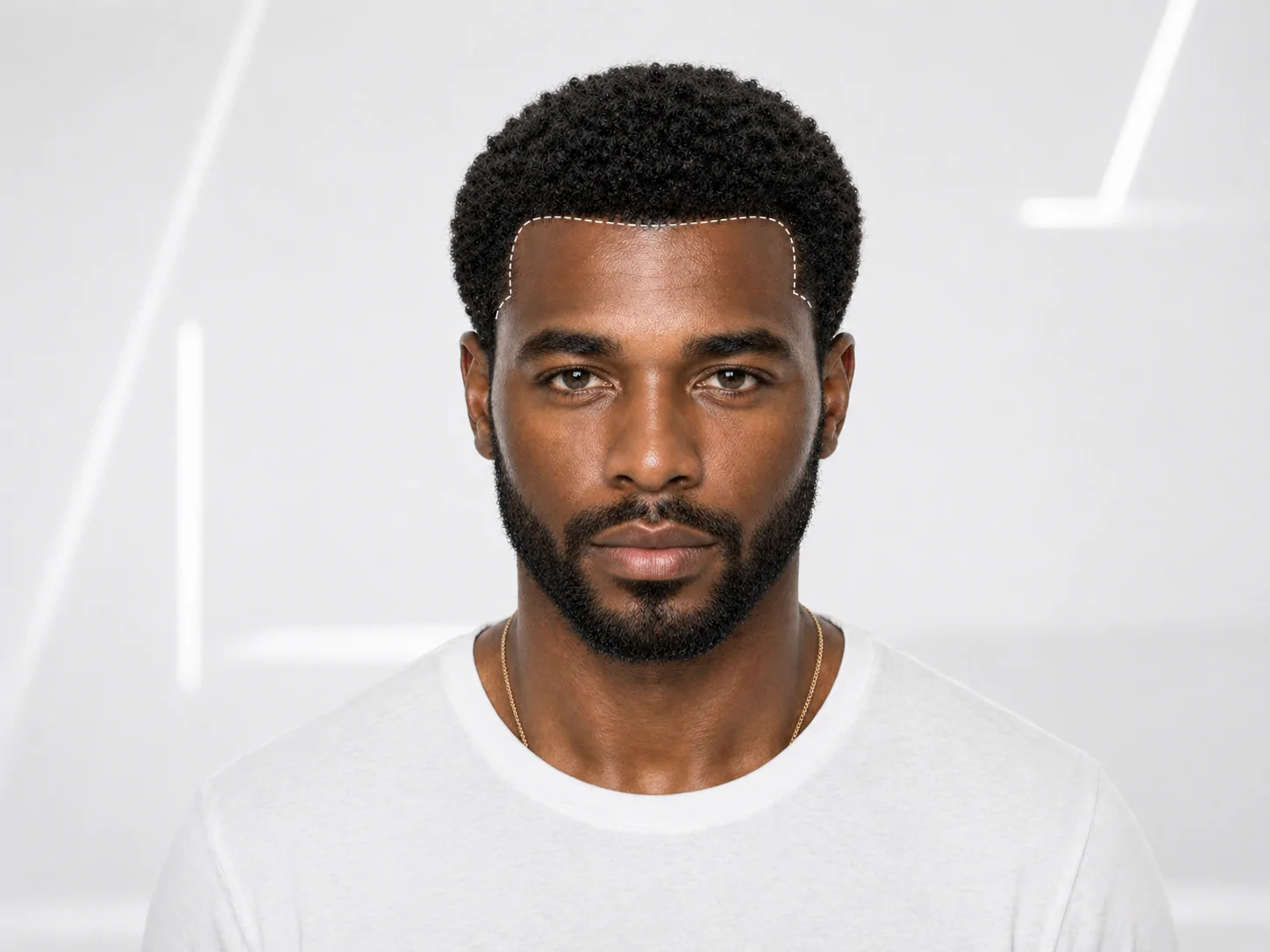
- What an afro hair transplant is
- The follicle under the skin
- Why extraction is the hard step
- Skin thickness matters more than curl
- Test extraction and donor mapping
- Punch, depth and angle
- The limits of robotic systems
- Who is a candidate
- Traction alopecia
- CCCA and scarring alopecia
- Acne keloidalis nuchae
- Keloid and scar risk
- Women with afro-textured hair
- Hairline design and curl direction
- Graft numbers and coverage
- The day of the procedure
- First wash and crusting
- Aftercare for coily hair
- Recovery timeline
- Patient experiences
- Price
- Frequently asked questions
- Sources
- Related pages
What is an afro hair transplant?
An afro hair transplant moves follicular units from the permanent donor area at the back and sides of the scalp into areas that have thinned or been lost. The surgical principle is the same as any hair transplant: grafts are removed one by one, recipient sites are opened at a planned angle and direction, and the grafts are placed. What changes is every parameter inside that sequence.
The term afro hair transplant covers tightly coiled hair generally — sometimes written as afro type hair transplant, afro-textured or coily hair. Curl is measured on a continuous scale rather than by ethnicity: a 2007 study of 2,449 people across 22 countries defined eight objective curl groups using curve diameter, curl index, number of waves and number of twists. Afro-textured hair sits at the tightly coiled end of that scale, and planning follows the measured curl rather than any assumption about background.
Two things follow from tight curl. The hair shaft has an elliptical, ribbon-like cross-section instead of a round one, which is what makes it coil. And the follicle that produces it is itself curved along its whole length, including the part buried in the scalp. The second point is the one that governs surgery.
The follicle under the skin
In 2005 a study in the British Journal of Dermatology compared follicles from African, Guyanese and Caucasian volunteers and found that curly follicles are “curved with a retrocurvature at the level of the bulb”, with the bulb itself shaped like a golf club. Cultured outside the skin, those follicles kept producing curved hair. The curl is not imposed by the scalp; it is programmed from the deepest point of the follicle and runs the entire length.
The practical consequence is the one every afro hair transplant has to solve. In straight hair the angle at which a hair exits the skin is a fair guide to the angle of the root below it, so a punch aligned with the visible hair will follow the follicle. In tightly coiled hair that relationship breaks. The exit angle tells you where the hair leaves; it does not tell you where the root goes.
Below the surface the follicle takes a curved course that has been described as ranging from a J shape to a C shape, with the most closed C forms seen in the tightest curl types. These are descriptive terms used by surgeons rather than a formal classification, but they capture the range accurately. The amplitude is not trivial: one published series measured the width of that subdermal curve at 3–4 mm or more in some patients — three to four times the diameter of the punch being used to cut around it.
Follicles in afro hair transplant candidates are also shorter than straight ones. Reported lengths run from 4–5 mm in loosely waved hair down to 2.5–3 mm in the most closed curl types. A shorter follicle with a wider curve inside a fixed-diameter tube is the whole geometric problem in one sentence.
| Feature | Straight hair | Tightly coiled hair |
|---|---|---|
| Shaft cross-section | Round to slightly oval | Elliptical, ribbon-like |
| Follicle course below skin | Essentially straight | Curved along its full length |
| Where curvature begins | — | At the bulb, the deepest point |
| Exit angle predicts root direction | Yes, closely | No |
| Follicle length | 4–5 mm | 2.5–3 mm |
| Width of subdermal curve | Negligible | Up to 3–4 mm in some patients |
Why this is not a detail
A punch is a tube. It removes a cylinder of tissue around the follicle. If the follicle bends outside that cylinder before the punch has passed it, the follicle is cut — and a cut follicle does not grow. Everything else on this page follows from keeping the follicle inside the tube.
Why extraction is the hardest step
Graft damage during removal is called transection. In an afro hair transplant it is the number that matters most, and it is the single number that separates a good afro hair transplant from a wasted one. A transected graft is not a graft that grows less well; in most cases it is a graft that is gone, taken from a donor area that cannot be replenished.
The published figures make the size of the afro hair transplant problem clear. In a series of patients with tightly coiled afro-textured hair, a sharp rotary punch — the standard instrument for straight hair — produced transection rates reported at over 80% in some patients and around 90% in one. A blunt rotary punch brought that down to roughly 20% in the same patient. An approach that cut along the long axis of the curved follicle instead of across it brought it below 5%.
For comparison, the reference transection rate reported for robotic extraction in patients described by the authors as having “relatively straight hair” averaged 6.6%. The gap between 6.6% and 80% is not a difference of skill in the ordinary sense. It is the difference between an instrument that follows the follicle and one that cuts across it.
The most useful finding in that series is not the headline number. In a single patient, transection stayed under 10% in the mid-occipital corridor and rose to 60–80% when extraction moved to the lateral areas. The donor area of a patient with coily hair is not one surface with one set of rules. It is several, and they have to be found.
| Instrument | Reported transection | What it means |
|---|---|---|
| Sharp rotary punch | Up to 80–90% in some patients | Cuts across the curve; most grafts lost |
| Blunt rotary punch | Around 20% | Better, still one graft in five |
| Cutting along the follicle’s long axis | Under 5% | The curve stays inside the instrument |
| Reference: robotic extraction, straight hair | 6.6% average | Published on patients with straight hair only |
Skin thickness matters more than curl
In 2023 a multicentre study in Dermatologic Surgery followed 64 patients — 45 men and 19 women — across clinics in seven countries, and reported a mean transection rate of 3–6% using a technique that adapts to the skin. The headline figure is useful. The secondary finding is more useful still.
The authors reported that skin thickness and firmness had a greater effect on the maximum transection rate than hair curliness did. That reverses the usual explanation. The common account is that afro-textured hair is difficult because it is curly. The measured account is that the combination of a curved follicle and thick, firm skin is what drives graft loss, and that the skin is the stronger of the two variables.
This matters clinically in every afro hair transplant, because curl can be assessed by looking. Skin thickness and firmness cannot be assessed reliably by looking at all — they are found by cutting. Two patients with visually identical hair can behave completely differently under the punch, and the only way to know is to extract a small number of grafts and examine them before committing to the settings for the day.
Test extraction and donor mapping
For that reason a test extraction is part of every afro hair transplant at Hair of Istanbul, and it is not a single test at the start. A small number of grafts is taken, examined under magnification for transection, and the punch diameter, scoring depth and entry angle are adjusted from what is found. The test is then repeated as extraction moves across the donor area, because the donor area does not behave uniformly.
An afro hair transplant is also where a formal donor assessment earns its place. Density, shaft calibre, curl type, skin thickness and hair-to-skin contrast are recorded region by region, and the harvesting plan is drawn on that map rather than on a target number agreed in advance. Where a region resists, the plan takes fewer grafts from it, not more force.
- A small trial harvest is taken and inspected before the session settings are fixed
- Punch diameter, depth and angle are set from what the trial shows, per region
- The trial is repeated as extraction moves to a new area of the donor zone
- Regions that transect are reduced or left alone rather than pushed
- The nape is examined separately for existing scarring and folliculitis
Punch, depth and angle
Three settings do most of the work in an afro hair transplant, and all three differ from straight-hair practice.
Diameter. Punches reported for tightly coiled hair sit at 0.95–1.05 mm and occasionally 1.10 mm, against 0.7–1.0 mm in general practice. The wider tube is what allows the curve to stay inside it. The cost is a slightly larger point scar in the donor area, which is why the diameter is set at the minimum the curve allows rather than the maximum the skin tolerates.
Depth. Scoring in coily hair is shallow — a maximum of around 2–2.5 mm, and at the tightest curl types no more than 2 mm. This is the opposite of the instinct that deeper scoring frees the graft more reliably. Because the follicle is short and curves away from the axis of the punch, going deeper does not release the graft; it meets the curve and cuts it.
Angle. Entry is close to vertical, near 85° or perpendicular to the scalp, rather than following the visible hair. In the tightest curl types an arc motion that imitates the curve of the follicle is used instead of a straight plunge. The instrument is asked to travel the path the follicle travels, not the path the hair suggests.
Instrument geometry follows the same logic. Designs that hold the cutting edge further from the follicle are preferred, and on firm skin a serrated edge penetrates with less axial force, which means less deformation transmitted to the graft. Rotation speed and torque are adjusted by feel and by test result; no published figure exists for them in coily hair, and any specific number quoted elsewhere is not from the literature.
| Setting | Straight hair | Tightly coiled hair | Why |
|---|---|---|---|
| Punch diameter | 0.7–1.0 mm | 0.95–1.05 mm, up to 1.10 mm | The subdermal curve has to fit inside the tube |
| Scoring depth | 2.5–3.5 mm | 2–2.5 mm maximum | The follicle is shorter and bends away deeper down |
| Entry angle | Follows the visible hair | Near vertical, around 85° | The exit angle does not predict the root’s direction |
| Motion | Straight advance | Arc imitating the curve, in tight curl types | Keeps the cutting axis along the follicle |
| Settings fixed | Usually at the start | Re-tested through the session | Donor regions behave differently within one patient |
The limits of robotic systems
Robotic extraction is a poor fit for an afro hair transplant. These systems read the hair at the surface, calculate the likely axis of the follicle below, and align the punch to it. On straight hair that inference holds. On tightly coiled hair the premise is the part that fails, because the curl begins at the bulb and the surface tells you little about the root.
This is not a matter of opinion between clinics. The clearance granted in 2013 to the robotic system most often cited in this field states its indication as harvesting follicles in men “who have black or brown straight hair”. A 2025 review of extraction systems puts it directly: harvesting curly and particularly tightly coiled hair, as commonly seen in individuals of African descent, is more challenging for the robotic system. The same review notes higher transection in lateral areas because of acute angulation — the same regions that behave worst under a fixed manual setting.
Afro hair transplants at Hair of Istanbul are performed by manual extraction for this reason, with the settings re-tested as the donor area changes.
Who is a candidate for an afro hair transplant?
Candidacy for an afro hair transplant is decided on three questions: whether the hair loss has stopped progressing, whether the donor area can supply what the recipient area needs, and whether the scalp is free of active inflammation. The third question carries more weight in afro-textured hair than in straight hair, because several conditions that scar the scalp are more common in this group and two of them sit directly in the donor area.
Assessment before an afro hair transplant includes dermoscopy, a written donor map and, where the pattern is not clearly androgenetic, referral for dermatological diagnosis before any surgical date is offered.
Usually suitable
- Stable androgenetic hair loss in men or women with adequate donor density
- Permanent gaps from traction alopecia, once the causative styling has stopped and the pattern is stable
- Scarring from an old injury or a previous procedure, where the tissue is quiet
- A scalp free of active inflammation, pustules or tenderness
- Expectations that match the donor supply rather than the area to be covered
Needs assessment first
- Active traction — braids, locs, weaves or buns still worn tight
- Central centrifugal cicatricial alopecia, or any scarring alopecia, that is still active
- Papules, pustules or keloidal plaques at the nape
- A personal or family history of keloid scarring
- Ongoing chemical relaxing of the hair
- Diffuse loss without a clear pattern, which needs a diagnosis before a plan
Traction alopecia
Traction alopecia is hair loss caused by sustained pull on the roots. It is the most common reason people with afro-textured hair seek a transplant, and roughly one third of women of African descent who wear traumatic styling are affected. Two South African population studies — one in adults, one in schoolchildren — put it at 31.7% of adult women against 2.3% of adult men, and 17.1% of schoolgirls against none of the boys — a difference that is cultural, not biological, which is exactly why it is preventable.
The mechanism is cumulative. Early on the follicle is only irritated and the hair can return in full if the pull stops. If the pull continues, the follicles are replaced by fibrotic tracts and the loss becomes permanent. There is no published threshold for when that crossing happens, and any specific figure quoted for it is invented.
One clinical sign changes the surgical plan. In traction alopecia at the hairline, a narrow strip of hair is typically retained at the very front — the fringe sign, present in every woman in the original series whose loss involved the marginal hairline. It means the band of loss sits behind the existing front edge, not in front of it. A plan that simply brings the hairline forward is the wrong operation; the grafts belong in the band behind the retained fringe.
The order of treatment before an afro hair transplant is fixed. The styling that caused the pull is stopped first. Spontaneous regrowth is allowed to complete, because grafting into an area that would have recovered on its own spends donor hair for nothing. Only the areas that do not come back are transplanted. If the styling is going to continue, the same mechanism will take the transplanted follicles too, and surgery is not offered.
- Tight braids and cornrows, locs, weaves and extensions, tight buns and ponytails
- Rollers worn overnight, and friction from a hat, helmet or headscarf
- Chemically relaxed hair under tension — the highest-risk combination, with roughly three and a half times the odds of traction alopecia compared with natural hair
- Warning signs before hair is lost: pain during styling, stinging, crusting, or the scalp tenting up in sections
- The simplest test there is: if styling hurts, it is causing damage
CCCA and scarring alopecia
Central centrifugal cicatricial alopecia is the most common scarring alopecia in middle-aged women of African descent, with reported prevalence between 2% and 7% and a mean onset around 36. It starts at the crown and spreads outward; early on it looks like thinning, and later the skin becomes smooth and shiny as the follicles are lost. Itching, pain or altered sensation over the area are common and are the clue that the process is still active.
Diagnosis is confirmed on biopsy — typically two 4 mm punches taken from the active edge, guided by dermoscopy. It can coexist with traction alopecia in the same patient, which is why the crown is examined even when the presenting complaint is at the hairline.
Two numbers matter to anyone considering an afro hair transplant. Grafts placed into scarred tissue survive at around 50%, against over 90% in non-scarred scalp. And surgery is considered only once the inflammation has been controlled for at least a year, with one to two years of inactivity the generally accepted interval. Where there is doubt, a small test graft is placed and its survival assessed before a full session is planned.
Active disease is not a timing problem
Transplanting into an inflamed scarring alopecia does not produce a smaller result; it spends donor follicles into tissue that is still destroying follicles. Hair of Istanbul does not schedule a session in this situation. Dermatological treatment comes first, and the assessment is repeated afterwards.
Acne keloidalis nuchae
Acne keloidalis nuchae is a chronic inflammation of the follicles at the nape that ends in keloidal papules and permanent scarring. Reported prevalence in men of African descent ranges from 0.5% to 13.6%, it affects men around twenty times more often than women, and most cases begin between 14 and 25. Close shaving, friction from collars or helmets, heat and humidity are the recognised triggers.
Its importance to an afro hair transplant is anatomical. Acne keloidalis nuchae occupies the occipital scalp and the posterior neck — which is the lower part of the donor area. Where it is active, harvesting from that zone takes grafts from inflamed tissue and traumatises lesions that respond poorly to trauma; surgical excision of these lesions is itself known to recur. It also reduces donor capacity permanently, because the follicles it destroys are not recoverable.
For that reason the nape is examined in every male patient with afro-textured hair before a session is planned. Where papules, pustules or keloidal plaques are present, the transplant is postponed until dermatological treatment has brought them under control, and the harvesting boundary is then kept above the affected zone. Worth noting: researchers found no association between acne keloidalis nuchae and pseudofolliculitis barbae, so a patient with ingrown hairs in the beard cannot be assumed to have the other condition. Both are examined separately.
Keloid and scar risk
Keloid scarring is reported more often in darker skin types, and the tendency correlates with Fitzpatrick phototype. It is honest to add that the incidence figures in circulation rest on studies several decades old — the oldest from 1931 — and that no recent population data exists. A study of African patients with albinism found keloid prevalence no different from the general local rate, which suggests the tendency tracks genetic background rather than pigmentation itself.
For an afro hair transplant the relevant detail is regional. The recognised keloid-prone sites are the earlobe, neck, sternum, upper back, shoulders and upper limbs. The vertex and mid-occipital scalp are not on that list — but the posterior neck is, and that is where the lower boundary of the donor area sits. Risk across the donor area is therefore not uniform.
Screening is by history and examination: personal and family history of keloids, and inspection of the earlobes, chest, shoulders and nape for existing lesions. A test extraction is sometimes described elsewhere as a way to predict keloid risk; no published source supports that use, and it is not offered here as one. Test extraction measures transection and graft survival, which is a different question.
Women with afro-textured hair
Hair loss in women who come for an afro hair transplant is more often traction-related than androgenetic, and the two are frequently combined with central centrifugal cicatricial alopecia. The assessment is therefore wider than in male pattern loss: the front margin, the temples, the crown and the donor area are each examined, because tight buns and ponytails can thin the sides and back as well as the front.
Chemical processing history is asked directly. Adding traction to chemically relaxed hair carries roughly three and a half times the odds of traction alopecia compared with natural hair, and in one large series more than eight in ten affected patients had previously had symptoms related to hairdressing — pain, stinging or crusting — that had been ignored.
Where the loss is marginal, the recipient area is the band behind the retained fringe rather than the front edge itself, and the design follows the original hairline rather than creating a new one. Acne keloidalis nuchae is rare in women, so the donor area is usually less constrained; traction damage to the donor zone itself is the more common limit and is measured before planning.
Hairline design and curl direction
Hairline design in an afro hair transplant follows the same principles as any hair transplant — the frontal line is placed on facial proportions rather than on where the hair used to start in youth, it is irregular rather than ruled, and it respects the temporal angles. The differences are in what the curl does to the impression of the line.
Tight curl softens a hairline naturally. A coiled hair leaves the scalp and turns, so the eye reads a band rather than a row of points, and small irregularities are forgiving in a way they are not with straight hair. That is an advantage in the front and a responsibility further back: direction changes that would be invisible in straight hair are visible when a coil sits against its neighbours.
Recipient sites are opened at the angle at which the hair is intended to grow, since the incision angle determines the exit angle of the hair that grows from it. Because coily grafts are bulkier, site dimensions are matched to the grafts actually harvested rather than to a standard blade set — a point made explicitly in the published afro-textured series.
Where the transplant is for traction alopecia, design starts from the retained fringe. The original hairline is still visible in most cases and is the reference; the aim is to refill the band that was lost, not to invent a lower line.
- Facial proportions and forehead height, measured rather than estimated
- The retained fringe, where traction alopecia is the cause
- Curl type and direction, so neighbouring coils sit together rather than against each other
- Donor supply, region by region, from the test extraction map
- Site dimensions matched to the harvested grafts, not to a fixed blade
- Long-term loss pattern, so the design still reads naturally in ten years
Graft numbers and coverage
Most afro hair transplant sessions use between 2,500 and 4,000 grafts. Graft numbers in an afro hair transplant are decided after examination, never before. Where the donor area supports it and the recipient area needs it, up to 5,000 grafts can be harvested in a single session. That is a capacity, not a target: the number is set by what the donor area can give without thinning it visibly, and taking more than that trades a denser front for a sparse back.
Coily hair is often said to give better coverage per graft, because a curled hair occupies more space and shadows more scalp than a straight one. Clinically this impression is widely shared and it is consistent with what curl does optically. It is also, honestly, unmeasured: no controlled study has quantified it, and any specific figure — a percentage of grafts saved, a coverage multiplier — has no source behind it. What can be said is that hair-to-skin contrast and curl are recorded during planning and do influence the number agreed.
There is a counterweight worth stating. Patchy growth patterns can reduce the usable donor supply in afro-textured hair, and acne keloidalis nuchae removes part of the donor zone permanently where it is present. Donor capacity in this group is measured, not assumed to be generous.
| Area | Typical grafts | Note |
|---|---|---|
| Frontal hairline and forelock | 1,500–2,500 | Highest visual return per graft |
| Front and mid-scalp | 2,500–3,500 | The most common request |
| Front, mid-scalp and crown | 3,500–5,000 | Only where the donor area allows it |
| Traction alopecia band | 800–2,000 | Placed behind the retained fringe |
| Scarred tissue | Test graft first | Survival around 50% against over 90% in healthy scalp |
The day of the procedure
An afro hair transplant runs for six to eight hours in one day under local anaesthesia. The donor area is trimmed short — shorter than usual in coily hair, so that the direction of each hair at the surface can be read as clearly as possible before extraction begins. Blood tests are taken beforehand and reviewed by the medical team.
Extraction opens with the test harvest described above, and the settings are fixed from it before the main harvest starts. Recipient sites are opened at the planned angle and density, and grafts are placed either with forceps into pre-made sites or with the DHI technique, depending on the area and the graft architecture. Breaks are taken through the day; a patient can eat and use a phone throughout.
For patients travelling to Istanbul, the operation day is preceded by an in-person assessment, and a follow-up examination is scheduled before departure. The aftercare instructions and the first wash are demonstrated in person rather than handed over as a leaflet.
First wash and crusting
The first wash after an afro hair transplant is performed at the clinic and the routine is shown step by step. A foam is left on the recipient area for 20–30 minutes to soften the crusts, then rinsed. Shampoo is lathered in the palm and pressed onto the transplanted area by touch, never rubbed, then rinsed with plenty of low-pressure lukewarm water. The head is not dried with a towel.
Timing is worth being precise about, because coily hair complicates it. Published work on graft anchoring found that by the sixth day pulling on a hair no longer dislodged a graft, and by the ninth day grafts were no longer at risk of being dislodged by pulling on an adherent crust. Before that, pulling a stuck crust reliably cost the graft. Tightly coiled hair catches on crusts more readily than straight hair does, which is the mechanical reason combing and detangling wait until the crusting phase is over rather than being resumed early.
Aftercare for coily hair
Aftercare after an afro hair transplant has an unusual feature: the standard post-operative routine and the standard long-term routine for afro-textured hair point in opposite directions. Dermatological guidance for afro-textured hair recommends washing once a week or every other week to preserve moisture. Post-operative protocol requires frequent gentle washing in the first days to clear crusting and protect the grafts.
The two are separated in time rather than compromised. For roughly the first ten days the priority is graft security and crust clearance, and the clinic protocol applies. After that the long-term routine for coily hair resumes — conditioner at every wash, periodic oil treatment, heat protection, and gentle detangling.
One instruction has no evidence behind it and is usually given a confident number anyway: when braids, locs or weaves can be resumed. No peer-reviewed study, and no guidance from any dermatology association, gives a figure. Grafts are mechanically secure from around day nine, but that measurement was about a graft being pulled out, not about the effect of sustained tension on a transplanted follicle over months. Where the transplant was performed for traction alopecia, returning to the same styling means returning to the cause — and the same mechanism will act on the transplanted follicles.
- Days 0–10: clinic washing protocol, no combing, no picking at crusts
- Sleep on the back with the head elevated for the first nights
- No traction styling — braids, locs, weaves, tight buns — while healing
- After crusting clears: conditioner at every wash, gentle detangling from the ends up
- Heat protection before styling; thermal straightening no more than weekly
- If a style hurts while it is being done, it is causing damage — the simplest rule there is
Recovery timeline
The timeline for an afro hair transplant matches any hair transplant; curl does not change the biology of the growth cycle. What curl changes is how visible each stage is: shedding is less obvious in coily hair, and early regrowth is harder to see because short coils sit close to the scalp.
Patience is the practical requirement. The result is judged at 13–15 months, not before, and comparison photographs are taken in the same lighting and at the same angle to make judgement possible at all.
| When | What happens |
|---|---|
| Days 0–3 | Swelling and tenderness; head kept elevated |
| Days 6–9 | Grafts anchor; pulling a hair no longer dislodges one |
| Days 7–10 | Crusts loosen with the wash protocol and come away on their own, not lifted by hand |
| Weeks 3–8 | Transplanted hairs shed — expected, not a failure |
| Months 3–4 | New growth begins |
| Months 6–9 | Density becomes visible; curl pattern returns |
| Months 13–15 | Final result; texture and direction settled |
Patient experiences
Patients considering an afro hair transplant weigh other patients’ experiences heavily before booking, and reasonably so: this is a procedure where the difference between a good and a poor technical result is visible, and where it is worth seeing how a full course actually went rather than a single photograph.
The recordings below follow patients through consultation, the operation day and recovery. They are individual experiences; results depend on donor capacity, the cause of the loss and the plan agreed, and no outcome shown here is a prediction of another patient’s outcome. The before and after gallery shows results across a wider range of cases.
Price
An afro hair transplant is priced on the standard graft packages, €4,000–€5,000, according to the number of grafts planned. The additional time that curvature-adapted extraction takes is not charged separately.
The afro hair transplant price covers the pre-operative assessment and blood tests, the procedure under local anaesthesia, the aftercare set, the first wash at the clinic and the follow-up schedule. The pricing page sets out what is included in full. A graft number is quoted only after the donor area has been examined; a figure given before that is a guess.
What curl type, skin thickness and donor capacity allow in a particular case is settled by examination, in person or from photographs. Ask for an assessment and the plan and the graft number follow from what it finds.
Frequently asked questions
Is a hair transplant more difficult on afro-textured hair?
The extraction step of an afro hair transplant is, and that is where the difference lies. Because the follicle curves below the skin, an instrument aligned with the visible hair can cut across the root instead of following it. Published series show transection rates over 80% with instruments designed for straight hair in the same patients where an adapted approach stayed under 5%. Placement and healing are not fundamentally different.
Why does the follicle curve under the skin?
In an afro hair transplant the curl is already programmed at the bulb, the deepest point of the follicle, not imposed by the scalp. A 2005 study found African follicles curved with a retrocurvature at bulb level, and follicles kept in culture outside the body continued to produce curved hair. The whole follicle is curved, not just the part above the skin.
How many grafts will I need?
Most afro hair transplant sessions use 2,500 to 4,000 grafts, and up to 5,000 can be taken in one session where the donor area supports it. The number is set by what the donor can give without visible thinning, not by the size of the area you want covered. It is quoted after examination, not before.
Can I have a transplant if my hair loss is from braids or weaves?
Often yes, but not immediately. The styling that caused the pull has to stop first, and spontaneous regrowth has to complete — grafting into an area that would have recovered on its own wastes donor hair. Only the areas that do not return are transplanted. If the styling will continue afterwards, the same mechanism will affect the transplanted hair, and surgery is not the right answer.
I have CCCA. Can I have a transplant?
Only once the disease has been inactive. An afro hair transplant into active inflammation spends donor follicles for nothing. The generally accepted interval is at least one year of controlled inflammation, and one to two years is common practice. Grafts in scarred tissue survive at around 50% against over 90% in healthy scalp, so a small test graft is usually placed and assessed before a full session is planned.
I get bumps at the back of my neck. Does that matter?
Yes, it should be examined before anything is planned. Acne keloidalis nuchae sits in the occipital scalp and posterior neck, which is the lower donor area. Where it is active, that zone is not harvested; treatment comes first and the harvest boundary is kept above the affected area.
Will the transplanted hair be curly like the rest of my hair?
Yes. Curl is a property of the follicle, and the follicle is moved intact. Transplanted hair grows with the same curl type as the donor hair it came from, which is why it blends with the surrounding hair as it lengthens.
Does curly hair cover better than straight hair?
It is widely observed that curl gives a fuller impression for a given number of grafts, and that matches what curl does optically. It has not been measured in a controlled study, so no percentage should be attached to it. Curl and hair-to-skin contrast are recorded during planning and do influence the number agreed.
When can I braid my hair again?
There is no evidence-based answer, and any specific number you are given elsewhere has no published source. Grafts are mechanically secure from around day nine, but that was measured for a graft being pulled out, not for sustained tension over months. If the transplant was for traction alopecia, returning to tight styling means returning to the cause.
Can robotic systems be used on afro-textured hair?
Not well. They are designed around straight hair, not around an afro hair transplant. The clearance issued in 2013 for the most widely cited system states its indication as patients with black or brown straight hair, and a 2025 review of extraction systems notes that tightly coiled hair is more challenging for robotic harvesting. Extraction here is manual, with settings re-tested through the session.
Sources
The technical claims on this page are drawn from the sources below. Where a figure comes from a small series or a single study, that is stated in the text rather than rounded into a general fact.
- Thibaut S et al. Human hair shape is programmed from the bulb. Br J Dermatol 2005;152(4):632–638. Human hair shape is programmed from the bulb — British Journal of Dermatology, 2005
- Loussouarn G et al. Worldwide diversity of hair curliness: a new method of assessment. Int J Dermatol 2007;46(Suppl 1):2–6. Worldwide diversity of hair curliness: a new method of assessment — International Journal of Dermatology, 2007
- Umar S. Comparative study of a novel tool for follicular unit extraction for individuals with Afro-textured hair. Plast Reconstr Surg Glob Open 2016;4(9):e1069. Comparative Study of a Novel Tool for Follicular Unit Extraction for Individuals with Afro-textured Hair — Plastic and Reconstructive Surgery Global Open, 2016
- Umar S et al. Follicular unit excision in patients of African descent: a skin-responsive technique. Dermatol Surg 2023;49(10):949–955. Follicular Unit Excision in Patients of African Descent: A Skin-Responsive Technique — Dermatologic Surgery, 2023
- Chauhan K et al. A comprehensive review of evolution of advanced follicular unit excision systems. J Cutan Aesthet Surg 2025;18(2):69–77. A comprehensive review of evolution of advanced follicular unit excision systems — Journal of Cutaneous and Aesthetic Surgery, 2025
- Avram MR, Watkins SA. Robotic follicular unit extraction in hair transplantation. Dermatol Surg 2014;40(12):1319–1327. Robotic Follicular Unit Extraction in Hair Transplantation — Dermatologic Surgery, 2014
- Khumalo NP et al. Determinants of marginal traction alopecia in African girls and women. J Am Acad Dermatol 2008;59(3):432–438. Determinants of marginal traction alopecia in African girls and women — Journal of the American Academy of Dermatology, 2008
- Samrao A et al. The fringe sign — a useful clinical finding in traction alopecia of the marginal hair line. Dermatol Online J 2011;17(11):1. The Fringe Sign: a useful clinical finding in traction alopecia of the marginal hair line — Dermatology Online Journal, 2011
- Central centrifugal cicatricial alopecia. StatPearls, NIH Bookshelf. Central Centrifugal Cicatricial Alopecia — StatPearls, 2024
- Callender VD et al. Hair transplantation in the surgical treatment of central centrifugal cicatricial alopecia. Dermatol Surg 2014;40(10):1125–1131. Hair transplantation in the surgical treatment of central centrifugal cicatricial alopecia — Dermatologic Surgery, 2014
- Acne keloidalis nuchae. StatPearls, NIH Bookshelf. Acne Keloidalis Nuchae — StatPearls, 2023
- Limandjaja GC et al. The keloid disorder. Front Cell Dev Biol 2020;8:360. The Keloid Disorder: Heterogeneity, Histopathology, Mechanisms and Models — Frontiers in Cell and Developmental Biology, 2020
- Bernstein RM, Rassman WR. Graft anchoring in hair transplantation. Dermatol Surg 2006;32(2):198–204. Graft Anchoring in Hair Transplantation — Dermatologic Surgery, 2006
- Hairstyles that pull can cause hair loss. American Academy of Dermatology. Hairstyles that pull can lead to hair loss — American Academy of Dermatology, 2024
- Reyes A. Curly hair FUE: an approach using classification of follicle curvature and curl. Hair Transplant Forum International 2021;31(6):205–214. Curly Hair FUE: My Approach Using Classification of Follicle Curvature and Curl — Hair Transplant Forum International, 2021
- Khumalo NP et al. Hairdressing and the prevalence of scalp disease in African adults. Br J Dermatol 2007;157(5):981–988. Hairdressing and the prevalence of scalp disease in African adults — British Journal of Dermatology, 2007
- Khumalo NP et al. Hairdressing is associated with scalp disease in African schoolchildren. Br J Dermatol 2007;157(1):106–110. Hairdressing is associated with scalp disease in African schoolchildren — British Journal of Dermatology, 2007
Related pages
Pages that cover the techniques, the aftercare and the planning referred to above.
| Page | What it covers |
|---|---|
| Hair transplant | Planning, the procedure and what determines the result |
| FUE technique | How follicular unit excision works, step by step |
| DHI technique | Direct implantation and where it is chosen |
| Women’s hair transplant | Assessment and planning in female hair loss |
| Revision hair transplant | Correcting an earlier procedure |
| Forehead reduction | Bringing a high hairline forward with grafts |
| Beard transplant | Beard as a treatment area and as a donor |
| After care | The wash protocol and the recovery routine day by day |
| Before and after | Results across a range of cases |
| PRP | Where platelet-rich plasma fits alongside surgery |
| Pricing | What the graft packages include |
| Medical team | The physicians responsible for planning and surgery |
| Contact | Assessment and appointments |
| Hair transplant for Black women | Planning and technique for Black female patients |
| Curly hair | How curl affects graft handling and density planning |
