
 en
en TR
TR  SK
SK  ITA
ITA  FR
FR  DE
DE  ES
ES  BG
BG  RO
RO 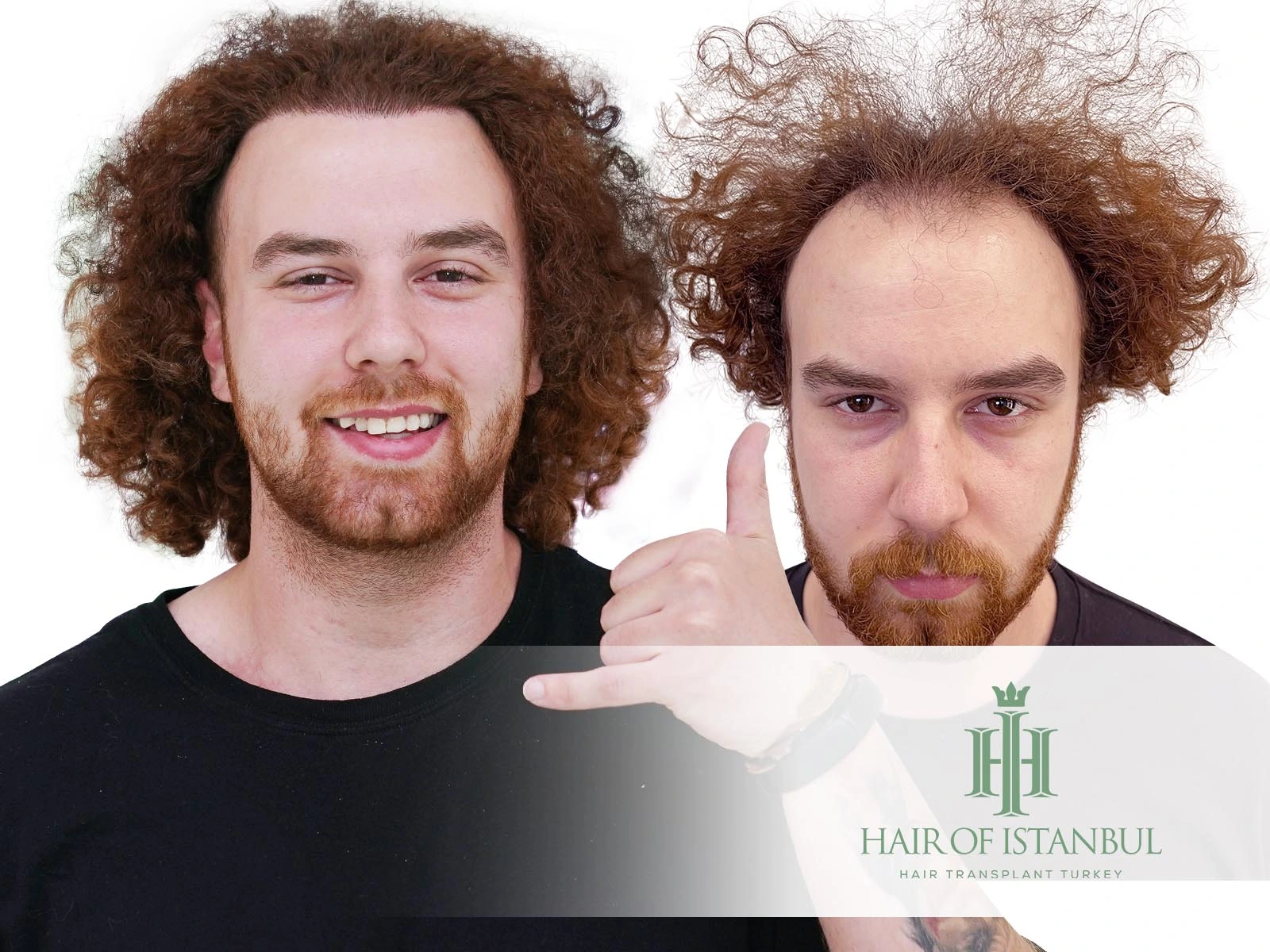
Curly Hair Transplant: Why the Punch Decides the Result
A curly hair transplant is not harder because curly hair is fragile. It is harder because of what the follicle does under the skin, where the surgeon cannot see it. Curl does not begin at the scalp surface — it continues below it, and a punch driven straight down around a follicle that curves sideways cuts the follicle in half.
That single mechanical fact explains almost everything about this operation: why some patients are turned away, why results vary so much between clinics, and why the most important question you can ask has nothing to do with your hair and everything to do with the instrument being used on it.
The Problem Is Underground
In straight hair the follicle runs more or less in line with the hair you can see, so a tubular punch placed around the hair shaft encloses the whole follicle down to the bulb. In tightly curled hair the follicle continues to curl beneath the surface, tracing an arc. Surgeons describe the width of that arc as the “diameter of the C”, and in published measurements it reaches 3–4 mm or more in some patients.
A conventional punch cutting on a straight, transverse axis has no way to follow that arc. It enters aligned with the visible hair, the follicle curves away from it underneath, and the punch edge shears through the follicle instead of around it. The result is a transected graft — damaged, and often unusable.
The obvious fix, using a wider punch to encompass the curve, runs into its own wall. Published practice notes that widening the punch enough to contain a 3–4 mm arc means punch sizes large enough to risk visible donor scarring. Bigger is not the answer. More on the trade-off is in our note on punch diameter selection.
What the Numbers Actually Look Like
Transection rate is the proportion of extracted follicles accidentally cut and damaged during removal. A retrospective case series of 18 patients with tightly curled Afro-textured hair tried three punch types in sequence on each patient and measured what happened. The results are stark enough to be worth quoting patient by patient.
| Case | Sharp rotary punch | Dull rotary punch | Curved non-rotary punch |
|---|---|---|---|
| 48-year-old, Bahamas | <10% in a narrow 5–6 cm corridor, but 60–80% once extraction moved sideways into the rest of the donor area | Similarly high | <5% across the whole donor area |
| 27-year-old, Cameroon | ~90% | ~20% | <5% |
| 42-year-old, previous failed FUE elsewhere | >80% | >80% | <5% |
| All 18 patients | Failed outright or gave excessive transection in 8 patients; fully successful in only 4 | <5% in every instance (<10% in the most difficult cases) | |
Read the second row again. The same head, the same hair, on the same day: roughly nine grafts in ten destroyed with one instrument, fewer than one in twenty with another. Nothing about the patient changed.
Two further details from the same series matter for anyone comparing clinics. The transection rate varied within a single patient from one part of the donor area to another — so a clinic that tests one small patch and declares success may still run into trouble elsewhere. And in the cases where the curved punch was needed, limiting the depth of the first cut, the other commonly suggested workaround, did not help either.
One honest qualification: this was a small retrospective series of 18 men, reported by the surgeon who developed and patented the punch, and he declares that interest in the paper. It is the best measured evidence available on this question, and it is not a randomised trial. We would rather tell you that than quote the numbers as if they settled everything.
The Tool That Changes the Answer
The instrument that produced those results is a two-pronged curved non-rotary punch. Rather than rotating a circular blade around the follicle on a flat plane, its prongs straddle either side of the hair and it is pushed subcutaneously in an arc that follows the curl of the follicle. The cutting axis tracks along the follicle rather than across it.
The practical consequences are worth spelling out, because they change what the operation feels like:
- The follicle is separated in a single action, so there is less secondary dissection and less handling stress on grafts — and graft handling is one of the things that decides survival months later.
- Punch size did not have to exceed 16 gauge regardless of how wide the subcutaneous curl was, which keeps donor wounds small.
- It is a manual technique. It has not been automated, and it requires specific training. That is precisely why the answer to “can I have FUE with curly hair” differs from clinic to clinic.
This is also the reason robotic and fully automated systems, which rotate a punch on a fixed axis, struggle with tightly curled hair. The general technique is covered on our FUE technique and DHI technique pages.
“Curly” Is Not One Thing
Curl exists on a continuum, and where you sit on it changes the plan. Loose waves behave almost like straight hair. Tight spirals do not. The same published series makes the point that Afro-textured hair is not homogeneous either: patients of mixed heritage, and those from regions along the historic out-of-Africa migration routes such as Ethiopia and Somalia, more often had follicles that conventional rotary punches could handle, with less tightly curled follicles and thinner skin.
It also noted an association worth knowing about: patients who also had acne keloidalis nuchae had tougher skin and curlier subcutaneous follicles, and rotary punches failed in all of them.
The practical reading is that no one can tell you your answer from a photograph of your hair dry and styled. If your hair is tightly coiled rather than curly, the dedicated page on Afro-type hair transplants goes into that texture specifically, and women dealing with traction alopecia or CCCA alongside texture should start with hair transplants for Black women.
Are You a Candidate? The Test Extraction
Because the answer genuinely varies, some clinics perform a test extraction: around 100 grafts are removed from the donor area and the surgeon counts how many came out intact before committing to a full session. It costs the patient an extra appointment, and it is a sign of a careful clinic rather than a hesitant one.
Notably, in the series above the curved punch worked reliably enough across every patient — including the most tightly curled — that the author considered pretesting unnecessary when using it. If a clinic tells you a test is required, that is useful information about the instruments they own.
One limitation to be aware of: the curved punch technique performed most consistently within the safe donor area and above it, with higher transection in zones below it. That restricts the use of nape hair in these patients. Our donor area page explains why those boundaries exist.
The Advantage Nobody Mentions
Everything above is about difficulty, so it is worth stating the other half plainly: once the grafts are out intact, curly hair is the best hair type to be transplanting.
A curl occupies volume. A straight hair covers a line of scalp; a coiled hair covers an area, and lifts away from the skin instead of lying flat against it. The same number of grafts therefore produces visibly more coverage than it would in straight hair, and the scalp between grafts shows far less. In practical terms a curly-haired patient often needs fewer grafts than a straight-haired patient with the same bald area — you can test that against the graft calculator, where density and area are the only two inputs.
Curl also hides the awkward stage. In straight hair the early months show every gap; curl closes those gaps optically much sooner. You can see how mature results read across different hair types in our before and after gallery.
Will the Transplanted Hair Still Be Curly?
Yes. Transplanted follicles keep the characteristics of the area they came from, so hair taken from the back of a curly-haired head grows back curly in its new position. A transplant cannot change hair texture in either direction — our page on changing hair texture with a transplant covers the claims made about this.
One thing does change temporarily. Hair emerging after surgery often comes through finer, straighter and sometimes oddly kinked for the first months, then thickens and returns to its natural curl pattern as the follicle matures. Curly-haired patients notice this more than most, because straight regrowth on a curly head is conspicuous. It is normal maturation, and the sequence is set out in our growth stages page.
Angle, Direction and Slit Size
Extraction is only half the operation. On the recipient side, curly hair is less forgiving in one respect and more forgiving in another.
- Slits must match the graft. Curly grafts are bulkier, so recipient incisions have to be sized to them. Slits cut for straight grafts crush curly ones on insertion.
- Angle matters more. A curl amplifies any error in placement angle: a straight hair placed a few degrees off looks slightly wrong, a curl placed a few degrees off springs in the wrong direction entirely. See graft implantation angle.
- Direction is more forgiving at the hairline. Because curl breaks up any hard line, the front edge reads as natural more easily than it does in straight hair, where a row of grafts can look like a row.
Aftercare
The schedule is the same as for any FUE and is on our aftercare page: no touching the recipient area for 72 hours, no hats for a month, no gym for a month, no sea or pool for a month, no razor on the recipient area for three months. Two points are specific to this hair type.
First, curly hair tangles as it regrows, and detangling over healing grafts is mechanical trauma. Keep hair short through the early months if you can, and use a wide-tooth comb from the ends upwards, never a brush over the recipient area. Second, curly and coily hair is drier by nature, so once your clinic clears normal washing, condition every wash on the lengths rather than the scalp.
What to Ask Before You Book
- What punch will you use on my hair, and is it a rotary or a curved non-rotary punch?
- How many patients with hair like mine has this team operated on?
- Will you do a test extraction, and what transection rate would make you stop?
- Will you check more than one zone of the donor area, given that transection can vary within the same head?
- How will recipient slits be sized to my grafts?
The first question is the one that separates clinics. A team that does not have an answer for it is planning to use the instrument they always use.
Frequently Asked Questions
Can you get a hair transplant with curly hair?
Yes. Curly and tightly coiled hair is transplanted routinely. The variable is the instrument: in a published series, conventional rotary punches failed or gave excessive transection in 8 of 18 tightly curled patients, while a curved non-rotary punch stayed under 5% in every case.
Why is curly hair harder to transplant?
Because the curl continues below the skin. The subcutaneous arc can span 3–4 mm or more, and a punch cutting straight down around a follicle that curves sideways cuts through it.
Does transplanted hair stay curly?
Yes. Follicles keep the characteristics of the donor area. New growth can come through finer and straighter for the first months, then returns to its natural curl as it matures.
Do I need fewer grafts with curly hair?
Often, yes. Curl covers area rather than a line and lifts off the scalp, so the same graft count produces more visible coverage than it would in straight hair.
Is FUE or DHI better for curly hair?
The extraction punch matters far more than the implantation method. Both approaches work if the grafts come out intact; neither compensates for a 90% transection rate.
What is a test extraction?
Removing about 100 grafts and counting how many are intact before committing to a full session. Some clinics do it as standard for tightly curled hair; with a curved punch the published experience suggests it is not always necessary.
Can robotic hair transplant systems handle curly hair?
They rotate a punch on a fixed axis, which is exactly the geometry that transects curled follicles. Tightly curled hair is where automated extraction is least reliable.
Is curly hair transplant more expensive?
It can be, because extraction is slower and manual. What you should be paying for is the instrument and the operator’s experience with it, not the label on the package.
References
- Umar S. Comparative Study of a Novel Tool for Follicular Unit Extraction for Individuals with Afro-textured Hair. Plast Reconstr Surg Glob Open. 2016;4(9):e1069. pmc.ncbi.nlm.nih.gov/articles/PMC5055031
- Singh MK, Avram MR. Technical considerations for follicular unit extraction in African-American hair. Dermatol Surg. 2013;39:1282–1284. pubmed.ncbi.nlm.nih.gov/23800215
- Rogers NE, Callender VD. Advances and challenges in hair restoration of curly Afrocentric hair. Dermatol Clin. 2014;32:163–171. pubmed.ncbi.nlm.nih.gov/24680003
- Zito PM, Raggio BS. Hair Transplantation. StatPearls, NCBI Bookshelf. ncbi.nlm.nih.gov/books/NBK547740
In Short
A curly hair transplant succeeds or fails on the extraction, and the extraction depends on the punch rather than on you. Curl continues under the skin across an arc that can exceed 3–4 mm, and a straight rotary punch cuts across it: in one measured series the same patient went from roughly 90% of grafts destroyed to under 5%, purely by changing instrument. So ask what punch will be used, ask how many patients with your texture the team has operated on, and expect a careful clinic to check more than one zone of the donor area. Once the grafts are out intact, curl is an advantage — it covers more scalp per graft and hides the early months. Your hair stays curly, though new growth may come through straighter for a while before it matures. For tightly coiled hair see our Afro-type hair transplant page, and for mature results across hair types, our before and after gallery.