
 en
en TR
TR  SK
SK  ITA
ITA  FR
FR  DE
DE  ES
ES  BG
BG  RO
RO Eyebrow Transplant: Design, Graft Numbers and What It Asks of You
An eyebrow transplant moves single hairs from the back of the scalp into the brow, one at a time, at an angle close to flat against the skin. It is a small operation with an unusually low tolerance for error: the brow is about three centimetres long, every hair in it points in a different direction from its neighbour, and the whole thing sits in the middle of a face.
It is also the procedure where the published failure analysis is most useful. In a review of 100 patients who were unhappy after an eyebrow transplant, the largest single problem was not poor growth. It was irregular density and irregular growth direction — 41%. Sparseness accounted for 36%, and 11% had not been given single-hair grafts at all. In other words, most eyebrow transplants that disappoint were not failures of surgery. They were failures of design.
There is one more thing that belongs at the top rather than buried in the small print. Scalp hair placed in a brow keeps growing at scalp speed. It has to be trimmed, and the published interval is every two to three weeks, for as long as it grows. Any page that does not tell you that is leaving out the part you will live with.
- What an eyebrow transplant is
- Why eyebrows are lost
- Frontal fibrosing alopecia
- Who is a candidate?
- Designing the brow
- The three zones
- Angle and direction
- Where the grafts come from
- Why single hairs
- How many grafts
- Density limit
- The day of the procedure
- Trimming
- Shedding, regrowth and the timeline
- Aftercare
- Risks and published complication rates
- Why eyebrow transplants disappoint
- Second sessions
- How long it lasts
- What an eyebrow transplant cannot do
- Price
- Frequently asked questions
- Sources
- Related pages
What an eyebrow transplant is
An eyebrow transplant takes follicular units from the back of the scalp and places them into the brow. The technique is FUE — the same extraction used for the scalp — but almost everything after extraction is different. Grafts are single hairs rather than groups. They are laid close to flush with the skin rather than standing up from it as scalp grafts do. And the direction changes every few millimetres along the brow, because that is what a brow does.
The operation takes two to four hours under local anaesthesia and leaves no incision line. Extraction is by the FUE technique, the same method used on the scalp. What it does leave is a commitment: the transplanted hair comes from the scalp and behaves like scalp hair, which means it grows and has to be cut.
It is worth being clear about what an eyebrow transplant is not. It is not a treatment for the condition that caused the loss. If the brow is thinning because of an active disease, moving hair into it does not stop the disease — and in one of those conditions the grafts are usually gone within a few years. That case has its own section below, and it is the section to read first.
Why eyebrows are lost
The cause of the loss decides whether an eyebrow transplant is worth doing, so it is established before anything is drawn.
A systematic review of 354 patients who underwent eyebrow reconstruction reports the reasons they were operated on: burns 57.6%, surgical treatment 12.8%, physiological ageing 7.17%, secondary causes 6.23%, trauma 6.23%, iatrogenic 2.80%, congenital 1.56%, infection 1.25% and radiation 0.31%. That is a distribution of surgical patients, not of eyebrow loss in the population — there is no published figure for how many people thin their brows by plucking, and this page does not invent one.
Some causes do have published frequencies, and they are worth knowing because they change the answer. Up to 96% of patients with frontal fibrosing alopecia lose eyebrow hair. Eyebrow involvement in alopecia areata has been reported between 19.8% and 62.8% depending on the cohort. Chemotherapy causes eyebrow loss in 82.4% of patients, and in about 5% of them it is permanent. Up to 39% of people with atopic dermatitis lose the outer third of the brow.
Two of these causes behave completely differently from the others. Alopecia areata can relapse in the transplanted area, and one review records a recurrence managed with corticosteroid injection. Frontal fibrosing alopecia is worse than that, and it has its own section.
| Cause | What it means for surgery |
|---|---|
| Trauma and burns | Grafting is possible; survival in burn scars has been reported around 60%, lower than in healthy skin |
| Over-plucking and traction | Usually correctable once the mechanical cause has stopped |
| Trichotillomania | Contraindicated unless disease control is confirmed by biopsy |
| Alopecia areata | Active disease is a contraindication; relapse in the grafted area has been reported |
| Frontal fibrosing alopecia | The single most important exception — see the section below |
| Hypothyroidism | Treat the thyroid first; brow loss may recover without surgery |
| Chemotherapy | Usually regrows on its own; surgery is not the first answer |
| Congenital hypotrichosis | A reconstruction case; expectations set against donor calibre |
Frontal fibrosing alopecia — read this before booking
Frontal fibrosing alopecia is a scarring alopecia that very often takes the eyebrows, sometimes before it takes anything else. It is also the reason this page has a warning box in the middle of it rather than a testimonial.
It is also more common in this setting than most patients expect. Up to 96% of people with frontal fibrosing alopecia lose eyebrow hair at some stage, and in 43.7% the brow goes first — before anything happens at the hairline.
The short-term results are good, and that is the trap. In a series of ten patients with frontal fibrosing alopecia who had 120 to 270 single-hair follicles placed per brow, 80% had excellent growth at six to twelve months, and results held for up to two years. Then most of them began to lose the transplanted hair at three to four years. Only one patient out of ten kept it beyond four years.
A larger multicentre series of 51 patients grafted for frontal fibrosing alopecia measured the same curve: mean graft survival was 87% at year one and 41% at year five. One systematic review reports that only about a third of patients still had their result at year two. The authors’ conclusion is the honest one: patient satisfaction was reported as high, but the outcome in frontal fibrosing alopecia is temporary.
None of this makes surgery automatically wrong for someone with frontal fibrosing alopecia. It makes it a decision about a few good years rather than something that lasts, and that is a different decision. What it does rule out is operating while the disease is active. Published guidance requires the disease to be quiet first, and does not put a number on how long — no study has measured that interval.
If frontal fibrosing alopecia has not been excluded
A brow that has thinned from the outer edge inwards is examined by a dermatologist before an eyebrow transplant is planned — on its own, with no change at the hairline and no other sign. This matters because of one published figure: in a clinical review, eyebrow loss preceded scalp hair loss in 43.7% of patients with frontal fibrosing alopecia, and up to 96% of them have eyebrow involvement at some point. Waiting for the hairline to recede before asking the question misses about half of them.
Who is a candidate for an eyebrow transplant?
Candidacy has two parts, and only one of them is about the brow. The first is whether the cause of the loss has stopped. The second is whether the donor scalp can supply hair fine enough to pass as brow hair — and that one refuses more often than people expect. In a prospective series, 27.5% of patients had donor density below 55 follicular units per square centimetre, and one systematic review puts the proportion of patients suitable for FUE at around 60%.
Usually suitable
- Loss from over-plucking or traction where the mechanical cause has stopped and the brow has been given time to recover on its own, and has not
- Scars from trauma, burns or surgery, with the tissue settled
- Congenital sparseness, where the donor hair calibre is a reasonable match
- Thinning after a treated thyroid problem, once the brow has been given time to recover on its own
- A patient who understands that the hair will need trimming every two to three weeks
Not suitable, or not yet
- Active alopecia areata
- Frontal fibrosing alopecia that is not under control
- Any active cicatricial alopecia
- Trichotillomania, unless disease control has been confirmed by biopsy
- Uncontrolled systemic disease
- An expectation of a brow that never needs maintenance
Designing the brow: the published reference points
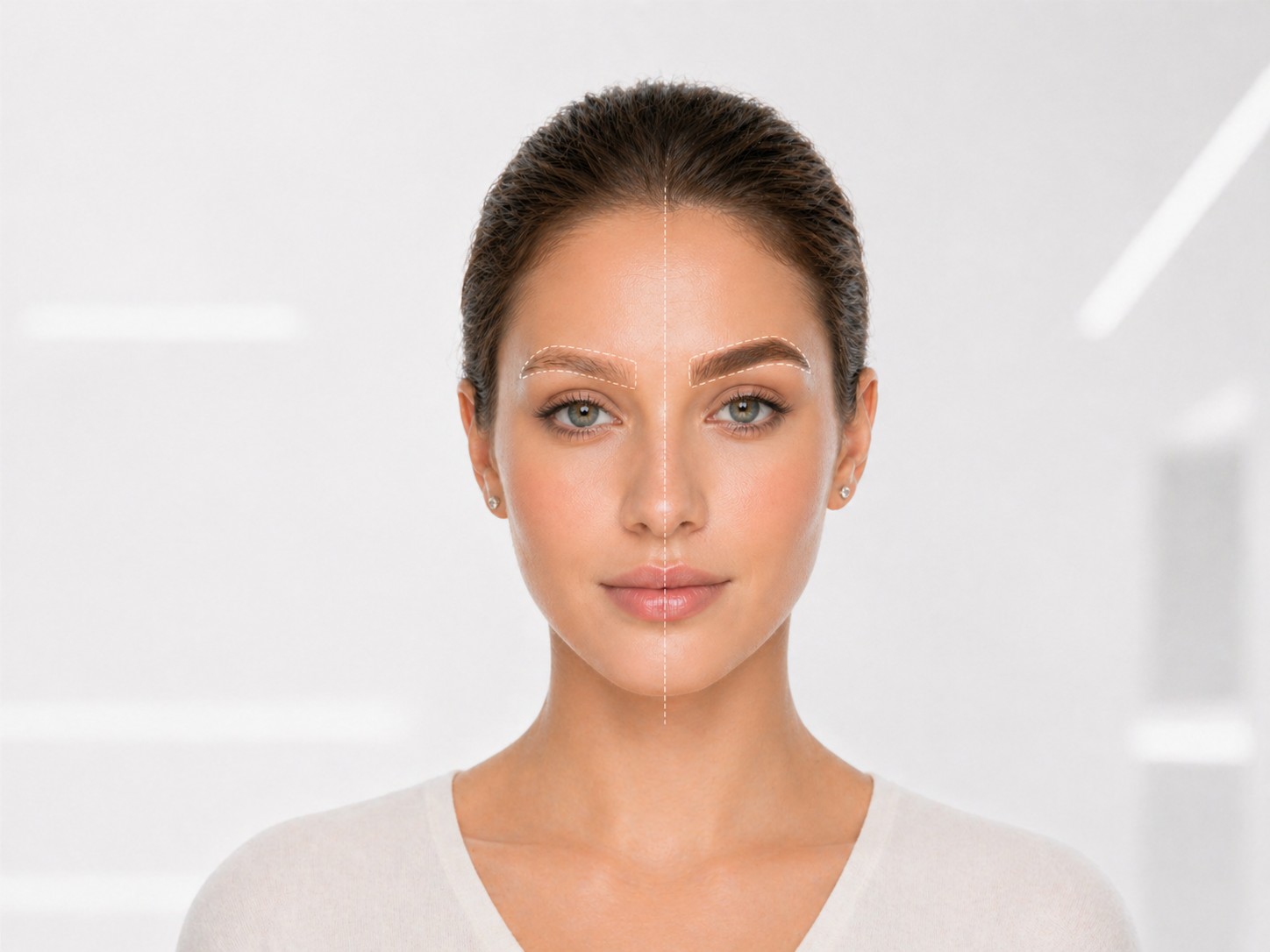
Brow design is not freehand. There is a published set of reference points, most of them attributed to Westmore, and they are drawn on the patient’s own face before anything is measured in grafts. The same geometry governs the forehead above it — one of the published measurements is the 50 mm from the upper brow margin to the hairline in women.
The medial border begins on the vertical line through the ala of the nose and the inner canthus. The lateral border ends where an oblique line from the ala through the lateral canthus meets the brow. The peak sits on the vertical through the lateral limbus. Both ends sit at roughly the same horizontal level, about a centimetre above the bony orbital rim.
Numerical guidance exists alongside those landmarks, and it is worth knowing that it is level-V evidence — expert opinion and trend analysis rather than trials. It is used as a check on a drawing, not as a formula that produces one.
Male and female brows are not the same shape, and designing one as the other is a common way to get a technically clean result that still looks wrong. The female brow sits a few millimetres above the orbital rim with a more defined arch. The male brow sits on the rim, and is heavier, straighter and less arched.
| Reference | Published value |
|---|---|
| Medial border | Vertical line through the ala and the inner canthus |
| Lateral border | Oblique line from the ala through the lateral canthus |
| Peak | Vertical line through the lateral limbus |
| Height above bony orbital rim | About 1 cm |
| Mid-pupil to upper brow margin | 25 mm |
| Upper brow margin to hairline (women) | 50 mm |
| Brow to upper lid crease | 15 mm |
| Peak height above the medial brow | 8–10 mm |
| Take-off angle | 17–20° |
| Brow width | Men about 1.5 cm, women about 1.3 cm |
The three zones and why each one points differently
A brow is three regions, not one line, and the hair in each points a different way. Getting this wrong is what the failure analysis calls irregular growth direction, and it is the single commonest reason an eyebrow transplant disappoints.
The head is the medial tenth or so — six to eight millimetres — and its hairs run vertically, almost straight up. The body is the middle 60%, two and a half to three centimetres, and it is the densest part. Here the upper row angles downward and the lower row angles upward, so the two cross: the pattern the literature calls herringbone, and the reason a real brow looks solid without actually being dense. The tail is the outer fifth to quarter, and runs laterally, fanning slightly at the tip.
This is also why single hairs matter more in some places than others. Published practice puts single-hair units at the head and the tail, where any grouping shows, and allows two-hair units in the body of the brow where the crossing pattern hides them.
| Zone | Share of brow length | Size | Hair direction |
|---|---|---|---|
| Head (medial) | 10–15% | 0.6–0.8 cm | Vertical, almost straight up |
| Body (middle) | About 60% | 2.5–3 cm | Horizontal; upper row down, lower row up — crossing |
| Tail (lateral) | 20–25% | 1.2–1.7 cm | Lateral, fanning slightly at the tip |
Angle and direction
Scalp grafts stand clearly away from the skin. Brow grafts do not: they are placed as close to flush as the tissue allows. One prospective study reports 10 to 15 degrees, and it comes from a single low-tier journal, so it is quoted here as a reported value rather than a standard. No study has compared brow and scalp angles in degrees, and this page does not manufacture that comparison — but every qualitative description in the literature agrees on the principle: as flat as the tissue allows.
The reason is visible rather than technical. A hair standing up out of a brow catches light from a different angle than every hair around it, and it does not lie down. It reads as transplanted from across a room.
Slit orientation is used to control two different things. Sagittal slits control the way a curved hair curls, which matters because a scalp hair brought to the brow arrives with its own curl. Coronal slits control the angle. Getting the curl wrong produces the wavy, kinked appearance the literature attributes to over-manipulation of grafts, compression during placement, or poor circulation in scarred tissue.
Where the grafts come from
Grafts for an eyebrow transplant are taken from the occipital scalp — the back of the head — and selected for the finest single-hair units available. The area is chosen for two reasons: it is the most reliable donor on the body, and it is hidden.
Finer hair can be found lower, at the nape, and some published practice prefers it precisely because it is closer in calibre to brow hair. It is a trade rather than a free improvement: nape hair is finer, but the nape is a less stable donor zone than the mid-occipital scalp and the literature is not unanimous about using it.
Body hair — leg or arm — is the other published alternative, and its argument is the growth cycle: it is shorter and slower, so it needs trimming every five to six weeks instead of every two to three. What the literature reports against it is different from what is usually assumed: a prolonged telogen phase, unreliable regrowth and a tendency to kink, with calibre and curl less predictable. Yield is not the objection — one comparison measured 8.2 grafts per cm from leg against 7.2 from the nape. Hair of Istanbul uses occipital scalp, and the trimming interval that comes with it is stated plainly rather than avoided.
Why single hairs
A natural brow is made of single hairs. That sounds obvious until you look at what happens when it is ignored: in the review of 100 dissatisfied patients, 11% of the complaints came down to not having been given single-hair grafts at all.
A two-hair follicular unit placed at the head or the tail of a brow produces two hairs emerging from one point. On a scalp that is invisible. On a brow it is the tuft that makes the whole thing read as artificial, because the eye is looking at it from thirty centimetres away in good light.
Follicular units are separated under magnification before placement. In the body of the brow, where the crossing pattern is dense enough to absorb them, two-hair units can be used deliberately — but that is a design decision made in advance, not what is left over from dissection. Placement itself may use forceps or the DHI technique, chosen for the control it gives over angle and direction.
How many grafts
Published graft counts for an eyebrow transplant are per brow, not per patient, and they vary with sex and with how much brow is left to work with.
One technical review gives 70 to 90 grafts for a female brow — two to three rows — and 150 to 200 for a male brow described as thick and full. Others place average single-hair placement at around 200 per side, and full reconstruction at roughly 200 to 300 per brow. A prospective series of 40 patients averaged 206 follicles per patient.
At Hair of Istanbul a typical eyebrow transplant uses 300 to 600 grafts for both brows together. That corresponds to the published male and full-reconstruction figures doubled. A woman wanting cosmetic thickening rather than reconstruction sits below it — the published range there is about 140 to 180 for both brows — and the plan follows the brow, not the band.
One practical limit shapes the session: published practice caps extraction at around 200 follicular units per session, to keep grafts out of the body for as short a time as possible. Larger plans are staged rather than compressed.
| Case | Published count | Both brows |
|---|---|---|
| Female brow, cosmetic thickening | 70–90 per brow | About 140–180 |
| Male brow, full and thick | 150–200 per brow | About 300–400 |
| Full reconstruction | 200–300 per brow | About 400–600 |
| Prospective series, n=40 | 206 ± 34 follicles per patient | — |
| Reported in frontal fibrosing alopecia, n=10 | 120–270 per brow | — |
| Maximum extraction per session | About 200 follicular units | — |
Density, and the case that shows why it is capped
Density in an eyebrow transplant is capped at 30 to 35 follicular units per square centimetre, and some series work at 30 or below. The cap is not there because of a comparison with anywhere else. It is there because of what has been published about exceeding it.
The temptation to exceed it is obvious. A brow is small, the patient wants it full, and more grafts look like more result.
A 35-year-old man received 355 grafts in one brow — 710 in total — placed with dense packing. He developed persistent folliculitis that resolved into atrophic ice-pick scarring. The authors identified four contributing factors: the dense packing itself, pre-existing skin conditions, irregular sebaceous secretion, and postoperative care. They also noted that placement depth, not only bacteria, has been implicated in folliculitis.
That is one case, and one case is not a rate. But it is the reason the number is treated as a ceiling rather than a suggestion, and the reason a brow that needs more coverage is planned as two sessions rather than one crowded one.
Why the density cap is not negotiable
A denser brow placed in one pass is not a better brow. Folliculitis in the eyebrow is described in the literature as uncommon for reasons that are not fully understood — but where it becomes persistent, the reported outcome was permanent atrophic scarring. Scar in a brow cannot be undone with more grafts.
The day of the procedure
An eyebrow transplant in Istanbul takes two to four hours in one day under local anaesthesia. The design is drawn first, checked against the published landmarks and against the patient’s own face in a mirror, and agreed before anything is extracted.
Two things are settled before that. Where a patient takes medication or supplements that affect clotting, nothing is stopped on their own initiative — the prescribing doctor and the Hair of Istanbul medical team plan it together. And smoking is asked about, because it appears among the factors identified in the published complication literature.
Extraction is FUE from the occipital scalp, selecting the finest single-hair units, capped at around 200 units in a session. Grafts are separated under magnification. Recipient sites are then made zone by zone — vertical at the head, crossing at the body, lateral at the tail — at an angle close to flush with the skin, with slit orientation chosen to control curl in one direction and angle in the other.
There is no incision line and no stitches. The donor sites at the back close on their own and are covered by the hair above them. For patients travelling to Turkey the procedure is preceded by an in-person assessment and followed by an examination before departure, with the aftercare routine demonstrated in person.
The part most pages leave out: trimming
This is the section that decides whether someone is happy with an eyebrow transplant two years later, and it is the section most clinic pages do not write.
Eyebrow hair and scalp hair run on completely different clocks. An eyebrow follicle has an anagen — growth — phase of about two to three months, growing at 0.12 to 0.15 mm a day. A scalp follicle has an anagen phase of two to seven years, growing at roughly a centimetre a month. The growth phase is ten to thirty times longer and the rate is around twice as fast.
Move a scalp follicle into a brow and it brings its clock with it. The systematic review puts it plainly: transplants from the scalp grow much faster because of the prolonged anagen phase and may require more frequent maintenance. The published trimming interval for scalp- and nape-derived hair is every two to three weeks. For body hair it is five to six weeks.
There is a claim in circulation that transplanted hair gradually adapts to the recipient area and stops needing this. It deserves a careful answer rather than a flat denial. There is a measured recipient-area effect — but it was measured in leg skin, not in a brow. In that study, occipital hair transplanted to the leg slowed from 16.0 to 8.2 mm a month, roughly halving. Two things about it matter here: the shaft diameter did not change, so the hair did not become finer; and when those hairs were moved back to the nape, they did not return to their original speed.
So: partial slowing is plausible and has been measured somewhere else. Full conversion into brow hair has not been measured anywhere, in a brow or otherwise, and the trimming does not stop. Anyone who tells you it does is describing something no study has shown.
One related detail from published practice: from about the third week, gel or petroleum jelly is used to train hairs that are growing in the wrong direction into line.
And if the trimming stops? The hair does not know it is in a brow. At roughly a centimetre a month it keeps going, which is why the interval is two to three weeks rather than a matter of taste.
Shedding, regrowth and the timeline
The transplanted hairs shed within the first weeks. This is expected and it is not the graft failing — the follicle stays, the shaft is released. Regrowth begins in the third to fourth month, and the brow is judged at nine to twelve months.
That timeline is also why a second session is not planned early. The result of the first is not assessed before month nine; the published minimum interval between procedures is eight months.
One question patients ask late rather than early: what happens to the eyebrow hair they still have. Placing grafts among existing hairs can push some of them into the resting phase, and they shed alongside the transplanted ones before returning. No published figure exists for how often this happens in the brow specifically.
| Period | What happens |
|---|---|
| Days 1–3 | Swelling and crusting around the grafts; sleeping position matters |
| Days 5–10 | Crusts clear; donor sites at the back close on their own |
| Weeks 2–4 | Transplanted hairs shed — expected, not a failure |
| From week 3 | Gel or petroleum jelly is used to train hairs growing the wrong way |
| Months 3–4 | Regrowth begins; trimming starts and continues every 2–3 weeks |
| Months 6–8 | Regrowth largely complete |
| Months 8–14 | Maximum density; the result is judged, and a second session considered |
Aftercare
Aftercare for an eyebrow transplant is short but specific. The grafts sit in a small area that people touch, rub and sleep on without thinking about it, and the first week is where most avoidable losses happen.
The brow is not rubbed, scratched or covered with make-up during the crusting phase. Sleeping position is adjusted to keep pressure off the area. Swimming, saunas and steam wait. Any product on the brow — including the gel used later to train direction — starts when the medical team says so, not before. The general protocol on the after care page covers the rest, and the first wash is demonstrated in person before departure.
Where a patient is taking medication that affects clotting, nothing is stopped on their own initiative — the prescribing doctor and the Hair of Istanbul medical team plan it together.
Risks and published complication rates
Complication rates for eyebrow transplant come mainly from small series, and they should be read as such. The most useful set comes from a prospective series of 40 patients followed for six months.
Two of these deserve emphasis. Misdirected follicles are not rare — one series reports 5% and published pre-operative counselling puts the expected figure at 5 to 10%. And folliculitis, while uncommon, is the complication with the worst reported ceiling, because the one published case that became persistent ended in permanent scarring.
Systematic reviews list further complications without giving rates: swelling and bruising, graft asymmetry, graft necrosis, relapse of alopecia areata in the grafted area — managed in one report with corticosteroid injection — and scarring in the donor area, where hypertrophic scarring has been reported.
One complication has no published rate at all: cyst formation. None of the eyebrow transplant papers reviewed for this page reported it. Rates from general scalp surgery are not transferable to the brow and are not quoted here as if they were.
Where grafting is not the right answer for a brow at all — an active scarring process, or a donor that cannot supply what the design needs — micropigmentation is a different conversation rather than a lesser version of this one.
| Complication | Published rate | Source context |
|---|---|---|
| Erythema | 10% | Prospective series, n=40, 6 months |
| Folliculitis | 7.5% | Same series |
| Graft misdirection | 5% | Same series |
| Expected follicle misalignment | 5–10% | Pre-operative counselling, n=21 series |
| Partial graft loss | 1 of 21 patients | Retrospective series |
| Expected graft loss | 5–10% | Expert opinion |
| Persistent folliculitis to scarring | 1 published case | 355 grafts per brow, dense packing |
| Cyst formation | No published rate for eyebrows | Not measured |
Why eyebrow transplants disappoint
The most useful paper in this literature is not about technique. It is a review of 100 patients who came in unhappy after an eyebrow transplant, and it counted what they were unhappy about.
What the authors identified as the underlying causes were low hair survival, an inadequate understanding of what a natural brow looks like, and insufficient communication with the patient. Only the first of those is surgical.
- Irregular density and irregular growth direction — 41%
- A result that was simply too sparse — 36%
- Single-hair grafting not used — 11%
- Poor blending with the surviving brow — 7%
- Hair character that did not match the brow — 5%
Second sessions
Whether an eyebrow transplant needs a second session is one of the questions where the published answers disagree with each other, and the honest thing is to say so.
One technical review, summarising the literature, reports that 14% of cases were completed in one session, 77% needed two, and 9% needed three. A retrospective series of 21 patients reports that none required a second session, with one partial graft loss. Those two figures cannot both describe the same practice, and no larger study settles it.
What is agreed is the timing. The first session is not judged before month nine, because before that it has not finished growing, and the published minimum interval between procedures is eight months. The density cap is the reason a second session exists at all: it is safer to place a controlled number twice than to crowd a brow once.
A second session is quoted separately, and the interval is set out before the first one. Results from both are photographed at matched distance and lighting on the before and after page.
How long does the result last?
The transplanted follicle keeps its own biology, and published graft survival in eyebrow series is generally above 75%, with modern series reporting 85 to 95%. One comparative study measured 85.13% with a direct-extraction technique against 69.91% with strip harvesting. Where the brow was lost to burns, survival has been reported around 60%. These are short- and medium-term series: outside frontal fibrosing alopecia, no systematic follow-up beyond five years has been published, so this page does not describe the result as permanent.
Satisfaction is measured less well than survival. One prospective series of 40 patients scored overall satisfaction at 4.3 out of 5, with 77.5% rating themselves much or very much improved. There is no large multicentre satisfaction figure for eyebrow transplant, and this page does not present a single-series number as one.
The exception is the one already described. In frontal fibrosing alopecia the grafts are usually lost within three to four years, and survival at five years has been measured at 41%. Permanence depends on the disease, not on the technique.
What an eyebrow transplant cannot do
These are the limits, stated before the operation rather than discovered afterwards.
- It does not stop the condition that caused the loss — in frontal fibrosing alopecia the grafts are usually gone in three to four years
- It does not remove the need for trimming; scalp hair keeps growing at scalp speed and the published interval is every two to three weeks
- It does not produce a brow denser than 30 to 35 follicular units per cm², because exceeding that has a published cost
- It does not replace brow pencil for colour or contour in every case — published pre-operative counselling says so directly
- It cannot control direction in every follicle; 5 to 10% misalignment is the published expectation
- There is no published comparison between an eyebrow transplant and microblading, and no published data on grafting into skin that has been microbladed — so this page makes no claim in either direction
Price of an eyebrow transplant in Istanbul
An eyebrow transplant in Turkey is priced at €2,500 at Hair of Istanbul, for both brows. The pricing page sets out the full list alongside the scalp procedures.
The price covers the pre-operative assessment and blood tests, the design, the procedure under local anaesthesia, the aftercare set and the follow-up schedule. Where a second session is part of the plan it is quoted separately, and the interval — not before month nine — is set out before the first one.
What a particular case needs is settled by examination. A first assessment can be made from photographs; the design itself is drawn on the face, in person, on the day. Ask for an assessment and both the design and the graft number follow from what it finds — in a brow more than anywhere else, the number depends on how much is left.
Frequently asked questions
Will I have to trim my transplanted eyebrows?
Yes, and this is the part worth knowing before you book. The grafts come from the scalp and keep the scalp’s growth cycle: an anagen phase of two to seven years against two to three months for a natural brow hair, growing at roughly twice the rate. The published trimming interval for scalp-derived brow grafts is every two to three weeks, and it does not stop.
Do the transplanted hairs eventually turn into eyebrow hairs?
Not in the sense the claim usually implies. A recipient-area effect has been measured, but in leg skin rather than in a brow: occipital hair moved to the leg slowed from 16.0 to 8.2 mm a month. Two details matter. The shaft diameter did not change, so the hair did not become finer. And hairs moved back to the nape did not return to their original speed. Partial slowing is plausible; conversion into brow hair has not been measured anywhere, and the trimming requirement remains.
How many grafts will I need?
Published counts are per brow: 70 to 90 for a female brow, 150 to 200 for a full male brow, and 200 to 300 per brow in full reconstruction. A typical case at Hair of Istanbul uses 300 to 600 grafts for both brows together. The number is set by how much brow survives and by the density cap, not by how full you would like it — extraction is also limited to around 200 follicular units per session.
Is an eyebrow transplant cheaper in Turkey?
The price at Hair of Istanbul is €2,500 for both brows, and the procedure is performed at the clinic in Istanbul. What travel does not change is whether you are a candidate. If the brow is thinning from an active disease, that is true in Istanbul as well as at home — which is why the cause is established before a date is offered.
I have frontal fibrosing alopecia. Can I have an eyebrow transplant?
Only with the disease under control, and only knowing what the published follow-up shows. In a series of ten patients, 80% had excellent growth at six to twelve months and results held to about two years — then most began losing the grafts at three to four years, and only one patient kept the result beyond four. A multicentre series of 51 patients measured mean survival of 87% at year one falling to 41% at year five. It can still be worth doing. It is a decision about a few good years, not a permanent one.
Why single hairs? Can’t you place more per graft to save time?
Because a brow is looked at from close range in good light, and two hairs emerging from one point is what makes a transplant visible as a transplant. In a review of 100 dissatisfied patients, 11% of the complaints came down to single-hair grafting not having been used. Two-hair units can be used deliberately in the body of the brow, where the crossing growth pattern absorbs them, but not at the head or the tail.
Why can’t you just make my brows as thick as I want?
Because density in a brow is capped at 30 to 35 follicular units per square centimetre, and there is a published reason. A patient who received 355 grafts in one brow with dense packing developed persistent folliculitis that healed into permanent atrophic scarring. A brow that needs more coverage is planned as two sessions at least nine months apart, not as one crowded one.
Will I need a second session?
The published answers disagree. One review of the literature reports 14% of cases finished in one session, 77% needing two and 9% needing three; a series of 21 patients reports that none needed a second. No larger study settles it. What is agreed is that a second session is not planned before month nine, because before then the first has not finished growing.
What is the most common reason an eyebrow transplant looks wrong?
Design, not surgery. In the review of 100 dissatisfied patients, 41% of complaints were irregular density and irregular growth direction, 36% were a result that was simply too sparse, and 11% were single-hair grafting not used. The brow has three zones and the hair in each points a different way — vertical at the head, crossing in the body, lateral at the tail. Placing it as one uniform line is what produces the look people recognise.
Can I have a transplant if I have had microblading?
There is no published data on grafting into microbladed skin, and no published comparison between microblading and transplantation. That means the skin is assessed at consultation rather than against a rule — and it means any statement that microblading definitely does, or definitely does not, affect graft survival is a statement without evidence behind it. For context, microblading places pigment in the papillary dermis and lasts up to about three years depending on the pigment, with retouching required.
How long until it looks finished?
The transplanted hairs shed in the first two to four weeks, which is expected. Regrowth begins in the third to fourth month. The result is judged at nine to twelve months, which is also the earliest point at which a second session is considered.
Sources
The figures on this page come from peer-reviewed sources and professional society publications. Eyebrow transplantation has no randomised trials; most of this literature is case series and expert opinion, and it is presented that way. Where a number relevant to eyebrow transplant does not exist, this page says so instead of supplying one.
- Klingbeil KD, Fertig R. Eyebrow and eyelash hair transplantation: a systematic review. J Clin Aesthet Dermatol 2018;11(6):21–30. Eyebrow and Eyelash Hair Transplantation: A Systematic Review — Journal of Clinical and Aesthetic Dermatology, 2018
- Rajput RJ. Hair transplant for eyebrow restoration. Indian J Plast Surg 2021;54(4):489–494. Hair Transplant for Eyebrow Restoration — Indian Journal of Plastic Surgery, 2021
- Gupta J, Kumar A, Chouhan K, Ariganesh C, Nandal V. The science and art of eyebrow transplantation by follicular unit extraction. J Cutan Aesthet Surg 2017;10(2):66–71. The Science and Art of Eyebrow Transplantation by Follicular Unit Extraction — Journal of Cutaneous and Aesthetic Surgery, 2016
- Audickaite A, Alam M, Jimenez F. Eyebrow hair transplantation in frontal fibrosing alopecia: pitfalls of short- and long-term results. Dermatol Surg 2019;45(7):922–925. Eyebrow Hair Transplantation in Frontal Fibrosing Alopecia: Pitfalls of Short- and Long-Term Results — Dermatologic Surgery, 2020
- Nguyen B, Hu JK, Tosti A. Eyebrow and eyelash alopecia: a clinical review. Am J Clin Dermatol 2023;24(1):55–67. Eyebrow and Eyelash Alopecia: A Clinical Review — American Journal of Clinical Dermatology, 2023
- Nelson J, Friedman A. Eyebrow madarosis: an updated review of the etiology and management, part I. J Drugs Dermatol 2026;25(3):246. Eyebrow Madarosis: An Updated Review of the Etiology and Management, Part I — Nonscarring Disorders — Journal of Drugs in Dermatology, 2026
- Hwang S et al. Does the recipient site influence the hair growth characteristics in hair transplantation? Dermatol Surg 2002;28(9):795–798. Does the recipient site influence the hair growth characteristics in hair transplantation? — Dermatologic Surgery, 2002
- Khan KU, Abdullah F. Achieving natural aesthetics in brow hair transplantation. Pak J Med Health Sci 2023;17(11):345–347. Achieving Natural Aesthetics in Brow Hair Transplantation: Challenges and Solutions — Pakistan Journal of Medical and Health Sciences, 2023
- Navalta JTP, Pathomvanich D. Folliculitis and scarring after eyebrow transplantation: an uncommon complication. Hair Transplant Forum International 2013;23(2):54–56. Folliculitis and Scarring After Eyebrow Transplantation: An Uncommon Complication — Hair Transplant Forum International, 2013
- Chen L, Li Z, Liu X, Yang J, Jiang W. Clinic analysis and effective improvement tips for poor eyebrow transplantation. Aesthetic Plast Surg 2024;48(23):4769–4777. Clinic Analysis and Effective Improvement Tips for Poor Eyebrow Transplantation — Aesthetic Plastic Surgery, 2024
- Yalçınkaya E, Cingi C, Söken H, Ulusoy S, Muluk NB. Aesthetic analysis of the ideal eyebrow shape and position. Eur Arch Otorhinolaryngol 2016;273(2):305–310. Aesthetic analysis of the ideal eyebrow shape and position — European Archives of Oto-Rhino-Laryngology, 2016
- Brown TM, Krishnamurthy K. Histology, hair and follicle. StatPearls, NIH Bookshelf. Histology, Hair and Follicle — StatPearls, 2023
- Murphrey MB, Agarwal S, Zito PM. Anatomy, hair. StatPearls, NIH Bookshelf. Anatomy, Hair — StatPearls, 2023
- Shishak M, Kuthial M. Eyebrow microblading: science, art, and complications. Skin Appendage Disord 2025;11(4):355–359. Eyebrow Microblading: Science, Art, and Complications — Skin Appendage Disorders, 2025
- Frontal fibrosing alopecia. DermNet. Frontal fibrosing alopecia — DermNet, 2023
- Vañó-Galván S et al. Hair transplant in frontal fibrosing alopecia: a multicentre review of 51 patients. J Am Acad Dermatol 2019. Hair transplant in frontal fibrosing alopecia: A multicenter review of 51 patients — Journal of the American Academy of Dermatology, 2019
- Eyebrow restoration with hair transplantation. Journal of the Bangladesh Society of Aesthetic Plastic Surgeons, retrospective series, n=21. Eyebrow Restoration with Hair Transplantation — Journal of the Bangladesh Society of Aesthetic Plastic Surgeons
Related pages
An eyebrow transplant is often planned alongside one of these.
| Page | Why it is relevant here |
|---|---|
| Hair transplant in Turkey | The scalp procedure and how the donor is assessed |
| FUE technique | The extraction method used here |
| Beard transplant | The other facial procedure using single-hair placement |
| Hair transplant for women | Female pattern loss, and scarring conditions |
| Revision hair transplant | Correcting a previous procedure |
| Scalp micropigmentation | Pigment where grafting is not the answer |
| After care | The day-by-day protocol |
| Before and after | Results photographed at matched distance and light |
| Hair transplant cost | The full price list |
| Medical team | Who reviews the plan |
| Contact | Ask for an assessment |
