 en
en TR
TR  SK
SK  ITA
ITA  FR
FR  DE
DE  ES
ES  BG
BG  RO
RO 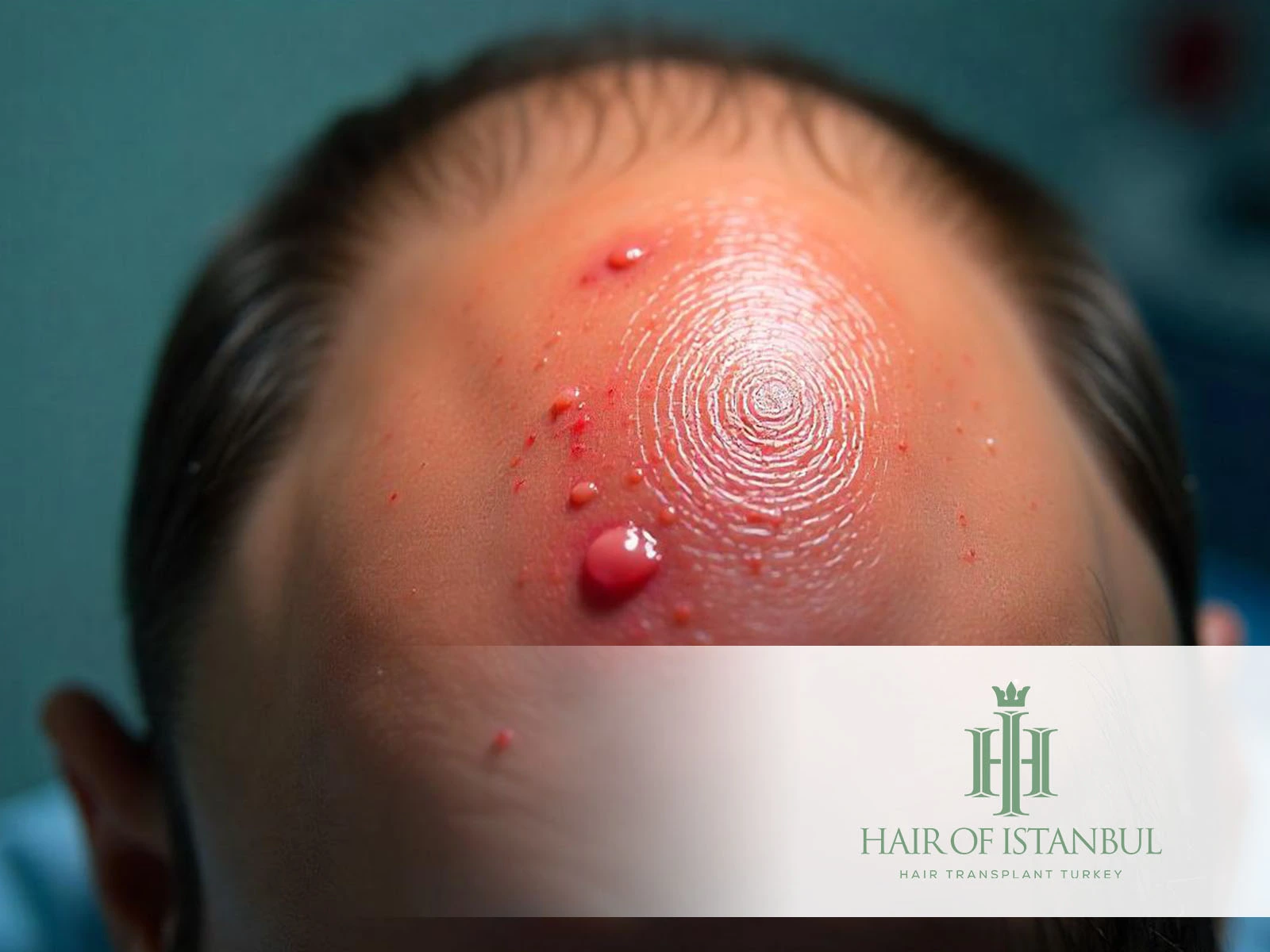
Infected Hair Transplant: How to Tell, and How Rare It Is
An infected hair transplant is rare. Across the published literature the reported rate of infection after follicular unit excision is below 1%.1 Most of what patients photograph in the first weeks and send to us as “an infected hair transplant” is not an infection at all — it is inflammation around healing follicles, which is common, expected, and behaves differently.
This page explains what a true infection looks like, how it differs from the things that resemble it, what causes it, how it is treated, and the small number of signs that justify contacting the clinic the same day rather than waiting. If what you are looking at is pustules or spots without fever or spreading redness, the page you probably want is folliculitis after a hair transplant.
How common is infection after a hair transplant?
Uncommon, and much less common than the things mistaken for it. Putting the two side by side is the fastest way to understand what you are seeing.
| What it is | Reported frequency | Is it an infection? |
|---|---|---|
| Folliculitis after hair transplantation | 12.1% in a large multicentre study1 | Sometimes. The early form is usually bacterial, the later form is sterile |
| Immediate post-operative folliculitis (first week) | Reduced to 0.7% under one published protocol2 | No. A foreign body reaction; cultures grow nothing |
| True wound infection after FUE | Below 1%1 | Yes |
In other words: for every patient who develops a genuine infection, roughly twelve develop something that looks like one. That ratio is the reason this page spends as much time on what infection is not as on what it is.
Is my hair transplant infected?
Four things separate a true infection from the far more common inflammatory reactions, and they are easy to check without any equipment.
- Spread. Inflammation around individual follicles stays around individual follicles. Infection spreads outward from a point into surrounding skin as a widening area of redness and warmth.
- Systemic signs. Fever, chills or feeling generally unwell do not belong to healing. They belong to infection.
- Pain that increases. Discomfort after a transplant declines day by day. Pain that starts rising again after the third day is a warning, not a variation.
- Discharge. A single pustule with a small amount of fluid is common. Persistent pus, a foul smell, or a draining area is not.
None of these describes the scattered red spots or small pustules that appear around growing hairs. Those are covered separately: pustules and spots on the folliculitis page, and the wider question of what a bump on the scalp turns out to be on the page about pimples after a hair transplant.
What does an infected hair transplant look like?
People search for photographs of this, and photographs are a poor diagnostic tool — the same image can represent a self-limiting reaction in one patient and a spreading infection in another. What matters is the pattern, and the pattern can be described.
A true infection tends to present as a defined area rather than scattered spots: skin that is red, warm to the touch, tender, and often slightly swollen, with a border that is expanding rather than fading. There may be yellow discharge, crusting that keeps re-forming after washing, and skin that feels tight. It is usually accompanied by how the patient feels overall, not only by how the scalp looks.
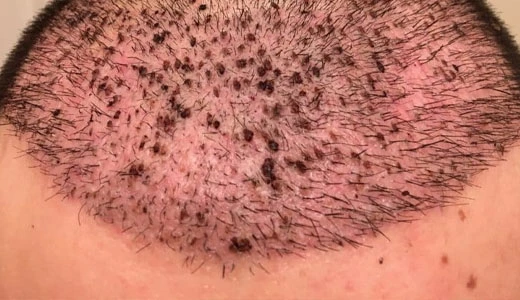
By contrast, the appearance that alarms most patients — dozens of small, evenly spaced red or white-topped bumps, one at each transplanted unit — is the opposite pattern. Even, distributed, follicle-bound, and not accompanied by fever. That is inflammation, not infection.
“Infected hair plugs” — what the term actually refers to
The phrase belongs to an older era of hair restoration. Hair plugs were round punch grafts, typically 4 mm across, containing fifteen to twenty hairs each, transplanted in rows. They left visible circular scars, produced the tufted appearance that gave hair transplantation its reputation for looking artificial, and — because each wound was large — carried a meaningfully different healing profile from modern surgery.
Follicular unit excision removes follicles in their natural groupings of one to four hairs, through openings under a millimetre wide. The wounds close within days. When people search for “infected hair plugs” or “hair plug infection” today, they are almost always describing a modern transplant and using inherited vocabulary. The answer is the same either way, and it is the one above: genuine infection is rare, and the appearance that prompts the search is usually inflammatory.
Patients who actually have old punch grafts and want them corrected are a separate matter, dealt with on our page about revision hair transplant surgery.
What causes an infected hair transplant?
Infection after follicular unit excision is usually caused by Staphylococcus aureus. Opportunistic organisms — nontuberculous Mycobacterium species, Mucor species — have been reported, but only rarely.1
The recognised predisposing factors are these:1
- Inadequate scalp hygiene. The single most modifiable factor, and the reason the washing schedule exists.
- Excessive crust formation. Crusts that are allowed to build up and stay give bacteria a surface and a barrier. This is why crusting is cleared on a schedule rather than left indefinitely — set out in the page on dry scalp and scabs.
- Pre-existing medical risk factors, principally diabetes and immunosuppression.
Two of those three are within the patient’s control after they leave the clinic, and the third is why medical history is taken seriously before surgery rather than treated as paperwork.
Do you need antibiotics after a hair transplant?
Not routinely. This surprises patients, and it is worth stating plainly because the opposite is widely assumed.
Many surgeons prescribe oral antibiotics as a matter of course, but current evidence does not support their systematic use in hair transplantation. Prophylaxis should in most cases be reserved for patients at increased risk.1 The specialist literature goes further: antibiotics should be reserved for confirmed infections with positive culture results, with routine prophylaxis discouraged because of antibiotic resistance and hypersensitivity risk.2
There is a clinical logic behind this that matters to anyone worried about their own scalp. If most early post-operative inflammation is sterile — a reaction to disrupted sebaceous glands, retained hair fragments or a buried graft rather than to bacteria — then an antibiotic is being aimed at something that is not there.2 One published protocol replaced routine prophylactic antibiotics with a short course of low-dose corticosteroid and reported immediate post-operative folliculitis falling to 0.7%.2
None of this means antibiotics have no place. It means they are a treatment for a diagnosis, not a blanket precaution, and that a patient who is prescribed them should know which of the two situations they are in.
How is an infected hair transplant treated?
Treatment is decided by extent, and it is a clinician’s decision rather than a self-care one.
| Situation | Usual approach1 |
|---|---|
| Localised lesions | Gentle cleansing and warm compresses to help crusts release; topical antibiotic as first-line therapy |
| Extensive or painful involvement | Oral antibiotics, reserved for these cases rather than used routinely |
| Painful or inflamed cyst | Incision and drainage, with topical or systemic antibiotics where infection is present |
| Sterile inflammation, no infection | Not an antibiotic problem; managed as inflammation2 |
What is not part of treatment at any stage: squeezing, picking, needling, or applying anything the clinic has not provided. Each of those converts a small, self-limiting problem into a larger one, and in the first ten days it also risks the graft itself.
Infection in the donor area
The donor area follows the same rules, with one practical difference: it is out of sight, and patients check it less. It heals under thousands of very small extraction points, and the same principles apply — spreading redness, warmth, increasing pain or discharge are the signals worth acting on, while evenly distributed small spots are not.
Because the donor area cannot be seen without help, a photograph taken by someone else is worth more than a description. Sending one costs nothing and settles the question quickly.
Can an infection ruin a hair transplant?
It can damage a result if it is left, which is the honest answer, and the reason this page exists. Infection in the recipient area threatens the follicles while they are still establishing a blood supply, and inflammation that persists in skin can heal with scarring, which affects the growth of hair from that skin afterwards.
That risk is a function of delay rather than of the infection itself. Recognised early and treated, infection after a hair transplant does not usually cost a result. The failure mode is not the bacteria — it is the four weeks a patient spends deciding whether to mention it.
How infection is prevented
Prevention here is unglamorous and almost entirely about hygiene and timing, which is exactly what the recognised risk factors point to.
- Washing on schedule rather than late. Patients often delay washing because they are frightened of dislodging grafts. Delay is the greater risk: it is inadequate hygiene and accumulated crusting that predispose to infection, not careful washing.1 The full sequence is set out in our hair transplant aftercare guide.
- Clearing crusts on a schedule. Crusts are loosened by foam over days seven to ten, and anything still present is cleared deliberately at the ninth wash using the method provided — not brought forward, not left indefinitely.
- Nothing on the scalp that the clinic did not provide. Not for the first ten days. This includes products marketed for healing.
- Honest medical history. Diabetes and any cause of immunosuppression change the risk calculation and change what is planned.
Hair of Istanbul patients are on a structured follow-up programme after surgery. The aftercare set, the wash schedule, and the photograph checks at the ninth and tenth wash exist for exactly this reason: to find problems while they are still small, rather than to react to them once they are not.
When to contact the clinic
Send a message with photographs the same day — not at the next scheduled contact — if any of the following are present:
- Fever or chills
- Redness spreading outward into skin beyond the treated area
- Pain that is increasing after the third day rather than decreasing
- Pus, a foul smell, or a discharging area
- Swelling that is one-sided or worsening after the first week
- Skin that is dusky, grey or blackened rather than pink or red
- Crusting that has not shifted by the ninth wash
Everything on that list is treatable when it is seen early. Most of it is not an infection when it is finally assessed — but the assessment is the point, and it costs a photograph.
Planning a hair transplant, and worried about this?
Concern about infection is one of the most common reasons people postpone surgery, and it deserves a straight answer rather than reassurance: the reported rate is under 1%, the recognised risk factors are largely about hygiene and medical history, and the ones that matter are managed rather than hoped away.
At Hair of Istanbul every procedure is attended by a plastic surgeon, a medical aesthetic physician and an anaesthesiologist, with cardiology available on site. Every patient has an ECG and cardiology and anaesthesia clearance before surgery, and medical history — including diabetes and any cause of immunosuppression — is assessed as part of that, not after it. Aftercare is a programme with fixed contact points, not a leaflet.
If you would like your own case assessed, including a scalp condition or a medical history you are unsure about, contact us and we will tell you plainly what we would and would not do.
References
- Romera de Blas C, Vega Díez D, Ricart Vayá JM, Gómez Zubiaur A. Complications in follicular unit excision hair transplantation: current evidence and practical approaches. Frontiers in Medicine. 2026. doi:10.3389/fmed.2026.1750989
- Tse F, Ng B. Immediate post-operative folliculitis: a foreign body reaction, not an infection. Hair Transplant Forum International. 2025;35(6):193–199. doi:10.33589/35.6.193
- Khatib M, Skorochod R, Wolf Y. Complications following hair transplantation: a systematic literature review and meta-analysis. Aesthetic Plastic Surgery. 2025. doi:10.1007/s00266-025-05125-y
Rare. Published studies report an incidence below 1% after follicular unit excision. By comparison, folliculitis — which is frequently mistaken for infection — was reported at 12.1% in a large multicentre study. Roughly twelve patients see something that looks like an infection for every one who has one.
Four signs separate infection from normal healing: redness that spreads outward into surrounding skin rather than staying around individual follicles; fever or chills; pain that increases after the third day instead of decreasing; and persistent pus or a foul smell. Evenly distributed small red or white-topped bumps, one per transplanted unit, are inflammation rather than infection.
“Hair plugs” refers to an older technique using round punch grafts around 4 mm across, each containing fifteen to twenty hairs. Modern follicular unit excision moves natural groups of one to four hairs through openings under a millimetre wide. Most people searching the phrase today have had a modern transplant and are using inherited vocabulary; the answer is the same either way, and genuine infection is rare.
Not routinely. Current evidence does not support the systematic use of oral antibiotics in hair transplantation, and prophylaxis should in most cases be reserved for patients at increased risk. Specialist literature recommends reserving antibiotics for infections confirmed by culture, because much early post-operative inflammation is sterile and does not respond to antibacterial treatment.
Staphylococcus aureus is the usual organism. Opportunistic infections with nontuberculous Mycobacterium species or Mucor species have been reported but are rare. Recognised predisposing factors are inadequate scalp hygiene, excessive crust formation, and pre-existing conditions such as diabetes or immunosuppression.
Management depends on extent. Localised lesions are treated with gentle cleansing, warm compresses to help crusts release, and a topical antibiotic as first-line therapy. Oral antibiotics are reserved for extensive or painful cases. A painful or inflamed cyst is managed with incision and drainage. Squeezing, picking or applying products the clinic has not provided is not part of treatment at any stage.
It can damage a result if it is left untreated. Infection threatens follicles while they are still establishing a blood supply, and inflammation that persists can heal with scarring, which affects hair growth from that skin afterwards. Recognised early and treated, infection does not usually cost a result — the risk comes from delay rather than from the infection itself.
Yes, and the same signs apply: spreading redness, warmth, increasing pain, or discharge. The practical difference is that the donor area cannot be seen without help, so it is checked less often. A photograph taken by someone else settles the question faster than any description.