
 en
en TR
TR  SK
SK  ITA
ITA  FR
FR  DE
DE  ES
ES  BG
BG Hair Transplant Aftercare: What to Do, Day by Day
Aftercare after a hair transplant decides how much of the work done in theatre survives. The grafts are placed in a few hours; whether they stay, settle and grow is determined over the following ten days and the following year. Nothing on this page is optional or decorative — each instruction exists because breaking it has a known consequence.
The aftercare course has two distinct halves. The first seventy-two hours are the fragile window. After that the grafts are anchored and the risk shifts from losing them to slowing them down. From day three aftercare becomes washing: ten days of it, in a specific order, with two products and no improvisation.
This page sets out the whole of aftercare — the first hours, swelling, sleeping position, the day 2 check-up, the wash protocol step by step, scab removal, what to avoid and for how long, shock shedding, the result timeline and the signs that mean you should contact the clinic rather than wait.
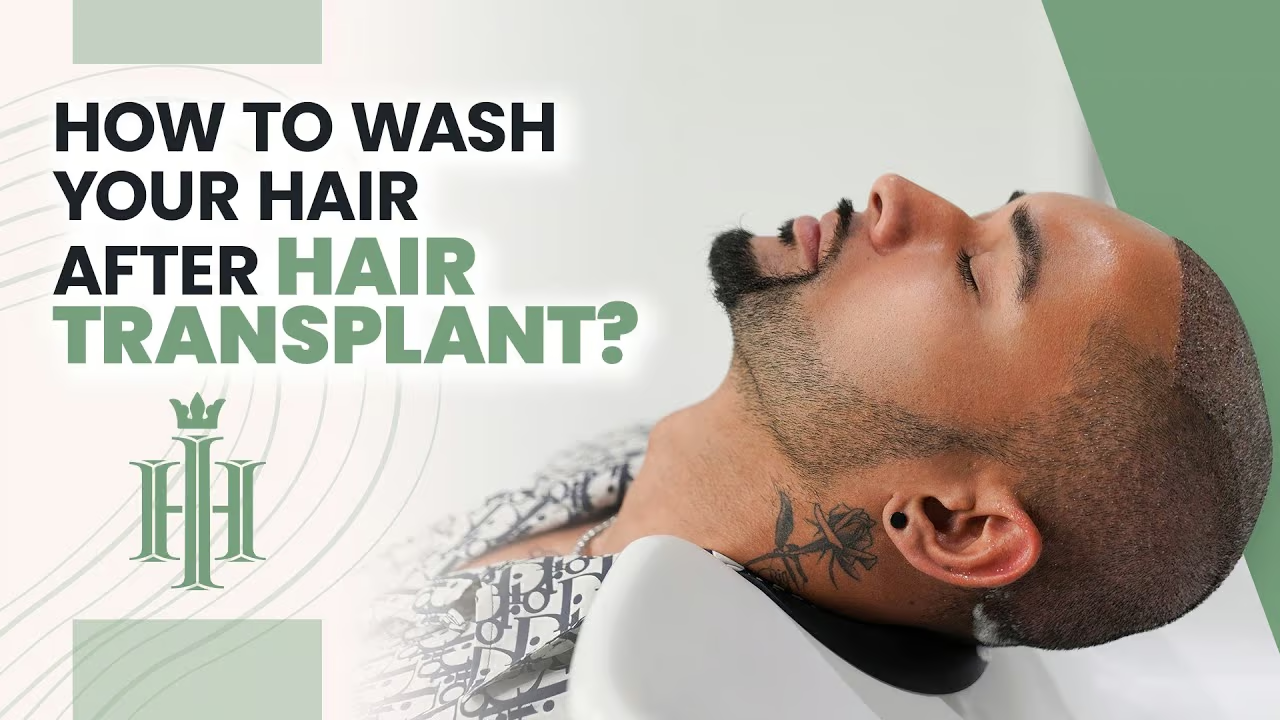
Do not touch the recipient area for 72 hours. Sleep on your back with the head raised for the first three nights. Washing begins on day 3 and continues for 10 days: foam on for 20–30 minutes, rinse, then shampoo lathered in the palm and pressed onto the area without rubbing, rinsed with plenty of low-pressure water. No towel. After the ninth wash the scabs are removed; after the tenth, photographs are sent to the clinic. Sport and swimming wait a month, sauna five months, hair dye eight.
- Straight after the procedure
- Swelling and leakage
- How to sleep
- The first 72 hours
- The day 2 check-up
- What is in the set
- How to wash, step by step
- Scabs and the 9th wash
- What to avoid
- Shock shedding
- Itching and numbness
- Result timeline
- Donor area
- Medication and alcohol
- When to contact us
- Beyond the first year
- Frequently asked questions
- Related pages
Hair Transplant Aftercare Begins the Moment You Leave
Local anaesthetic wears off over several hours, and during that time the scalp gives very little feedback. That is the practical risk on the first evening: a graft can be dislodged by contact that would not normally register as contact at all. Car doors, cupboard doors, pulling a jumper over the head, a hand run through the hair out of habit.
Pillow protection pads are provided at the hotel and should be used. Some of the fluid infiltrated into the scalp during the procedure drains out overnight and may mark the pillow yellow or lightly red. This is expected and is not bleeding.
If a graft comes out
It is not an emergency and it is not usually a disaster. Do not try to put it back, do not press on the area, and do not cover it. Contact the clinic and describe what happened; a single graft displaced on the first night does not change the plan, and knowing about it early is what matters.
Swelling and Leakage in the First Days of Hair Transplant Aftercare
Fluid used during the procedure moves downwards with gravity over the first days, which is why swelling appears in the forehead and around the eyes rather than at the transplanted area itself. It typically peaks on day two or three and resolves on its own by day four. Swelling of this kind looks alarming and is medically unremarkable. Swelling that is one-sided, or still worsening after day four, is a different matter and is listed further down.
Swelling is reduced by keeping the head above the heart and by not letting fluid pool at the front of the skull.
- Keep the head raised, including when resting during the day
- Do not bend forward from the waist — squat instead of stooping
- Avoid standing still for long periods in the first three days
- Drink water steadily; dehydration prolongs the swelling rather than shortening it
How to Sleep After a Hair Transplant
Sleep on your back for the first three nights, with the head and upper body raised to roughly thirty to forty-five degrees. A travel pillow around the neck is the simplest way to hold that position without thinking about it, and it also stops the head rolling sideways in the night.
The recipient area must not touch the pillow. The bandaged donor area at the nape may rest against it — that is what the dressing is for. Patients who sleep face down out of habit should expect the first two nights to be uncomfortable; that discomfort is doing useful work.
The First 72 Hours
Three days is not an arbitrary figure. It is roughly how long the transplanted follicles need to establish a blood supply from the surrounding tissue. Until that has happened, a graft is held in place mechanically and can be removed by water pressure, friction or a fingernail.
| Do not | Until | Because |
|---|---|---|
| Touch the recipient area | 72 hours | Grafts are not yet anchored and come out under almost no pressure |
| Let water reach the scalp | Day 3 | Direct water lifts grafts before the blood supply is established |
| Apply any product not provided | Day 10 | Unknown formulations irritate healing skin and can cause folliculitis |
| Sleep on the front or side | 3 nights | Contact with the pillow is the most common cause of graft loss at home |
The Day 2 Check-Up: Hair Transplant Aftercare at the Clinic
On the second day you return to the clinic. The dressing over the donor area is removed and not replaced, the donor and recipient areas are examined, and the wash routine is explained and demonstrated on your own scalp rather than described in the abstract. Have breakfast beforehand and be ready in the hotel lobby at the time you were given.
If you fly home on day two, the wash is taught at that appointment before the transfer to the airport. If you stay until day three, the first wash is carried out at the clinic on the morning of day three, so that you have seen the whole sequence done correctly once before doing it yourself.
What Is in the Hair Transplant Aftercare Set
The aftercare set contains two products, and only these two are used for the first ten days. They are given in cabin-restricted volumes, which is why a checked bag is needed for the return flight.
Neither product is a cosmetic choice. The foam softens and lifts crusting without any mechanical force being applied to the grafts; the shampoo cleans without stripping. Substituting either one — including for something gentler, more natural or more expensive — changes how the scabs behave and is the most common reason a wash course goes wrong.
| Item | Amount or source | What it does |
|---|---|---|
| Care foam | 150 ml | Softens crusting so it releases without rubbing; the first step of every aftercare wash |
| Care shampoo | 250 ml | Cleans the scalp without stripping; applied after the foam is rinsed |
| Pillow pads | Provided at the hotel | Protect the pillow from drainage in the first nights |
| Travel pillow | Optional, bring your own | Holds the head raised and stops it rolling sideways in sleep |
How to Wash: Hair Transplant Aftercare Step by Step
The aftercare wash starts on day 3 and runs for ten consecutive days without a break. Skipping a day of aftercare does not make the scalp safer; it lets crusting harden, and hardened crusting is what has to be pulled off later. The aftercare sequence below is the same every day for the first nine washes.
The water is lukewarm — not hot — and never directed at the scalp under pressure. Fill a cup and pour, or hold the shower head low and let the water run down. The rule for the whole ten days is that nothing rubs, scrubs or scratches.
- Apply the foam. Cover the recipient area and the donor area with the care foam. Do not massage it in; lay it on.
- Wait 20–30 minutes. This is the part patients cut short, and it is the part that does the work. The foam is softening the crusts so that they release on their own instead of being pulled.
- Rinse the foam off. Lukewarm water, low pressure, poured rather than sprayed. The area is not touched with the fingers at this stage.
- Lather in your palm. Take the care shampoo into your hand and work it into a foam between your palms first. Shampoo is never applied directly to the scalp from the bottle.
- Press the lather on. Bring the foam into contact with the recipient area by touching and pressing with the flats of the fingers. No circular motion, no rubbing, no fingernails.
- Rinse thoroughly. Plenty of lukewarm water at low pressure until no product remains. Residue left on healing skin causes irritation.
Do not dry with a towel. Let the water drip off, or blot with a soft cloth using downward touches without dragging. A hairdryer is not used at any setting during the ten days.
For the donor area the same products are used but the restriction is lighter — the donor area is a healing surface, not a set of loose grafts, and can be cleaned with a little more contact once the dressing is off.
| Stage | What happens | Note |
|---|---|---|
| Days 0–2 | No washing at all | Water does not reach the scalp; the dressing stays on the donor area until day 2 |
| Day 3 | First wash | Carried out at the clinic if you are still in Istanbul, otherwise done by you as demonstrated |
| Days 4–9 | Daily wash, same sequence | Crusting softens and starts to release on its own during rinsing |
| Wash 9 | Scab removal instructions | Separate guidance is given at this point; do not attempt removal earlier |
| Wash 10 | Final wash of the course | Photographs are sent to the clinic so the scalp can be checked before you stop |
Scabs, the Ninth Wash and the Tenth
Small crusts form around each graft within a day and are a normal part of healing. They should come away gradually between roughly day seven and day ten, loosened by the foam rather than lifted by hand. A crust removed early takes the graft with it; the scab is not a covering over the follicle, it is attached to it.
After the ninth wash the scalp is usually ready for the remaining crusting to be cleared deliberately, and specific instructions are given for that. Do not bring it forward because the scalp looks ready. After the tenth wash, send photographs to the clinic — the point is to confirm that nothing has been left behind, because retained crusting keeps the follicle inflamed.
Watch: how the scabs are removed after the ninth wash
Hair Transplant Aftercare: What to Avoid and for How Long
The aftercare restrictions are listed below in full. Where two periods are given for what sounds like the same thing, the difference is real — direct sun and a sunbed are not the same exposure, and the donor area and the recipient area do not heal at the same rate, so their aftercare periods differ.
| Avoid | For how long | Reason |
|---|---|---|
| Touching the recipient area | 72 hours | Grafts are held mechanically until the blood supply establishes |
| Water on the scalp | Until day 3 | Direct water dislodges grafts that are not yet anchored |
| Sexual activity | 7 days | Raised blood pressure and sweating both act on the healing area |
| Alcohol, including beer | 1 week | Interacts with the prescribed antibiotic course and impairs healing |
| Hats, beanies, helmets | 1 month | Friction and heat; short periods are possible after 2 weeks if work requires it |
| Exercise, gym, heavy lifting | 1 month | Sweat and raised pressure; light walking is fine from the start |
| Sea and swimming pools | 1 month | Salt and chlorine on skin that has not finished healing |
| Direct sunlight on the scalp | 2 weeks | New skin burns easily and pigment changes at the recipient area can persist |
| Sunbeds | 1 month | The same exposure, concentrated |
| Shaving the donor area | 1 month | The extraction points are still closing |
| Shaving the recipient area | 3 months | A razor reaches grafts that are still shallow; scissors only, and not before |
| Sauna, steam room, hamam | 5 months | Sustained heat affects follicles well past the point the scalp looks healed |
| Hair dye, chemical treatment and heat styling | 8 months | Chemicals reach the follicle through skin that is still remodelling |
Shock Shedding in Weeks 3 to 8
The hardest part of aftercare is psychological, and it arrives in week three. Between roughly the third and the eighth week, a large proportion of the transplanted hairs fall out. Patients who have not been warned about this find it devastating, which is why it is stated plainly here: the hair falls, the follicle stays. What was transplanted was the follicle, not the hair shaft attached to it, and the shaft is shed while the follicle resets into a growth cycle.
Some of the original hair around the transplanted area may also shed in the same period. That too usually returns. Shedding at this stage is not a sign that the procedure failed — it is the expected sequence, and its absence is no more reassuring than its presence.
Itching, Numbness and Sensitivity
Sensation returns unevenly and takes longer than the skin takes to heal, so these complaints run well past the end of the aftercare wash course. The complaints below are the usual ones and none of them require treatment.
- Itching and sensitivity at the recipient area, usually from the second week and commonly lasting about a month — do not scratch with fingernails; from day 10 the area may be touched with the palm and the pads of the fingers
- Numbness across the donor area or the crown, which can persist for several months and resolves gradually
- Tightness at the nape when the head is turned, common in the first weeks as the donor area settles
- Occasional small pimples at the recipient area as hairs push through — report these rather than squeezing them, particularly if the area is red and tender
The Result Timeline
Growth outlasts aftercare by a year. It is slower than most patients expect and slower than most before-and-after photographs suggest. The table below is the honest sequence; judging the result before month twelve means judging it while it is still incomplete.
| When | What is happening | What you see |
|---|---|---|
| Weeks 3–8 | Transplanted shafts shed, follicles reset | The area looks worse than it did at week 1 |
| Months 3–4 | New hairs begin to emerge | Fine, short and sparse — the first real sign |
| Months 6–9 | Hairs thicken and darken | Density becomes visible to other people |
| Months 9–12 | The bulk of the result is in place | Most patients consider this the result |
| Months 13–15 | Final maturation, particularly at the crown | Texture and direction settle; the result is complete |
Donor Area Care in Hair Transplant Aftercare
Donor area aftercare is simpler than the recipient area. The donor area is dressed at the end of the procedure and the dressing is removed at the day 2 check-up. It is not replaced. The extraction points close over the following days and are usually indistinguishable within two to three weeks at the hair lengths most patients wear.
The donor area follows the same aftercare wash but tolerates more contact, since there are no loose grafts to displace. It should not be shaved with a razor for a month; clippers with a guard are acceptable sooner if the hair length makes them necessary.
Medication, Alcohol and Smoking
Medication is the part of aftercare that has nothing to do with the scalp. What is prescribed at discharge is taken exactly as directed and completed even if the scalp feels fine. The points below are the ones patients most often get wrong.
- Complete the antibiotic course; stopping early because there is no visible problem is what creates one
- No alcohol during the antibiotic course and for at least a week — this includes beer
- Reduce smoking as far as you can, and ideally stop for at least 2 weeks; nicotine constricts the small vessels the grafts are depending on
- Do not stop prescribed blood-thinning medication on your own — it is reviewed together with the prescribing doctor and the Hair of Istanbul medical team
- Painkillers and anti-inflammatories are taken only as advised; do not add over-the-counter products on top without asking
Signs of Infection: When to Contact the Clinic Rather Than Wait
Most of what happens during aftercare is normal and needs no intervention. The signs below are the exceptions, and they are worth a message rather than a wait-and-see.
- Fever above 38 °C, or spreading redness and heat around the recipient or donor area
- Pus, or a discharge that is not the clear or lightly blood-tinged fluid of the first days
- Pain that increases after the third day instead of decreasing
- Swelling that is one-sided, or that is still worsening after day four
- A patch where crusting has not shifted at all by the ninth wash
- Any graft loss you can see happening, particularly in the first week
Send a photograph with the message
A description of a scalp is far less useful than a picture of one. Photograph the area in daylight, from directly above and from the side, without flash. Most concerns raised in the first month are resolved with a photograph and a reply the same day; almost none of them are improved by waiting a week to see whether they settle.
Hair Transplant Aftercare Beyond the First Year
Aftercare effectively ends at the first year, when the transplanted hair begins to behave like the hair it came from. It is cut, dyed, styled and washed normally, and it needs no special aftercare products. What it does still need is protection from sun on the parts of the scalp that show, and the same general conditions any hair depends on: enough water, enough protein, iron and vitamin D within normal range.
Transplanted follicles are taken from an area that is not sensitive to the hormone responsible for pattern hair loss, which is why they persist. The hair around them is not necessarily protected in the same way, and if the underlying loss is still active it will continue. That is a separate question from whether the transplant worked, and it is the reason medical support is sometimes planned alongside surgery rather than after it.
From month three onwards, PRP therapy can be used to support the surrounding hair, and Regenera Activa is an option where thinning is early-stage. Photographs sent monthly make the difference between noticing a change and remembering one.
Hair Growth After a Scalp Fungal Infection
A fungal infection of the scalp inflames the follicle and can cause hair to shed in patches. Whether the hair returns depends on what the infection left behind. Treated while the inflammation is still active, the follicle usually survives and the hair regrows over several months. Left untreated for a long period, the skin becomes smooth and shiny without visible follicle openings — scarring has occurred and that area will not regrow on its own.
This distinction matters before a hair transplant rather than after it. A scalp with a history of fungal infection is examined for two things: whether the infection has fully resolved, and whether the affected area is scarred or simply thinned. Placing grafts into skin with active inflammation puts them at risk. Placing them into scarred tissue is possible, but the blood supply is poorer, graft survival is lower and the plan is adjusted accordingly — sometimes in stages rather than one dense session.
If a fungal infection is diagnosed after a transplant, it is treated as a medical condition first. The transplanted hair is not removed and the plan is not abandoned; the infection is cleared and recovery is reassessed once the scalp is calm.
Returning to Work and Daily Life
Most people take between three and seven days away from work. What decides the number is not the procedure but the job and how visible the recovery needs to be.
- Desk-based work without client contact: three to four days is usually enough. Swelling peaks around day two or three and settles afterwards.
- Work with in-person meetings: seven to ten days is more comfortable. By day ten the crusts have usually cleared and redness is fading.
- Physical work, heavy lifting or dusty environments: two weeks. Sweat, friction and airborne dust are the concerns, not the effort itself.
- Work requiring a helmet or head covering: helmets are avoided for a month; where work makes one unavoidable, short periods are possible from the end of the second week. Pressure and heat on the recipient area are the limiting factors, not the hours worked.
Travel home fits around the same schedule. Most patients fly on day two, after the check-up at the clinic, and some stay until day three so that the first wash is done under supervision. On the flight, a window seat away from the overhead air vent is more comfortable, and in the first ten days a loose hood is easier than a hat.
Scarring After FUE and DHI
Every method that moves a follicle leaves a mark where it was taken from. The question is size and visibility, not presence.
In follicular unit extraction, each follicle is removed individually with a punch under one millimetre. The marks are round and scattered across the donor area, and at conversational distance they are not visible once healed. They become noticeable when the donor area is shaved to a very short guard, or when extraction was performed too densely in one region.
In the recipient area, incisions close without stitches and leave no marks in normal healing. Raised or pitted skin in the recipient area is usually a sign that incisions were made too deep, too wide or too close together.
Older strip surgery leaves a linear scar across the back of the scalp. It can be partly camouflaged with follicular unit extraction into the scar line or with scalp micropigmentation, though the blood supply of scar tissue limits how dense the result can be.
Donor area appearance is decided during the procedure rather than afterwards: how many follicles are taken, how widely they are spread and whether donor capacity is respected.
Detailed Guides on Each Stage of Recovery
The sections above cover what most people need in the first weeks. The guides below go further into single topics, in the order they usually come up.
The first fortnight
- The first wash — when it happens, and why the technique matters more than the timing
- Shampooing and scalp care — product choice, water temperature and pressure
- Recognising a dislodged graft — how to tell a lost graft from a shed crust
- Sleeping position and the neck pillow — how long it is actually needed
Reactions that are part of normal healing
- Redness in the recipient area
- Small spots around emerging hairs
- Numbness and altered sensation
- Pain during and after the procedure
What happens month by month
- The full recovery timeline — day one to month twelve
- Growth stages — shedding, dormancy and regrowth explained
- The three-month mark — the point at which most people worry
Returning to normal habits
- Exercise and the gym
- Alcohol
- Wearing a hat
- The first haircut
- Wax, gel and styling products
- Sun exposure
Medical treatment alongside the procedure
Specific situations
- Aftercare for women — longer hair changes washing and styling advice
Frequently Asked Questions
When does aftercare washing start after a hair transplant?
Aftercare washing begins on day 3. Before that no water should reach the scalp at all. If you are still in Istanbul on day three the first wash is carried out at the clinic; if you fly home on day two, the full sequence is demonstrated on your own scalp before you leave.
How long does the aftercare wash course last?
Ten days. The care foam and care shampoo provided are used every day in the same order, and no other product goes on the scalp during the aftercare course — including shampoos marketed as gentle or natural.
Why does the foam have to stay on for 20 to 30 minutes?
Because that is what softens the crusting. If the foam is rinsed off early the crusts stay hard, and hard crusts have to be pulled rather than released — which takes the graft with them. This is the single most commonly shortened step in aftercare and the one that causes the most avoidable loss.
When do the scabs fall off?
Between roughly day seven and day ten they loosen and come away during rinsing. After the ninth wash you are given specific instructions for clearing what remains. Do not bring that forward, and do not pick at a scab that has not released on its own.
My transplanted hair is falling out. Has the procedure failed?
Almost certainly not. Shedding between weeks 3 and 8 is expected: the hair shaft is shed while the follicle beneath it resets into a growth cycle. New hairs begin to emerge from months 3 to 4. This is the stage at which patients most often panic, and it is the stage at which panic is least warranted.
When can I go back to the gym?
Aftercare puts exercise, weights and anything that causes heavy sweating at one month. Light walking is fine from the start. Swimming waits a month, and sauna, steam room and hamam wait five months — sustained heat affects follicles long after the scalp looks healed.
When can I wear a hat again?
One month. If work requires head covering, short periods are possible after two weeks provided the covering is loose and clean. The problem is friction and trapped heat, not the hat itself.
Can I dye my hair after a hair transplant?
Not for eight months. This is the longest single restriction in aftercare. Colouring, bleaching and chemical straightening all reach the follicle through skin that is still remodelling, and the follicle is more vulnerable than the visible hair suggests.
Is it normal to have no feeling in part of my scalp?
Yes. Numbness across the donor area or the crown is common well beyond the end of aftercare washing and resolves gradually, sometimes over several months. It is the small sensory nerves recovering, not nerve damage, and it does not affect hair growth.
When will I see the final result?
Months 13 to 15. The bulk of the result is in place between months 9 and 12, and density becomes visible to other people between months 6 and 9 — but the crown in particular continues to mature into the second year. Judging the outcome before month twelve means judging something unfinished.
Related Pages
Aftercare is one part of a course that starts well before the procedure. The pages below cover the rest.
| Page | What it covers |
|---|---|
| Hair transplant | The procedure itself: candidacy, planning, technique and what happens on the day |
| FUE technique | Extraction method and donor management |
| DHI technique | Direct implantation and where it is chosen |
| Before and after | Documented results at each stage of the timeline |
| PRP therapy | Medical support for the surrounding hair, from month three |
| Regenera Activa | A regenerative option for early-stage thinning |
| Scalp micropigmentation | Adding visual density where donor capacity was limited |
| Revision hair transplant | Where an earlier procedure fell short of what was planned |
| Medical team | The physicians responsible for planning and follow-up |
| Contact | Reaching the clinic during the recovery period |
