
 en
en TR
TR  SK
SK  ITA
ITA  FR
FR  DE
DE  ES
ES  BG
BG 
Hair Transplants for Men: Complete 2025 Guide
When people search online for hair transplants men often want straightforward answers: Will it work for me? How natural will it look? How long will it last? Modern FUE-based hair transplantation has become a reliable solution for many men with pattern hair loss, but results still depend heavily on the cause of hair loss, donor capacity, technique, and long-term planning.
This guide focuses specifically on hair transplants for men: why men lose hair, who is a good candidate, how FUE and advanced implantation methods work, what recovery looks like, and how to think realistically about long-term outcomes.
Why Men Lose Hair – And How Transplant Fits In
The most common reason men consider hair transplantation is androgenetic alopecia (male pattern hair loss). In this condition, hair follicles in genetically sensitive areas (front, mid-scalp, crown) gradually miniaturise under the influence of DHT (dihydrotestosterone). Over time, hairs become thinner, shorter, and eventually stop growing.
Typical male pattern hair loss patterns include:
- Receding hairline at the temples
- Thinning or a bald spot at the crown
- Combination of frontal recession and vertex thinning
Medical treatments (such as topical and oral medications) aim to slow or partially reverse this miniaturisation in the remaining follicles. A hair transplant does something different: it redistributes DHT-resistant follicles from the permanent donor area into thinning or bald regions to restore coverage and shape.
Are You a Good Candidate for a Hair Transplant as a Man?
Not every man with hair loss is automatically a good candidate. A responsible clinic will assess several factors before recommending surgery.
1. Pattern and Stability of Hair Loss
Ideal candidates usually have:
- A recognisable male pattern (rather than diffuse shedding from a temporary cause)
- A pattern that has slowed or stabilised, especially in younger men
- Clear areas of thinning or balding that can be addressed surgically
Very young patients with rapidly progressing loss may be advised to wait and stabilise with medical treatment first, to avoid designing a hairline that looks unnatural as they age.
2. Donor Area Quality
The permanent donor zone—typically the back and sides of the scalp—provides the follicles for transplantation. A strong donor area has:
- Sufficient density (number of follicular units per cm²)
- Good hair calibre (thicker shafts offer better coverage)
- Stable hair with minimal miniaturisation
Donor analysis is one of the most critical steps in planning. For a deeper understanding of why donor limitations matter so much, see the detailed donor area for hair transplant guide.
3. General Health and Expectations
Men considering surgery should be in generally good health, able to undergo local anaesthesia, and free from uncontrolled systemic diseases or severe scalp conditions. Equally important are expectations:
- Understanding that surgery redistributes existing hair; it does not create new follicles
- Accepting that future hair loss may require medical therapy or additional sessions
- Prioritising naturalness and long-term planning over extreme density in a single session
Hair Transplant Methods Used for Men
Most high-standard clinics today use FUE (Follicular Unit Extraction) as the donor harvesting method for men. The implantation phase can then be performed with different tools and techniques depending on the case.
FUE Extraction for Men
FUE involves removing follicular units individually from the donor area using micro-punches (typically 0.7–0.9 mm). This method:
- Avoids a long linear strip scar
- Leaves small dot scars that are usually inconspicuous with short hair
- Allows more flexible donor management and hair styling
For technical details and indications, refer to the FUE technique overview.
How to Reduce Transection Rate in FUE
DHI Implantation for Men
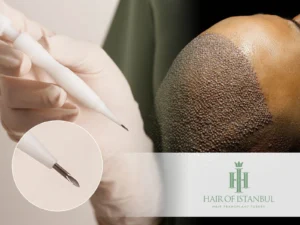
DHI (Direct Hair Implantation) uses implanter pens that allow the surgeon to control angle, direction, and density with precision—especially useful in:
- Refining the frontal hairline
- Working between existing hairs
- Creating dense, natural-looking transitions in visible areas
A full explanation of the method and its advantages can be found in the DHI hair transplant guide.
Other Implantation Techniques (Sapphire, Slit)
Some male patients benefit from micro-channel creation using Sapphire blades or classic Slit techniques, particularly when large areas such as the mid-scalp or crown are being restored. In experienced hands, all three implantation styles (DHI, Sapphire, Slit) can provide excellent results when matched correctly to the patient’s hair type and pattern.
Hairline Design in Men: Naturalness Over Fashion
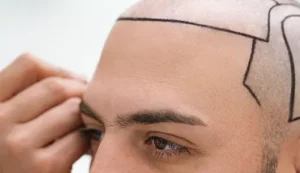
One of the most visible differences between a good and a poor transplant in men is the hairline. A well-designed male hairline considers:
- Age and facial proportions
- Future hair loss patterns
- Shape differences between male and female hairlines
- Natural irregularities (micro- and macro-variation)
Overly low, perfectly straight hairlines may look appealing at age 25 but can appear unnatural at 40 or 50. A strategic approach leaves room for natural ageing while still restoring a strong, masculine frame for the face.
How Many Grafts Do Men Typically Need?
The number of grafts required for a male transplant depends on:
- Current pattern (e.g., mild frontal recession vs. extensive crown involvement)
- Hair calibre and curl (thicker, wavy hair provides better coverage)
- Desired density and hairstyle
- Donor capacity and need for future sessions
For some men, a single session focusing on the hairline and front may be enough. Others with advanced hair loss may need staged procedures over several years to maintain balanced coverage. Clinics with a long-term perspective plan graft usage accordingly rather than extracting the maximum number in one session.
Recovery Timeline for Men After Hair Transplant
Recovery after a hair transplant for men follows the same biological principles as in women, but many male patients are particularly concerned about returning to work, training, or social life as soon as possible.
A simplified timeline:
- Days 1–3: Swelling and redness are most prominent. Sleeping with an elevated head and following early care instructions are crucial.
- Days 4–10: Scabs form and then shed gradually with proper washing. The look becomes steadily more discreet.
- Weeks 2–6: Transplanted hairs shed (shock loss). Some men feel like they are “back to baseline” during this phase.
- Months 3–6: New growth starts to emerge; density slowly increases.
- Months 6–12+: Hair thickens, texture improves, and the final shape becomes clear.
For a more detailed breakdown with photos and milestones, see the hair transplant recovery timeline.
Results in Men: What Is Realistically Achievable?
Men often ask whether a hair transplant can “restore everything.” The honest answer is that success depends on matching expectations to biology and donor limitations.
In suitable male candidates, a transplant can:
- Rebuild a receding hairline
- Thicken the frontal and mid-scalp areas
- Improve coverage at the crown
- Create a more youthful appearance that still looks age-appropriate
However, it cannot:
- Recreate the density of a teenager’s scalp in all areas at once
- Prevent new hair loss from occurring in non-transplanted areas
- Guarantee identical results for every man, even with similar patterns
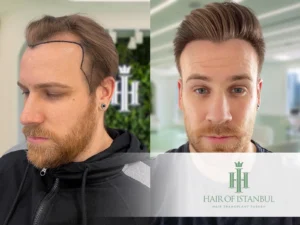
Reviewing real outcomes helps align expectations. For visual examples of different patterns and densities, see the clinic’s before & after hair transplant results gallery.
Do Men Need Medication After a Hair Transplant?
For men with androgenetic alopecia, surgery addresses areas where hair is already lost or severely thinned. The underlying genetic tendency, however, does not disappear. Many men benefit from combining a transplant with:
- Topical treatment to support miniaturising hairs
- Systemic therapy (where appropriate) to stabilise ongoing loss
- Supportive options like PRP in selected cases
The aim is to preserve non-transplanted hair and delay or reduce the need for future surgeries. The exact combination should be decided with a physician who understands your overall health and risk–benefit profile.
Risks and Side Effects for Men
Although hair transplantation is considered minimally invasive, it is still a surgical procedure. Men should be aware of potential short- and long-term risks, which may include:
- Temporary swelling, redness, or discomfort
- Scabbing and itching in donor and recipient areas
- Shock loss of native hairs around the transplant zone
- Small dot scars in the donor area (FUE)
- Rare complications such as infection or poor wound healing
With proper technique and after-care, serious complications are uncommon, but no medical procedure is entirely risk-free.
Independent Medical Reference for Men With Hair Loss
For men trying to understand the broader medical context of hair loss and its treatments (medications, procedures, and lifestyle advice), the American Academy of Dermatology (AAD) provides a comprehensive Hair Loss Resource Center where board-certified dermatologists discuss causes, patterns, and available treatment options for different types of hair loss in men and women.
Conclusion
Hair transplants for men can offer natural, long-lasting improvement when performed on the right candidates using modern FUE techniques and personalised implantation strategies. The key is not only surgical skill, but also honest assessment of donor capacity, careful hairline design, long-term planning, and adherence to evidence-based after-care.
For men considering this step, the most important decisions happen before the first graft is removed: choosing a medically structured clinic, clarifying expectations, and understanding both the potential and the limits of what a hair transplant can achieve over a lifetime.
In properly selected male candidates with adequate donor density and stable patterns of loss, hair transplants are often very effective at rebuilding the hairline and thickening thinning areas. Success depends on both surgery quality and long-term planning.
There is no single “correct” age, but many surgeons prefer to operate when the pattern of loss is more predictable—often mid‑20s or later. Very young men with rapidly progressing hair loss may be advised to first stabilise with medical treatment.
Mild frontal recession may need 1500–2500 grafts, while more advanced patterns affecting the front, mid-scalp, and crown can require 3000+ grafts over one or more sessions. Exact numbers depend on donor density, hair calibre, and goals.
Often yes. Surgery redistributes permanent follicles, but it does not stop genetic hair loss in non-transplanted areas. Many men benefit from ongoing medical therapy to help protect remaining native hair.
Yes, one advantage of FUE is that it leaves tiny dot scars rather than a long strip scar. Many men can comfortably wear short hairstyles, though ultra‑short buzz cuts may still reveal some donor texture depending on skin type and extraction density.
