 en
en TR
TR  SK
SK  ITA
ITA  FR
FR  DE
DE  ES
ES  BG
BG  RO
RO 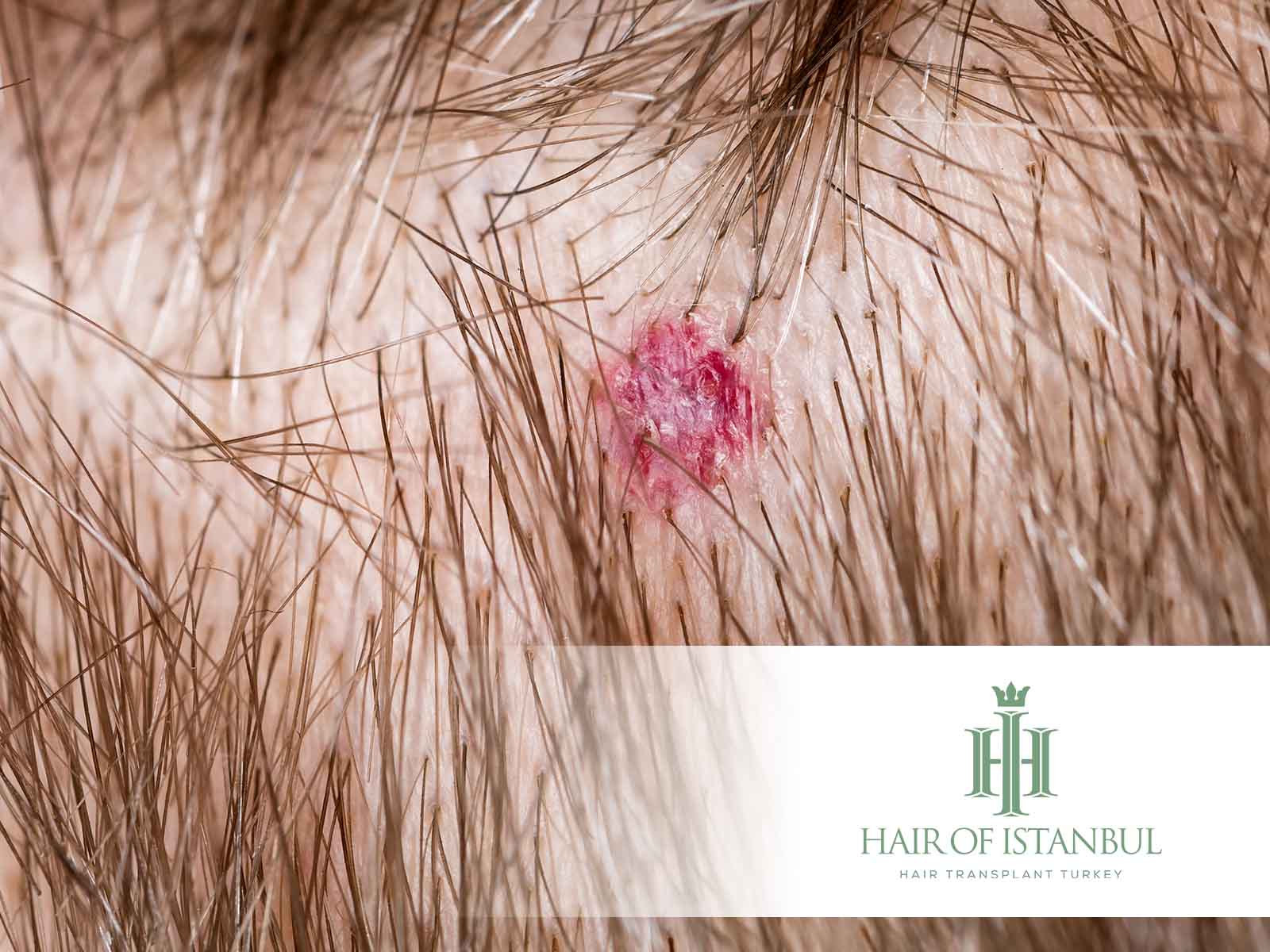
Folliculitis After Hair Transplant: Pimples That Are Not Infection
The pustules that appear on a transplanted scalp in the first weeks are folliculitis after hair transplant — and the single most useful thing to know about them is that they are usually not an infection. Immediate post-operative folliculitis is described in the surgical literature as a sterile foreign body reaction, not a bacterial one, which changes both how worried you should be and what the right treatment is.
Patients search for this as pimples after hair transplant, bumps or spots. It is the same thing. What follows is how common it is, how to tell the harmless kind from the kind that needs a doctor, why popping them is the one thing not to do, and why antibiotics are not the automatic answer.
The short answer
- Folliculitis is common. A large multicentre study reported it in 12.1% of patients; across studies the range runs from 1.1% to 20%.
- Infection is not. Most studies report infection after follicular unit excision at under 1%.
- Early folliculitis is sterile. Lesions in the first week are a foreign body reaction to disrupted sebaceous material and surgical trauma, with negative bacterial cultures.
- It usually settles on its own. The foreign body type is self-limiting and produces no fever or systemic symptoms.
- Do not squeeze them. There is a graft underneath.
Why it is usually not an infection
During implantation, incisions disrupt sebaceous glands. Sebaceous material pushed into the dermis can be read by the immune system as a foreign substance, and the inflammatory response to that is what you see: erythema, papules and pustules around the transplanted follicular units.
That is a reaction to the surgery itself, not to bacteria. The clinical consequence is significant — a pustule that looks alarming, and looks exactly like an infected spot, is in most cases sterile and will resolve without any antibacterial treatment at all.
Telling the two apart
| Foreign body folliculitis | Infective folliculitis | |
| When it appears | Within the first 7 days | After 72 hours |
| How it behaves | Self-limiting | Persists beyond 7 days |
| Systemic symptoms | None | Fever and lymphadenopathy in severe cases |
| Bacterial culture | Negative | Positive |
The two rows that matter to you at home are the middle ones. Duration and systemic symptoms are the dividing line. Spots that appear in the first week and are fading by the end of it are behaving as expected. Spots that are still spreading after a week, or come with fever or tender swollen glands, are a different matter and need to be seen — our page on an infected hair transplant covers that side, including what the term “infected hair plugs” actually refers to.
How common is folliculitis after a hair transplant?
Reported figures vary widely, and the variation is itself informative. A large multicentre retrospective study by Zhou and colleagues found folliculitis in 12.1% of patients. Across the wider literature, immediate post-operative folliculitis is reported anywhere from 1.1% to 20%, depending on surgical technique and post-operative care.
That spread is not measurement noise. It reflects real differences in how procedures are performed and how patients are looked after afterwards — which is why the risk factors below are worth reading before your operation rather than after it.
Where it appears is also documented: in the Zhou study the donor site was involved in 46.7% of cases, the recipient site in 40.3%, and both areas in roughly 13%. Folliculitis in the donor area is not a sign that something different has gone wrong.
When it appears
Immediate post-operative folliculitis typically presents within the first one to seven days. The wider window in which folliculitis is reported after surgery runs from the first one to four weeks.
Spots that appear months later are a separate question — that is usually ingrown hair as new growth pushes through, which behaves differently and is covered on ingrown hairs after a hair transplant.
What makes it more likely
| Risk factor | Whose decision |
| Megasessions exceeding 4,000 grafts | Surgical planning |
| High implantation density above 45 follicular units per cm² | Surgical planning |
| Buried grafts, improper implantation angle, excessive pressure during placement | Surgical execution |
| Thick, coarse or curved hair shafts | Anatomy — not modifiable |
| Delayed post-operative washing beyond 3 days | Aftercare, yours and the clinic’s |
| Procedures performed during summer months | Scheduling |
| Poor scalp hygiene | Yours |
Read the right-hand column. Most of this list is decided in the operating room, not by the patient — graft numbers, density and placement technique. The parts you control are hygiene and starting the wash protocol on time, which is one of the reasons our aftercare protocol begins washing on day three rather than leaving it open.
What to do
- Keep washing on schedule. Delayed washing is a documented risk factor; stopping because the scalp looks angry makes it more likely, not less.
- Gentle cleansing and warm compresses are what the review literature describes for ordinary cases.
- Do not squeeze, pick or pop. Every pustule sits over a graft you paid for and cannot replace.
- Do not scratch. Avoiding scratching is specifically emphasised in the surgical guidance.
- Photograph it. A dated photo each day tells your clinic whether it is settling or spreading far better than a description.
- Tell the clinic. Not because it is an emergency, but because they can tell you which of the two types you are looking at.
The antibiotic question
This is where the evidence has moved, and where a lot of online advice has not.
Because early folliculitis is a sterile reaction rather than an infection, prophylactic antibiotics do not address the mechanism. The review position is that routine antibiotic prophylaxis is not universally recommended, though it may be considered in megasessions or in patients with additional risk factors. For localised lesions, topical antibiotics are among the described treatments.
Antibiotics also carry their own risk. Around 10% of patients with a penicillin allergy show cross-reactivity with first-generation cephalosporins, and the risk of anaphylaxis is put at between 0.0001% and 0.1%. One reported protocol replaced prophylactic antibiotics with a short course of oral steroid from 2014 onward and saw its folliculitis rate fall to 0.7%.
None of this is a self-treatment instruction. It is the reason to ask your operating team what they use and why, rather than starting a leftover course of antibiotics on your own — and the reason a clinic that hands every patient antibiotics by default is not necessarily following current evidence.
When to stop waiting and call
Contact the clinic the same day if any of these appear:
- Fever, or tender swollen glands in the neck.
- Pustules still spreading after seven days rather than settling.
- Increasing pain rather than decreasing.
- Redness spreading outward across the scalp.
- An area of skin darkening or breaking down.
These are the features that separate infective folliculitis, and the rarer serious complications, from the ordinary post-operative kind.
Does folliculitis damage the result?
Raised, uneven graft surfaces are a different finding altogether and are covered on cobblestoning after a hair transplant. Ordinary post-operative folliculitis is self-limiting and does not by itself cost you the graft. What costs grafts is what people do to it — squeezing, picking and scratching in the window when grafts are still fragile.
Persistent or infective folliculitis is a different case and is worth treating properly rather than waiting out, which is exactly why the seven-day mark matters.
Frequently asked questions
Are pimples after hair transplant the same as folliculitis?
Yes. What patients describe as pimples, bumps or spots after a hair transplant is post-operative folliculitis. The everyday word and the clinical word describe the same finding.
Is it OK to pop pimples after hair transplant?
No. There is a graft under each one, and squeezing in the early weeks is one of the avoidable ways to lose it. It also risks introducing bacteria into a lesion that was sterile to begin with.
How long does folliculitis after a hair transplant last?
The foreign body type is self-limiting and generally settles within the first week. Lesions persisting beyond seven days are the ones to have assessed.
Is folliculitis after a hair transplant normal?
Common enough to be considered one of the more frequently reported post-operative findings, at 12.1% in a large multicentre study. Common is not the same as unimportant, but it is a long way from dangerous.
Why do I have pimples on my scalp after hair transplant in the donor area?
Because folliculitis affects the donor area as often as the recipient — 46.7% versus 40.3% of cases in the multicentre data, with about 13% affecting both.
What is the treatment for folliculitis after a hair transplant?
Gentle cleansing and warm compresses for ordinary cases, with topical antibiotics for localised lesions. What is right for you is a decision for the team that operated on you, who can distinguish the sterile type from the infective one.
Do I need antibiotics?
Not automatically. Routine prophylaxis is not universally recommended, and early folliculitis is not usually bacterial. Antibiotics are for confirmed infection, and that is a clinical judgement rather than a self-diagnosis.
Should I stop washing my hair until it clears?
No — the opposite. Delayed post-operative washing beyond three days is a documented risk factor for folliculitis.
I am months post-op and still getting spots. Is this folliculitis?
Possibly, but at that distance ingrown hairs are the more common explanation as new growth breaks through. Persistent lesions months later should be examined rather than assumed.
References
- Romera de Blas C, Vega Díez D, Ricart Vayá JM, Gómez Zubiaur A. Complications in follicular unit excision hair transplantation: current evidence and practical approaches. Frontiers in Medicine, 2026 — folliculitis among the most frequently reported postoperative complications, with an incidence of 12.1% in the multicentre retrospective study by Zhou et al. (donor site 46.7%, recipient site 40.3%, both areas approximately 13%); postoperative infection reported below 1% in most studies; onset within the first 1–4 weeks as erythematous papules or pustules around follicular units, occasionally with mild pain or pruritus; risk factors including megasessions exceeding 4,000 grafts, implantation density above 45 follicular units per cm², delayed postoperative washing beyond 3 days, summer procedures, buried grafts, improper implantation angle, excessive placement pressure, thick coarse or curved hair shafts and poor scalp hygiene; management by gentle cleansing, warm compresses and topical antibiotics for localised lesions, with routine antibiotic prophylaxis not universally recommended. doi.org/10.3389/fmed.2026.1750989
- Tse F, Ng B. Immediate post-operative folliculitis: a foreign body reaction, not an infection. Hair Transplant Forum International, 2025;35(6):193–199 — immediate post-operative folliculitis presenting within the first 1–7 days as erythema, papules and pustules around transplanted follicular units; mechanism described as a sterile foreign body reaction and surgical trauma, with sebaceous material displaced into the dermis perceived as a foreign substance; foreign body folliculitis distinguished from infective folliculitis by onset within 7 days, self-limiting course, absence of systemic symptoms and negative cultures; reported rates from 1.1% to 20%; approximately 10% cross-reactivity with first-generation cephalosporins in penicillin-allergic patients and anaphylaxis risk between 0.0001% and 0.1%; a 3-day oral steroid course adopted in place of prophylactic antibiotics from 2014 with folliculitis incidence falling to 0.7%. doi.org/10.33589/35.6.193
- Complications in Hair Transplantation, Journal of Cutaneous and Aesthetic Surgery — folliculitis described as a foreign body reaction to poorly dissected hairs, treated with topical or systemic antibiotics and antibacterial shampoo; cobblestoning, epidermal cysts and oedema described alongside. pmc.ncbi.nlm.nih.gov/articles/PMC6371733
In short
Folliculitis after a hair transplant is common — 12.1% in the largest multicentre series, and reported anywhere from 1.1% to 20% depending on how the surgery and the aftercare were done. Infection, which is what most people assume they are seeing, runs below 1%. The spots in the first week are usually a sterile reaction to the surgery itself, they settle on their own, and the useful test is duration: fading within seven days is expected, still spreading after seven days is not. Keep washing, do not squeeze, photograph it, and let the clinic decide whether anything more is needed.