
 en
en TR
TR  SK
SK  ITA
ITA  FR
FR  DE
DE  ES
ES  BG
BG  RO
RO 
Cobblestoning After a Hair Transplant: Cause, Timeline and Correction
Medically reviewed by Dr. Mahmut SATEKİN, Medical Aesthetics Physician.
Cobblestoning after a hair transplant is a placement problem, not a healing problem. It describes small raised bumps at the graft sites, giving the recipient area the texture of a cobbled street. The published review of hair transplantation complications is direct about the cause: “placement of the grafts at incorrect depth or into very small slits.” Grafts that sit proud of the surrounding skin instead of flush with it heal as raised points.
This page explains what cobblestoning looks like, how to tell it apart from the ordinary bumps of the first weeks, whether it settles on its own, and what can be done when it does not.
The Short Answer
- What it is: permanent-looking small elevations at graft sites, most visible in raking light or when the hair is very short.
- Cause: grafts placed too high, or into slits too small for them — a surgical technique issue, not something the patient caused.
- Not the same as: the swelling, crusting, pimples and ingrown hairs of the first weeks, which are common and resolve.
- Does it go away: the review states cobblestoning “mostly improves with time”, and in the remainder “the scars may need to be excised.”
- When to judge it: not before 6 to 12 months. Texture continues to settle long after the hair has grown.
- If it persists: options exist, but they are corrective procedures rather than creams.
What Cobblestoning After a Hair Transplant Is
During a transplant, each follicular unit is placed into a recipient site made for it. The intention is for the graft to sit level with the surrounding skin. When a graft is set slightly above that level, or forced into a site too small to receive it, the tissue heals around it in a raised mound. Repeated across hundreds or thousands of sites, the result is a bumpy surface.
The published review puts a figure on the tolerance: grafts should not sit more than one to two millimetres above the surrounding surface. That is the margin between a result that reads as normal skin and one that reads as cobbled.
Two things follow from this. Cobblestoning is decided in the operating room, not during recovery — no amount of aftercare creates or prevents it. And because it is scar tissue architecture rather than inflammation, it does not respond to the treatments that work on the ordinary complications of the first weeks.
What Cobblestoning After a Hair Transplant Looks Like
- Texture, not colour. Small firm elevations at regular intervals, following the pattern of the graft sites rather than appearing randomly.
- Most visible in raking light — sunlight from the side, or a bathroom downlight — and least visible head-on in flat light.
- Most visible with short hair. As transplanted hair grows and thickens, it covers the surface texture. Many patients only notice cobblestoning when they have the hair cut short.
- Firm to the touch, not fluid-filled, not tender, not warm.
- Uniform across the treated area rather than clustered in one spot.
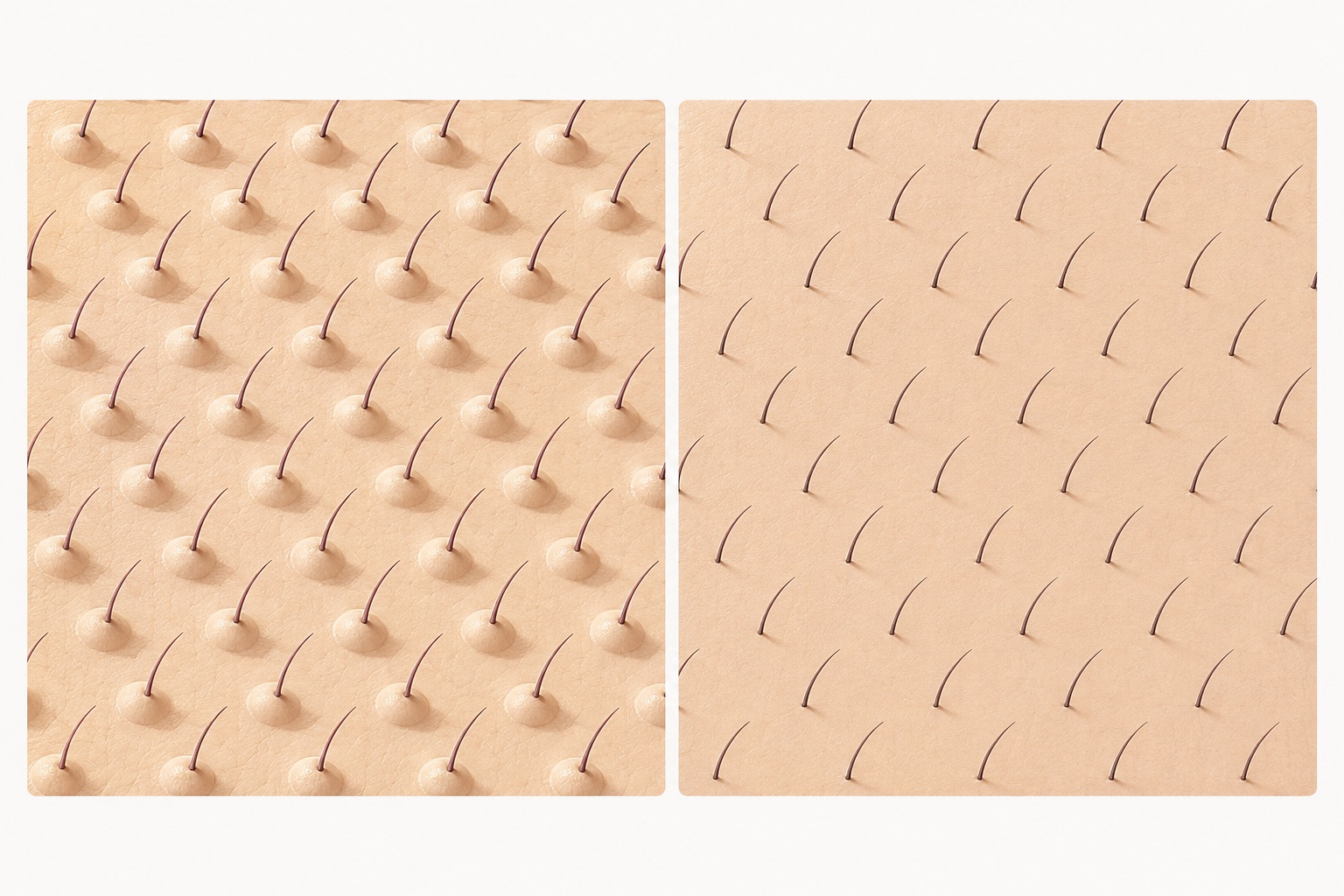
Left: a cobbled surface, each graft site raised and casting a small shadow under side lighting. Right: a normally healed recipient area at the same hair density, flat and without elevations.
Pain, warmth, spreading redness or discharge are not features of cobblestoning. Those point to an inflammatory or infective process instead — see infection after hair transplant.
Cobblestoning vs the Other Bumps of the First Weeks
Most bumps after a transplant are not cobblestoning, and the distinction matters because almost everything else on this list resolves by itself.
| What you are seeing | Likely cause | Timing | Outlook |
|---|---|---|---|
| Small firm raised points at graft sites, uniform, painless | Cobblestoning — placement depth | Visible once crusts clear, persists | Often improves over months; may need correction |
| Crusts and scabs over each site | Normal healing | First 5–10 days | Separate with gentle washing |
| Red spots with a white head, tender | Folliculitis or pimples | Weeks 2–12, often with regrowth | Usually self-limiting — see below |
| A single tender lump under the skin | Ingrown hair or cyst | Weeks 4–16 | Usually resolves; may need drainage |
| Generalised puffiness of forehead and eyelids | Post-operative oedema | Days 2–7 | Resolves; helped by sleeping elevated |
| Redness across the whole recipient area | Normal post-operative erythema | Weeks to a few months | Fades gradually |
Our separate pages cover the ones that are not cobblestoning: folliculitis, pimples, ingrown hairs and redness.
What Causes Cobblestoning After a Hair Transplant
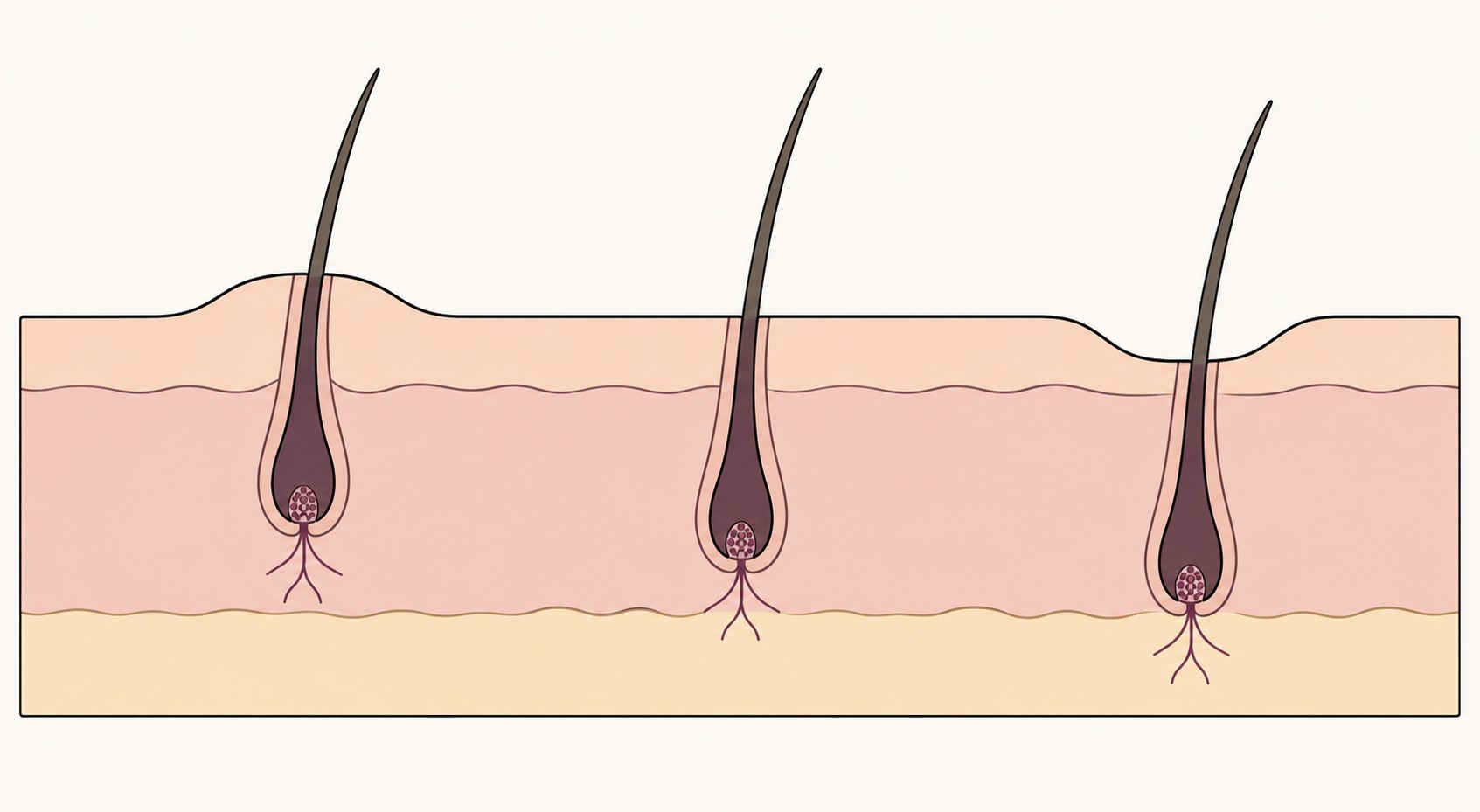
Placement depth decides the surface. Left: the graft sits above the skin and heals as a raised point — cobblestoning. Centre: flush with the surface, healing level. Right: set too deep, leaving a small depression — pitting.
| Factor | How it produces cobblestoning |
|---|---|
| Placement depth | The direct cause. Grafts set above the level of the surrounding skin heal as raised points |
| Recipient site size | Sites made too small for the graft force tissue upward as the graft is inserted |
| Graft trimming | Excess tissue left around the follicular unit adds bulk beneath the surface |
| Placement technique | Rushed or repeated insertion attempts disturb the site and the surrounding skin |
| Operator experience | Placement is the step most dependent on the individual placing the grafts |
| Individual healing | A tendency to raised or hypertrophic scarring makes any elevation more pronounced |
Only the last of these belongs to the patient. The rest are decisions made during the procedure, which is why cobblestoning is treated as a technique-related complication rather than a recovery problem.
Is Cobblestoning Normal?
Some unevenness in the first weeks is normal and is not cobblestoning after a hair transplant. Each recipient site is a small wound; while crusts are present and the tissue is still remodelling, the surface will not be smooth. That settles.
What is not normal is a uniformly bumpy surface that is still there once healing is complete and the hair has begun to grow. At that point the texture reflects how the grafts were placed, and waiting alone will only take it so far.
Published complication reviews do not give a reliable incidence figure for cobblestoning, so any percentage quoted elsewhere should be treated with caution. What the literature does establish is the cause and the tolerance — placement depth, and grafts sitting no more than one to two millimetres above the surrounding surface.
Does Cobblestoning After a Hair Transplant Go Away?
| Stage | What to expect |
|---|---|
| Weeks 1–4 | Surface irregular from crusting and healing. Cobblestoning cannot be assessed yet |
| Months 1–3 | Crusts gone, redness fading. Texture becomes visible for the first time |
| Months 3–6 | Scar tissue remodels; elevations commonly soften |
| Months 6–12 | Growing hair covers the surface. Most patients stop noticing it here |
| After 12 months | What remains is the final texture. This is the point to discuss correction |
The review’s position is that cobblestoning mostly improves with time, and that where it does not, the scars may need to be excised. Both halves of that sentence matter: patience is the first treatment, and it is not always sufficient.
Cobblestoning After a Beard Transplant
Cobblestoning after a hair transplant and after a beard transplant share the same mechanism, and the facial skin makes it more noticeable for three reasons. Facial skin is thinner and more mobile than scalp, so elevations show more readily. Beard hair is coarser and grows at a flatter angle, which needs precise site angulation. And a beard is often worn short, so there is less hair to cover the surface.
The timeline is the same — assessment at 6 to 12 months, not before — and so is the tolerance for placement depth. Shaving over a cobbled surface can be uncomfortable in the early months; an electric razor is easier than a blade until the texture settles.
How Cobblestoning After a Hair Transplant Is Corrected
| Approach | What it does | When it is considered |
|---|---|---|
| Time and observation | Scar tissue remodels; hair growth covers the surface | Always first. Nothing else before 6–12 months |
| Scar excision | Raised scar tissue is removed surgically | Discrete persistent elevations, as the review describes |
| Resurfacing procedures | Smooth the surface layer | Selected cases; carries its own risk to nearby grafts |
| Revision transplant | Grafts replaced at the correct depth, density added to camouflage | When texture and coverage both need addressing |
| Scalp micropigmentation | Reduces contrast so texture is less visible | Camouflage rather than correction |
| Growing the hair longer | Covers the surface entirely | The simplest option, and often enough |
There is no cream, oil, serum or massage that lowers a graft that was placed too high. Anything sold on that promise is not treating the mechanism.
How It Is Prevented
Prevention belongs entirely to the surgical side: recipient sites made to match graft size, grafts trimmed consistently, placement level with the surrounding skin, and enough time given to the placement stage rather than treating it as the fast part of a long day. The step is technique-dependent, which is why the questions worth asking before surgery are about who places the grafts and how many are placed per session — not about which device is used.
From the patient side there is nothing to do differently. Ordinary aftercare, set out on our hair transplant aftercare page, neither causes nor prevents cobblestoning.
When to Contact Your Clinic
- The surface is still uniformly raised after six months, once crusts and redness have gone.
- Individual bumps are enlarging, painful, warm or discharging — that is not cobblestoning.
- Elevations are thickening rather than softening between months three and six, which can indicate hypertrophic scarring.
- You are considering any corrective procedure — the clinic that placed the grafts has the operative record, including site sizes and graft numbers.
Frequently Asked Questions
What does cobblestoning look like after a hair transplant?
Small firm raised points at the graft sites, spaced in the pattern the sites were made in, most visible in side light and with short hair. It is a texture change rather than a colour change, and it is not tender.
Is cobblestoning permanent?
Often not. The published review states it mostly improves with time; where it persists, the scar tissue may need to be excised. Judge the final texture at 6 to 12 months, not before.
How do you fix cobblestoning after a hair transplant?
Time first. After 6 to 12 months the options are scar excision, resurfacing in selected cases, a revision transplant at correct depth, or camouflage with micropigmentation or longer hair. No topical product corrects it.
Does cobblestoning happen after every hair transplant?
No. It is a technique-related complication, not an inevitable stage of healing. Some surface irregularity in the first weeks is normal and is not the same thing.
Did I cause it with poor aftercare?
No. Cobblestoning is determined by how grafts were placed during the procedure. Aftercare affects infection risk and graft survival, not placement depth.
Does cobblestoning happen after beard transplants?
Yes, by the same mechanism, and it is often more visible because facial skin is thinner and beards are frequently worn short. Assessment timing is the same.
Can I hide cobblestoning?
Longer hair covers it in most cases. Scalp micropigmentation reduces the contrast that makes texture visible. Neither changes the underlying surface, but both change how it reads.
What is the opposite — grafts that sit too low?
Grafts placed too deep produce small depressions or pitting rather than elevations, and can also cause ingrown hairs or cysts. Both are placement-depth problems in opposite directions.
References
- Konior RJ et al. Complications in Hair Transplantation. National Center for Biotechnology Information — cobblestoning is caused by “placement of the grafts at incorrect depth or into very small slits”; grafts should not sit more than 1–2 mm above the surrounding surface; cobblestoning “mostly improves with time or the scars may need to be excised”. pmc.ncbi.nlm.nih.gov/articles/PMC6371733
- StatPearls, Hair Transplantation (National Center for Biotechnology Information) — postoperative course: wash without rubbing from 24 hours; remove donor crusts gently at 5 to 7 days; new hairs typically appear after 3 to 6 months, with grafts monitored to maturity over a further 6 to 12 months. ncbi.nlm.nih.gov/books/NBK547740
- American Academy of Dermatology, Hair transplant — patient information on the procedure, recovery and complications. aad.org
In Short
Cobblestoning after a hair transplant is a bumpy recipient-area surface caused by grafts placed above the level of the surrounding skin, or into sites too small for them. It is a technique matter decided during surgery, not a consequence of aftercare, and it is not the same as the crusts, pimples, ingrown hairs or swelling of the first weeks — those resolve on their own. Most cases soften over the first year and are covered as the hair grows; what remains after twelve months is the point at which excision, revision or camouflage is discussed.
If you are unsure whether what you are seeing is cobblestoning or one of the ordinary early complications, photograph it in side light and send it to the clinic that performed the procedure. Our documented hair transplant journey shows how one patient’s recipient area changed month by month across 279 dated photographs, which is a more useful comparison than a single before-and-after pair. Hair of Istanbul is a licensed clinic operating in Ataköy, Bakırköy, Istanbul since 2013; our medical team answers post-operative questions from patients directly, and the wider recovery sequence is set out on our recovery timeline.