
 en
en TR
TR  SK
SK  ITA
ITA  FR
FR  DE
DE  ES
ES  BG
BG  RO
RO 
Hair Transplant After 3 Months: What Is Normal and What Is Not
A hair transplant after 3 months usually looks worse than patients expect, and that is normal. Month 3 is the earliest edge of the window in which transplanted follicles begin to push new hair through the scalp — not the point at which results appear. The US National Library of Medicine’s clinical reference on hair transplantation states plainly that after the implanted hairs shed in the first days, “new hairs typically appear after 3 to 6 months”, and that grafts continue to mature for a further 6 to 12 months of follow-up.
This page explains what is genuinely happening under the scalp at month 3, what a hair transplant after 3 months should and should not look like, how to photograph your own progress honestly, and the small number of findings that are worth a call to your clinic rather than another month of waiting.
Hair Transplant After 3 Months: The Short Answer
At 3 months after a hair transplant, most patients are in the gap between shedding and growth. The transplanted hairs fell out weeks ago, the follicles beneath the skin are alive but resting, and only a minority of them have re-entered active growth. What is visible is usually a thin, patchy scatter of very short, fine hairs — often lighter in colour than the surrounding hair — over a recipient area that still looks emptier than it did on the day of surgery.
- Normal at month 3: sparse, fine, short regrowth; uneven coverage; the recipient area still looking thin; the donor area cosmetically healed.
- Also normal at month 3: no visible regrowth at all. Growth beginning at month 4, 5 or 6 is inside the documented range.
- Not the goal at month 3: density, style, or a result you would photograph for anyone else.
- Worth a clinic call: pain, spreading redness, pus, or new hair loss outside the operated areas — not slow growth.
Why Month 3 Feels Like the Hardest Stage
Month 3 is where patient satisfaction reaches its low point, and the reason is arithmetic rather than surgery. In the first two weeks the recipient area is covered with the transplanted hairs themselves, so it looks full. Those hairs then shed. By week 8 the area is emptier than before the operation, and by month 3 the replacement growth has barely started. The scalp is at its visual minimum precisely when the patient has been waiting longest.
Understanding this is what keeps people from making poor decisions at this stage — abandoning aftercare, buying unproven products, or booking a second procedure long before the first one has had a chance to show what it did. Nothing about a hair transplant after 3 months can tell you whether the operation succeeded.
Hair Transplant After 3 Months and the Hair Growth Cycle
Transplanted follicles are not implanted mid-growth. The surgical handling pushes them into the resting (telogen) phase, and they must re-enter the growing (anagen) phase before any hair appears. Once a hair does start growing, scalp hair extends at a well-documented rate: about 0.35 mm per day, roughly 1 cm per month, or 15 cm per year.
That number is the whole explanation for why month 3 looks the way it does. A hair that emerges on the first day of month 3 is one centimetre long by month 4 — barely stubble. The table below applies the same 1 cm per month to different emergence dates.
| If a transplanted hair emerges in… | Approx. length at month 6 | at month 9 | at month 12 |
|---|---|---|---|
| Month 3 | ~3 cm | ~6 cm | ~9 cm |
| Month 4 | ~2 cm | ~5 cm | ~8 cm |
| Month 5 | ~1 cm | ~4 cm | ~7 cm |
| Month 6 | just emerging | ~3 cm | ~6 cm |
Because follicles do not all wake at once, your head at month 6 contains hairs from every row of that table simultaneously. That is why coverage builds gradually rather than appearing on a single date, and it is covered in more detail in our guide to the hair growth cycle.
How the Hair Looks 3 Months After a Hair Transplant
The regrowth visible on a hair transplant after 3 months rarely looks like the hair a patient expected. Early transplanted hairs are typically:
- Thin and wispy. The first cycle after transplantation often produces a finer shaft than the follicle will eventually make. Calibre improves over subsequent cycles.
- Lighter in colour. Pigmentation frequently lags behind growth, so the first hairs can look pale or colourless against darker native hair.
- Curled or misdirected. Some early hairs grow in an unexpected direction before settling into the angle in which they were placed. This corrects itself as the shaft lengthens and gains weight.
- Unevenly distributed. One patch may be visibly ahead of the patch beside it.
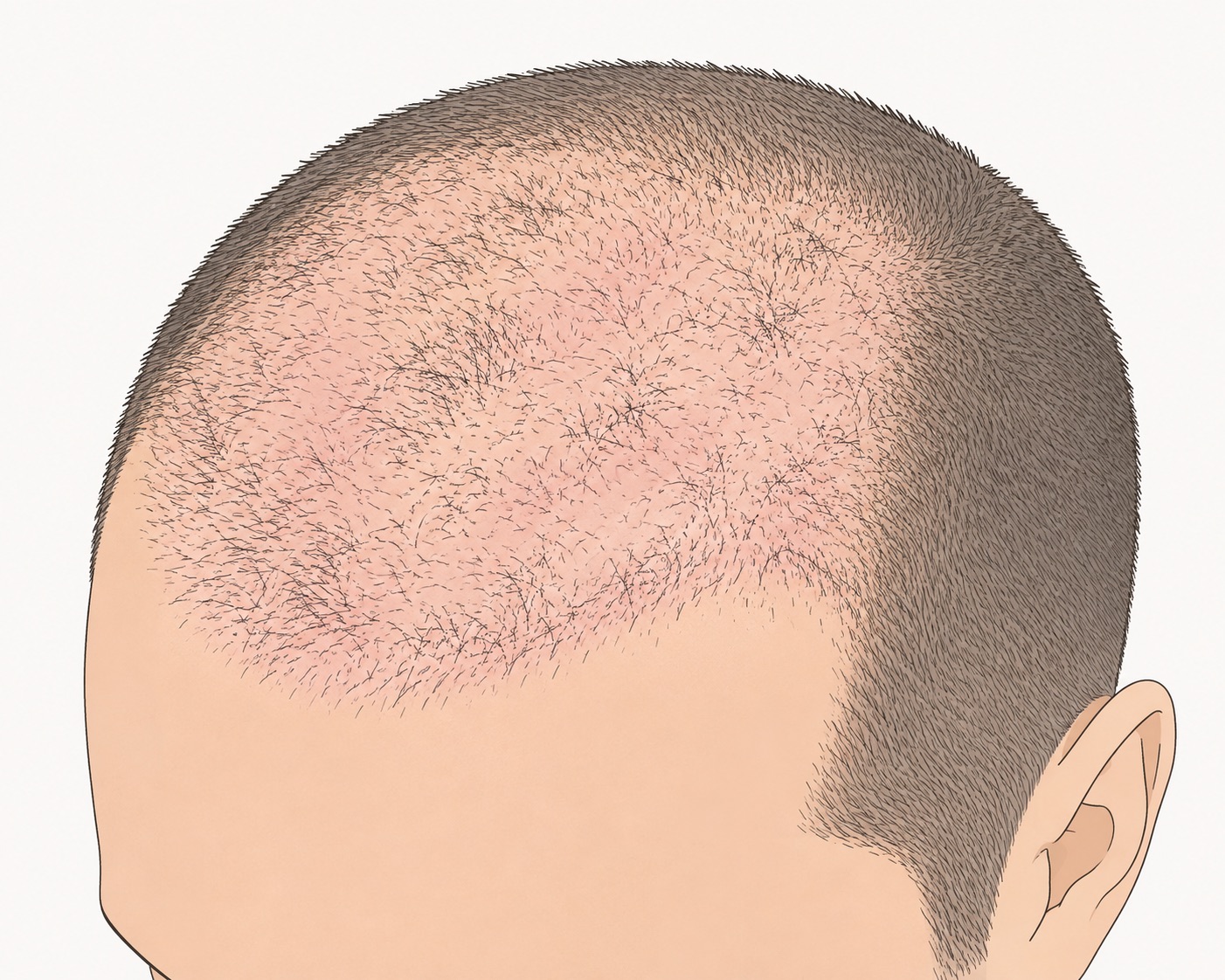
Month 3: short, fine hairs coming through unevenly, with the scalp still clearly visible between them. This is what the stage normally looks like — it is not a poor result.
None of these is a sign of graft failure. They are features of a first post-transplant growth cycle, and they resolve as the follicles complete that cycle over the following months.
Shock Loss Before Month 3: A Normal Process
Two separate sheds happen in the first quarter. The transplanted hairs shed within days to weeks — the graft stays, the shaft goes. Separately, some native hairs around the recipient or donor area can shed, a localised telogen effluvium triggered by the surgery. A published case series in the International Journal of Trichology documented exactly this pattern after hair transplantation and managed it with reassurance and follow-up alone, without treatment.
By 3 months, both sheds are normally finished. If hair is still actively falling from areas that were never operated on, that is not surgical shock loss and deserves a dermatological opinion rather than more waiting. Our encyclopedia entry on shock loss after hair transplant sets out the distinction in detail.
What Results Should You Expect at 3 Months?
The honest answer for a hair transplant after 3 months is: a beginning, and often not even that. Set against the documented 3-to-6-month window for new hairs to appear, month 3 is day one of the earliest possible outcome, not a checkpoint you can fail.
| Stage | What is realistic | What it means |
|---|---|---|
| Month 3 | Sparse fine stubble, or nothing yet | Follicles re-entering growth; no conclusion possible |
| Months 4–6 | Most follicles active; density visibly increasing | The first stage where progress is genuinely readable |
| Months 6–9 | Coverage established; shafts thickening | The result starts to resemble the plan |
| Months 9–18 | Calibre, direction and density mature | Final assessment point |
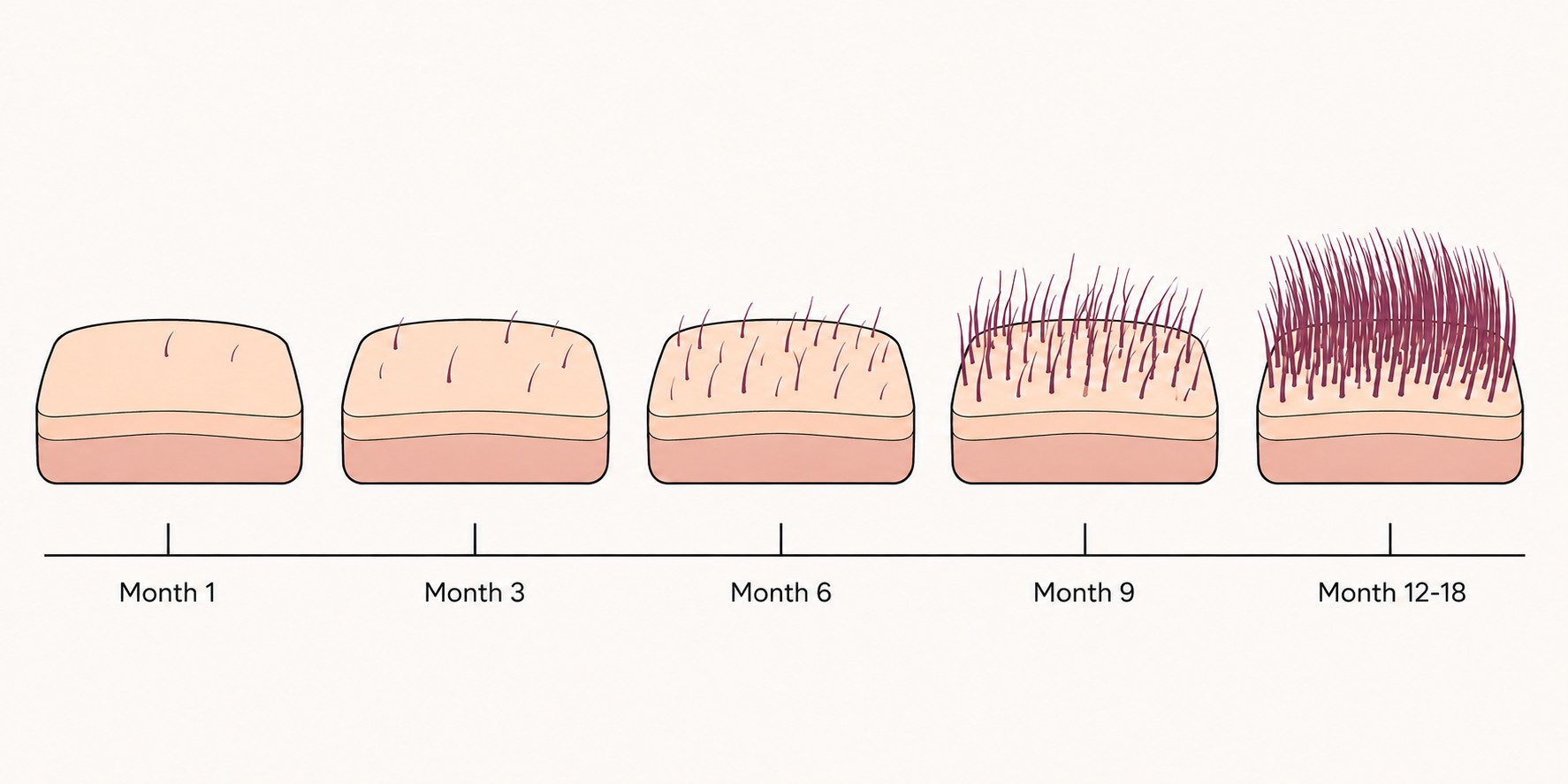
Month 3 sits at the very start of the growth window. Most of the change happens between months 4 and 9, and the result matures through months 12 to 18.
If you want to compare against verified patient outcomes rather than stock photography, our before and after gallery shows results at their mature stage. For month three specifically, our documented hair transplant journey follows one 4,500-graft patient through 279 dated photographs — the first six months almost daily — so you can see the stage rather than read about it.
3 Months After Hair Transplant Photos: How to Read Your Own
Most of the anxiety at this stage comes from comparing photographs that are not comparable. A month-3 photo taken under a bathroom downlight, with wet hair, from above, will look dramatically worse than a month-0 photo taken in daylight from the front — even if the transplant is progressing perfectly. Fine, pale, one-centimetre hairs are close to invisible in poor light.
If you are going to track your own progress with 3 months after hair transplant photos, make them measurable:
| Variable | What to fix | Why it matters |
|---|---|---|
| Light | Same window, indirect daylight, no flash | Overhead light exaggerates scalp show-through |
| Angles | Front, top, both sides, back — the same five every time | Crown and hairline change at different rates |
| Hair state | Dry and unstyled | Wet hair clumps and makes any scalp look barer |
| Distance | Same distance, no zoom | Zoom changes apparent density |
| Interval | Once a month, not weekly | At 1 cm per month, weekly change is unmeasurable |
Compare month 3 against month 6, not against last week. That is the interval at which real change becomes visible.
Recipient Area at Month 3: Redness, Tingling and Sensitivity
Mild residual pinkness in the recipient area can persist at 3 months, particularly in fair skin and in patients who had a high graft count. It fades gradually and is not itself a problem. Intermittent tingling, itching or patches of reduced sensation are also common at this stage and reflect the slow regeneration of small cutaneous nerves.
What is not expected at 3 months: pain, warmth, tenderness, spreading redness, or discharge. Those are signs of an inflammatory or infective process and should be assessed, not tolerated.
Donor Area After 3 Months
The donor area is usually the most reassuring part of a hair transplant after 3 months. With modern follicular unit extraction, the extraction points have long since closed, and the surrounding hair has grown enough to cover them at ordinary hair length. Some patients notice the donor looking slightly thinner than before — the result of the same localised shedding described above, and of the grafts that were legitimately removed.
By month 3 the donor should be settled: no scabbing, no open points, no ongoing shedding. Persistent thinning or visible patchiness in the donor at this stage is worth reviewing with your surgeon, and our page on the donor area for hair transplant explains how donor capacity is assessed and protected.
Does Hair Grow Unevenly at 3 Months?
Yes, and on a hair transplant after 3 months it is the rule rather than the exception. Follicles re-enter the growth phase individually, not in formation, so month 3 typically shows islands of stubble beside areas with nothing. The hairline often lags behind the mid-scalp because it is the last area to be planted and receives the finest single-hair grafts. The crown, with its whorl pattern, characteristically looks patchier for longer.
Uneven growth at 3 months is not evidence of uneven placement. Judging symmetry before month 9 is not meaningful.
What If There Is No Growth at 3 Months?
No visible growth at 3 months is within the normal range and is not, on its own, a sign that anything went wrong. The published window for new hairs to appear extends to 6 months. The table below separates what warrants patience from what warrants contact.
| Finding at 3 months | Interpretation | Action |
|---|---|---|
| No visible regrowth | Inside the documented 3–6 month window | Wait; reassess at month 6 |
| Patchy, uneven stubble | Follicles waking individually | Wait; reassess at month 9 |
| Fine, pale, curled hairs | First-cycle characteristics | Normal; calibre improves |
| Persistent redness with pain or discharge | Possible infection or inflammation | Contact your clinic promptly |
| Ongoing loss outside operated areas | Not surgical shock loss | Dermatological assessment |
| Donor still shedding or patchy | Needs review | Contact your surgeon |
Graft survival is judged at 12 to 18 months. Any clinic that offers to assess success — or to sell a second procedure — at month 3 is working outside the evidence.
Exercise, Styling and Haircuts at 3 Months
By the time of a hair transplant after 3 months the surgical restrictions are effectively over. Grafts are secure well before this point, the scalp has healed, and full-intensity training, swimming and contact sport are normally permitted. The one sensible caution is avoiding direct friction or impact on the recipient area — helmets, headgear and headlocks — and our guide to exercise after hair transplant sets out the staged return.
Cutting is also safe at 3 months, with one practical restriction: use scissors, not clippers, over the recipient area, and tell your barber where the transplant was. A very short clipper grade will simply expose scalp that the emerging hairs are not yet long enough to cover, which makes month 3 look worse for no benefit. Dye, heat styling and strong products are best left until growth is established — see haircut after hair transplant for the detail.
How to Support Growth After Month 3
After a hair transplant after 3 months there is no intervention that makes transplanted follicles emerge faster than their own cycle allows. What can be done is to avoid the things that hold them back and to protect the native hair that is still competing for the same scalp:
- Continue any medical therapy your clinic prescribed. Treatment for ongoing androgenetic hair loss protects the untransplanted hair; stopping it undoes the surrounding density while the grafts are still growing in.
- Eat normally and adequately. Rapid weight loss and restrictive dieting can trigger telogen effluvium of their own and will confuse the picture at exactly the wrong time. Supplements only correct a deficiency you actually have — including collagen supplementation, where more is not better.
- Protect the scalp from sun. New skin over the recipient area burns easily; a hat or sunscreen is worth the habit.
- Wash normally. Gentle daily washing is correct at this stage. Avoiding washing does not protect grafts and encourages scaling.
- Stop reading the scalp daily. At 1 cm per month, daily inspection produces anxiety and no information.
Whether the procedure was performed with FUE or DHI does not change this timeline. Technique affects how grafts are extracted and placed, not how fast a follicle completes its cycle.
Where Month 3 Sits in the Full Hair Transplant Timeline
Month 3 is one stage of a process that runs to 18 months. If you want the whole sequence rather than this single checkpoint, our hair transplant growth stages guide covers the journey stage by stage, and the hair transplant recovery timeline covers healing from day one.
Frequently Asked Questions About Hair Transplant After 3 Months
Is it normal to see no growth on a hair transplant after 3 months?
Yes. Clinical reference sources place the appearance of new hairs at 3 to 6 months after surgery, so month 3 is the earliest edge of that window rather than a deadline. No growth at 3 months is common and does not predict the final result.
How much hair should have grown 3 months after a hair transplant?
Scalp hair grows at approximately 1 cm per month, so any hair that emerged during month 3 will be a few millimetres to one centimetre long. Coverage at this stage is measured in stubble, not density.
Why does my hair transplant look worse at 3 months than before surgery?
Because the transplanted hairs have shed and their replacements have not yet arrived, and because surgery can push some native hairs into a temporary resting phase at the same time. The recipient area is at its visual minimum at around weeks 8 to 12.
Why are my new hairs thin, pale and curly at 3 months?
The first growth cycle after transplantation commonly produces a finer, less pigmented, sometimes misdirected shaft. Calibre, colour and direction normalise over the following cycles.
Can I have a haircut 3 months after a hair transplant?
Yes. Use scissors rather than clippers over the recipient area and avoid very short grades, which expose scalp the new hairs cannot yet cover.
Is the donor area supposed to still look thin at 3 months?
Slight thinning can persist while shed native hairs regrow, but the extraction points should be closed and covered. Ongoing shedding or visible patchiness in the donor at 3 months should be reviewed by your surgeon.
When can I judge whether my hair transplant worked?
At 12 to 18 months. Grafts continue to mature for 6 to 12 months after growth begins, so month 3 carries no diagnostic weight.
Does the 3-month stage differ between FUE and DHI?
No. Both place follicular units that must re-enter their own growth cycle. The extraction and implantation method does not shorten the biological timeline.
References
The timings on this page are taken from independent clinical sources rather than from clinic marketing:
- StatPearls, Hair Transplantation (National Center for Biotechnology Information): implanted hairs shed within days; new hairs typically appear after 3 to 6 months; grafts are monitored to maturity over a further 6 to 12 months. ncbi.nlm.nih.gov/books/NBK547740
- StatPearls, Physiology, Hair: scalp hair grows at about 0.35 mm/day, 1 cm/month, or 15 cm/year. ncbi.nlm.nih.gov/books/NBK499948
- Localized Telogen Effluvium Following Hair Transplantation, International Journal of Trichology: post-surgical localised shedding documented and managed with reassurance and follow-up. pubmed.ncbi.nlm.nih.gov/29606820
- NHS, Hair loss: general patient information on causes and treatment of hair loss. nhs.uk/conditions/hair-loss
In Short
A hair transplant after 3 months shows sparse, fine, pale, unevenly distributed stubble — or nothing at all — over a recipient area that still looks thin. Both pictures are normal. New hairs are documented to appear between months 3 and 6, grow at about 1 cm per month, and mature over 12 to 18 months. Month 3 tells you the shedding phase is over; it tells you nothing about the result. The only findings that justify contacting your clinic at this stage are pain, spreading redness, discharge, or hair loss outside the operated areas.
Hair of Istanbul is a licensed clinic operating in Ataköy, Bakırköy, Istanbul since 2013; you can read about our medical team, hair transplant cost in Turkey, and about Hair of Istanbul. If you are at month 3 and unsure whether what you are seeing is normal, send us your photographs — a review costs nothing and is more useful than another month of guessing.