 en
en TR
TR  SK
SK  ITA
ITA  FR
FR  DE
DE  ES
ES  BG
BG  RO
RO 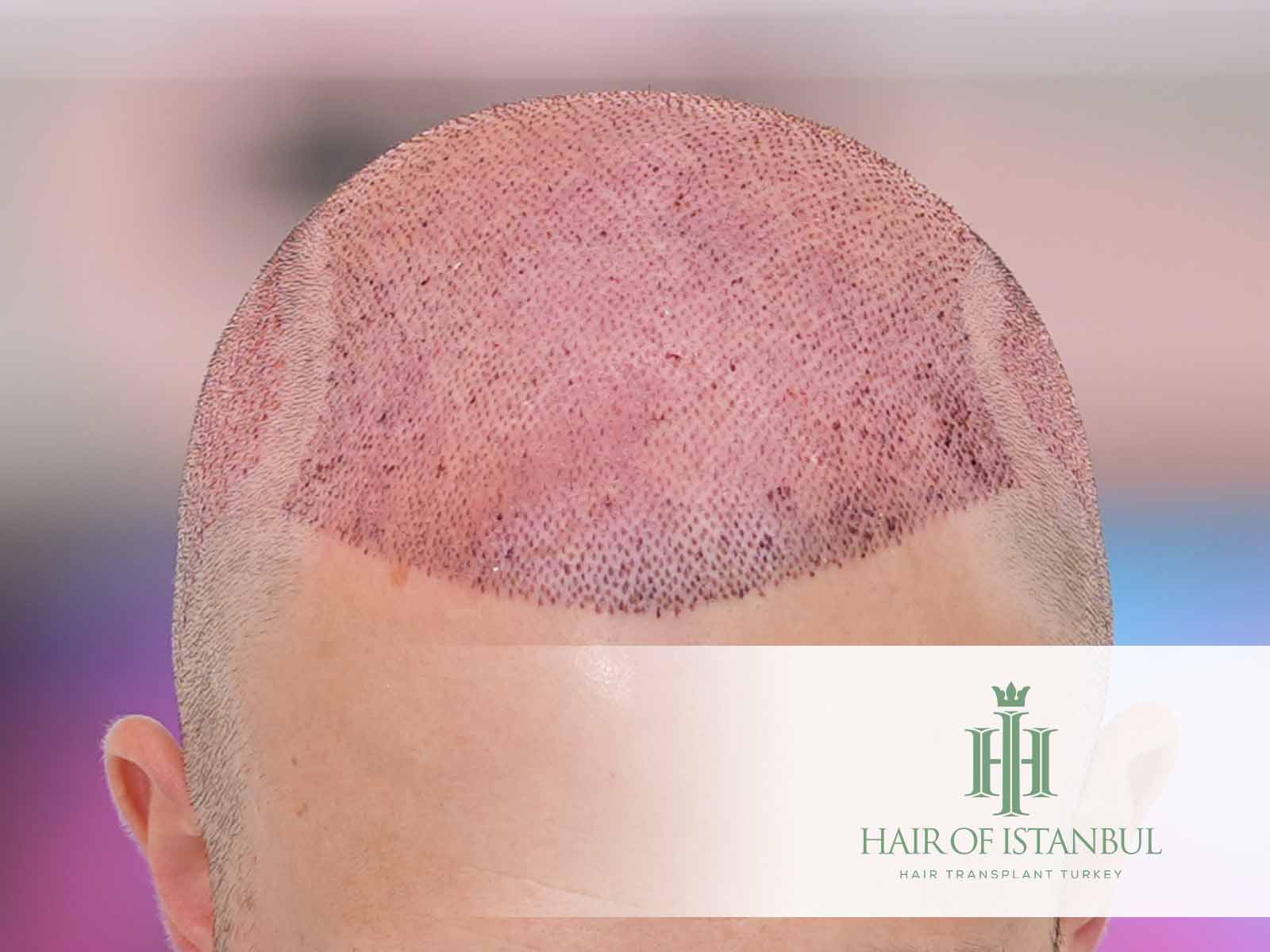
Redness After Hair Transplant: How Long It Lasts
Redness after hair transplant surgery is expected, and it is the symptom most often mistaken for a problem. The recipient area has thousands of small wounds in it; skin responds to that by becoming inflamed, and inflammation looks like redness.
The useful questions are how long it should last, what makes it look worse temporarily, and how to tell ordinary healing from something that needs attention.
The short answer
- It is normal and near-universal in the first weeks, in both the recipient and donor areas.
- It usually fades over two to eight weeks, gradually and unevenly rather than all at once.
- It gets briefly worse after washing — measured, expected, and not a sign of damage.
- Redness with pus, warmth or pain is a different matter and should be photographed and sent to your clinic.
Why redness after hair transplant happens
Two separate things are happening.
In the recipient area, each graft sits in an incision. Wound healing brings increased blood flow to the area, and because the incisions are dense and the skin between them is thin, the whole zone reads as pink or red rather than as individual points.
In the donor area, extraction leaves small circular wounds that heal by contraction. The redness there is usually more even and often fades sooner, though it can be more noticeable in someone who keeps the back of the head very short.
Neither is a complication. A systematic review of 45 studies recorded 442 complications among 2,353 patients, and the framing in the surgical literature is that most complications are preventable and follow from planning or technique — not from the ordinary inflammatory response that every wound produces.
How long does redness last after a hair transplant?
| Period | What is usual |
|---|---|
| Days 1–7 | Marked redness with crusting; most visible stage |
| Weeks 2–4 | Crusts gone, redness persists and often looks pinker without them |
| Weeks 4–8 | Fading unevenly; patches settle at different rates |
| Beyond 3 months | Most people are back to normal colour. Persisting redness is worth reviewing |
Two variables move this. Fairer skin shows redness longer because the contrast is greater, not because healing is slower. And density matters — a densely packed frontal zone stays pink longer than a lightly filled crown.
Where this sits alongside everything else in the same months is set out on growth stages, the recovery timeline and hair transplant after 3 months.
Why it looks worse right after washing
This alarms people, and it is measurable rather than imagined.
In a multicentre study of postoperative scalp care following a structured ten-day washing protocol, investigator-assessed erythema increased transiently after washing — from 1.90 ± 0.62 to 2.81 ± 1.21 on the scale used — and this was not associated with burning, itching or pain. No adverse events were recorded.
So a scalp that looks redder for an hour after the wash is behaving as expected. Washing itself is not the problem; skipping it is worse, because persistent crusts can delay healing and raise infection risk. The schedule is on shampoo after hair transplant.
Redness that is not just healing
The differential matters, because two of the alternatives are common and one needs treating.
| What you see | Likely explanation |
|---|---|
| Diffuse pink or red across the whole recipient area | Ordinary postoperative inflammation |
| Individual red bumps, some with a white head | Folliculitis — sterile in 23.29% and bacterial in 10.96% of one 73-patient series |
| Spreading redness with warmth, swelling, pain or discharge | Possible infection — contact the clinic the same day |
| Red, flaking, itchy skin weeks later | More likely dry scalp or seborrhoeic irritation than infection |
Infection is uncommon in this surgery, but it is the one item on that list where waiting to see costs something.
Covering it up
Awkwardly, the obvious solution is not available: hats are not permitted for the first month, for reasons set out on hats after hair transplant. Nothing is applied to the recipient area either, so make-up and concealers are out during the early period.
What is left is timing and light. Redness is most conspicuous in bright direct light and in photographs with flash. Most people plan two to three weeks away from anything that matters, which is the same reasoning behind planning surgery around your calendar — covered on best season for hair transplant.
Hair concealer fibres and dyes are a separate question and wait far longer; dye specifically waits eight months in our protocol.
What helps, and what does not
- Follow the washing schedule. It is the one intervention that has been studied here, and skipping washes to “let it calm down” delays healing.
- Keep it out of strong sun. Not because sun prolongs redness in a proven way, but because the area is healing skin that cannot be covered with a hat.
- Do not apply anything you were not given. Creams, aloe, oils and cooling gels on a fresh recipient area are how avoidable problems start.
- Do not rub it. Redness plus itching invites scratching, which is the commonest self-inflicted injury after this operation — see rubbing your head after a hair transplant.
There is no cream, supplement or device with evidence for making postoperative erythema resolve faster. Time and the protocol are the treatment.
When to contact the clinic
- Redness spreading beyond the operated area
- Warmth, swelling, throbbing pain or any discharge
- Fever
- Redness that is worsening after the first week rather than settling
- Redness still marked beyond three months
Photographs in daylight, from the same angle each time, are far more useful than descriptions. Send them rather than waiting for a scheduled review.
Frequently asked questions
How long does redness last after a hair transplant?
Usually two to eight weeks, fading unevenly. Most people are back to normal colour within three months. Fairer skin shows it longer because the contrast is greater.
Is redness after a hair transplant normal?
Yes, in both the recipient and donor areas. It is the ordinary inflammatory response to thousands of small wounds, not a complication.
Why is my scalp redder after washing?
Because erythema rises transiently after washing. In a multicentre study it increased from 1.90 to 2.81 on the scale used, without burning, itching or pain. It settles within the hour.
Is redness a sign of infection?
Not by itself. Infection presents with redness that spreads, plus warmth, swelling, pain or discharge. Individual red bumps are more likely folliculitis, which was sterile in 23.29% and bacterial in 10.96% of one 73-patient series.
How can I hide the redness?
Not with a hat for the first month, and not with make-up or concealer on a healing recipient area. Timing and avoiding bright direct light are the practical options.
Will redness affect my result?
No. It reflects healing rather than graft survival. What matters for the result is following the protocol, not how pink the area looks at week three.
What if redness lasts more than three months?
Uncommon and worth reviewing. Send daylight photographs from a consistent angle so the trend can be judged rather than a single moment.
References
- Meyer T, Fernández-González P, Shafiq-Sánchez A, et al. Early removal of post-operative scabs after follicular unit extraction using a 2% salicylic acid keratolytic shampoo: a multicentre descriptive pilot study. Front Med. 2026;13:1741064. PMID 42145713. pubmed.ncbi.nlm.nih.gov
- Loganathan E, Sarvajnamurthy S, Gorur D, et al. Complications of hair restoration surgery: a retrospective analysis. Int J Trichology. 2014;6(4):168–172. PMID 25368473. pubmed.ncbi.nlm.nih.gov
- Nadimi S. Complications with Hair Transplantation. Facial Plast Surg Clin North Am. 2020;28(2):225–235. PMID 32312509. pubmed.ncbi.nlm.nih.gov
- Khatib M, Skorochod R, Wolf Y. Complications Following Hair Transplantation: A Systematic Literature Review and Meta-Analysis. Aesthetic Plast Surg. 2025;49(23):6393–6405. PMID 40913181. pubmed.ncbi.nlm.nih.gov
In short
Redness after hair transplant surgery is the ordinary inflammatory response to thousands of small wounds, and it is near-universal in the first weeks. It usually fades over two to eight weeks, unevenly, and shows longer on fairer skin because the contrast is greater rather than because healing is slower. It rises briefly after each wash — that has been measured, and it comes without burning, itching or pain — so washing on schedule is right even when the scalp looks worse for an hour afterwards. What separates healing from a problem is spread, warmth, pain and discharge. Nothing accelerates the fading, and there is no hat for the first month, so the practical plan is two to three weeks away from bright light and anything that matters.
If the redness is spreading or worsening rather than settling, send us daylight photographs the same day.