
 en
en TR
TR  SK
SK  ITA
ITA  FR
FR  DE
DE  ES
ES  BG
BG Hair Transplant: How It Is Planned, How It Is Performed and What Determines the Result
Hair transplant surgery transfers healthy follicular units, taken from the donor area at the back of the head and around the temples, to regions affected by permanent hair loss. The procedure does not create new follicles; it redistributes a person’s own follicles. The limit of the result is therefore set as much by the capacity of the donor area as by the size of the area to be covered.
At Hair of Istanbul, hair transplant planning is not merely a calculation of how many grafts will be implanted. Donor capacity, hair shaft calibre and curl, facial proportions, hairline design and the future course of hair loss are assessed together. Even two patients with the same degree of baldness may require a different plan and a different graft distribution.
The hair transplant procedure is completed in a single day. For patients travelling from outside Istanbul, the consultation, the procedure and the initial aftercare are arranged within a three-day clinical programme following the day of arrival; follow-up continues after the patient returns home.
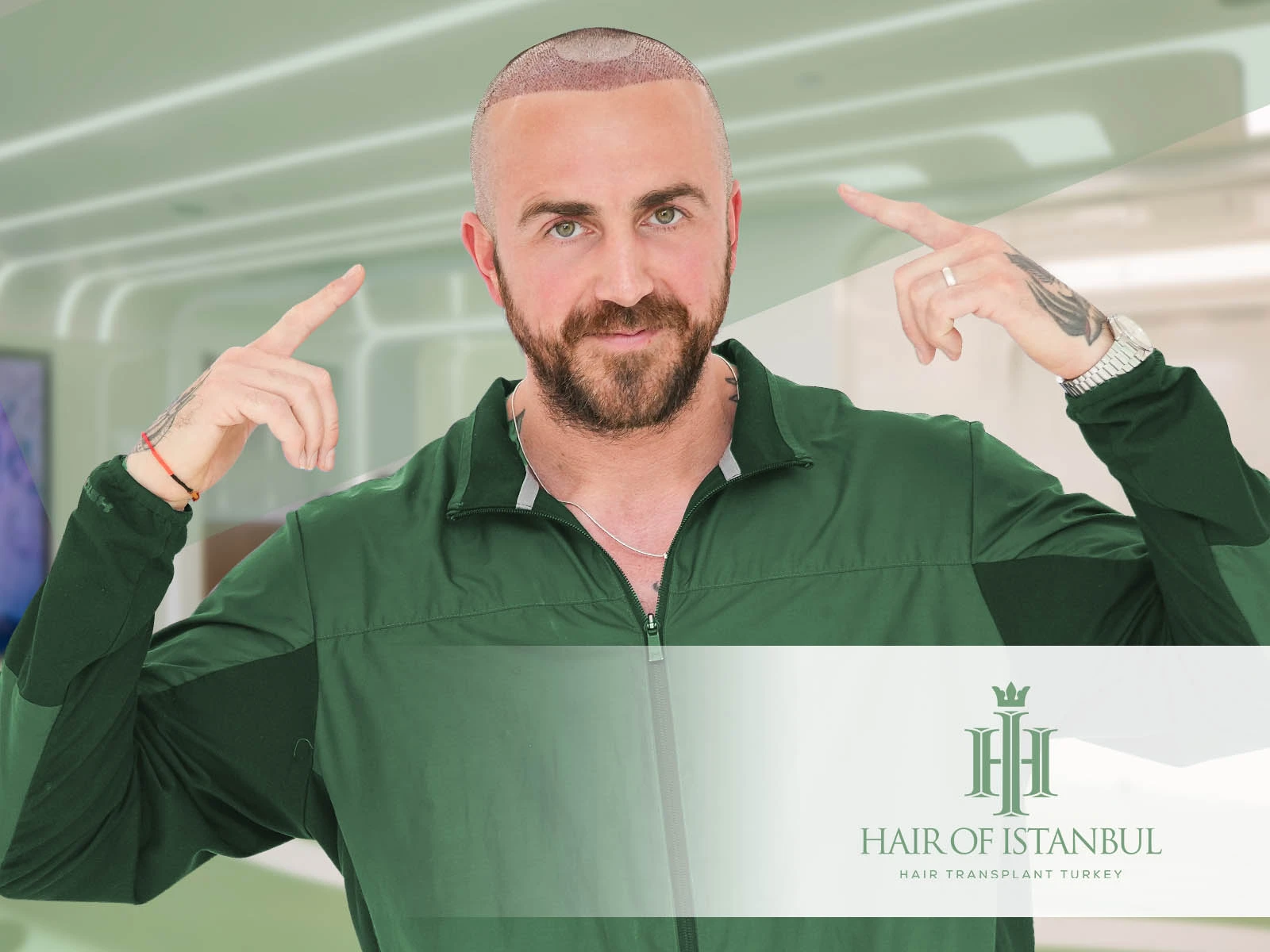
A hair transplant transfers follicular units taken from the donor area to regions of permanent hair loss. Grafts are harvested one by one with the FUE method; placement is carried out either by DHI implantation or through channels created with Sapphire or Slit, according to the case plan. The procedure is completed in a single day under local anaesthetic. Temporary shedding of the transplanted hairs may be seen between the third and eighth week; new growth begins in the third to fourth month and the result matures in the thirteenth to fifteenth month.
- What is a hair transplant?
- Who is a suitable candidate?
- Individual planning
- Hairline design
- Donor area and graft plan
- How is a hair transplant performed?
- Techniques: FUE, DHI, Sapphire, Slit
- Preparation before the procedure
- What happens on the day?
- The first 10 days afterwards
- What to avoid in the first months
- Hair transplant results timeline
- What determines the result?
- Risks and realistic expectations
- Patients travelling to Istanbul
- Medical team
- Before and after
- Hair transplant prices
- Frequently asked questions
- Related pages
What is a hair transplant?
A hair transplant is a surgical procedure in which follicular units taken from the donor area are transferred to regions where hair loss is permanent. A graft is a natural follicular unit that may contain one or more hair follicles; a graft and a single hair are not the same thing.
The back of the head and the area around the temples are used as the donor area. Because the follicles in this region are less affected by male/female pattern hair loss, they can produce long-lasting growth where they are transferred. Existing hair that has not been transplanted, by contrast, may continue to thin over time; planning is therefore based not only on today’s appearance but on the future course of hair loss.
The aim of a hair transplant is not to cover a bald area but to use the available donor resource in a way that creates a natural hairline and balanced coverage, while preserving the overall appearance of the donor area.
Who is a suitable candidate for a hair transplant?
A hair transplant is considered in people with sufficient donor reserve whose hair loss has a genetic, hormonal or stress-related cause. At Hair of Istanbul the age range assessed is 18–60. Age alone is not decisive; it is considered together with donor capacity, the course of hair loss and general health.
Situations generally considered suitable
- Male/female pattern hair loss that has stabilised at a certain level
- A receding frontal hairline and deepening temporal recessions
- Permanent hair loss in specific areas
- A naturally high forehead
- Correction of a previous procedure (revision hair transplant) and grafting into scarred areas
- Female pattern hair loss and Afro hair texture — planning is adapted to these cases
Situations that require further assessment
- Rapidly progressing hair loss that has not yet stabilised
- Donor density that is clearly insufficient for the area to be covered
- Uncontrolled systemic conditions and matters relating to bleeding tendency
- Active scalp problems — itching, redness, flaking or spots
- Goals that expect more than the procedure can provide
When a hair transplant is not recommended
If the donor area is very limited while the area to be covered is very large, the density that can be achieved may not meet expectations. In such cases a hair transplant is not recommended. The purpose of the assessment is not to direct every enquiry towards surgery; it is to set out clearly, before the procedure, whether the result will justify the time and the resource spent. Non-surgical options such as PRP, Regenera Activa or scalp micropigmentation may be considered in these cases.
Individual planning
Two patients with a similar degree of baldness may require different plans. Hair shaft calibre and curl, the colour contrast between hair and skin, donor density, the future pattern of hair loss and facial proportions together determine which regions the grafts are distributed to first and how much visible coverage can be achieved.
Thick, curly hair produces higher visible density with the same number of grafts. Where the contrast between hair and skin is low, sparse areas look fuller. Graft numbers alone are therefore not a measure of quality.
| Factor assessed | Effect on planning |
|---|---|
| Distribution and degree of hair loss | Determines the priority between the frontal, mid-scalp and crown regions. |
| Donor density and capacity | Limits the graft reserve that can safely be used. |
| Hair shaft calibre and curl | Changes the visible density achieved with the same number of grafts. |
| Hair – skin colour contrast | Affects the perception of density and the design of the transitions. |
| Age and facial proportions | Determines the position of the hairline and its long-term harmony. |
| Future course of the existing hair | Prevents grafts being spent on today’s appearance alone. |
Hairline design
A natural hair transplant result is achieved with a hairline design that is in harmony with the anatomical proportions of the face and takes the individual’s long-term hair loss dynamics into account. The aim is a frame that looks natural at first glance and does not become artificial with age.
The height and shape of the hairline are therefore not decided arbitrarily; facial reference points such as the glabella (the area between the eyebrows), the nasal root, the lateral canthus (the outer corner of the eye) and the tragus are used. Age-appropriate positioning is essential: hairlines placed too low, which may turn into an unnatural appearance over time, are avoided.
The depth of the temporal recessions, the width of the forehead, facial symmetry and the appropriate hairline type are assessed together — a slight M shape, a soft curve and a mature male line; in female patients, a more oval and rounded frame.
Four principles behind a natural appearance
- Facial proportion analysis — the height of the hairline is determined by facial reference points, not by a fixed template.
- Age appropriateness — a hairline that looks natural today must still look natural in fifteen years.
- Donor management — every graft spent on the frontal band is a graft that cannot be used for the regions behind it.
- Micro-irregularity — a perfectly straight line is not natural; the transition zone is built with controlled irregularity.
Two common errors are the use of too few single-hair grafts in the frontal band and positioning the hairline too low. Correct graft architecture — single-hair grafts at the front, graded density, and correct angle, direction and depth — makes the hairline natural at first impression and sustainable in the long term.
Donor area assessment and graft plan
The donor area is a limited resource that has to be managed over the long term. The harvesting plan takes into account not only how many grafts can be obtained in this procedure, but also how the donor area will look afterwards and what needs may arise later. The aim is balanced harvesting, not the highest possible number of grafts.
The ranges below are for guidance only and do not replace clinical assessment. The final graft number is based on measurement: the area to be covered and the density the donor area can support without being over-thinned are calculated together. Two patients at the same Norwood stage may require markedly different graft numbers.
| Degree of hair loss | Area affected | Typical graft range |
|---|---|---|
| Norwood 2 | Temporal recessions, hairline refinement | 1,500 – 2,000 |
| Norwood 3 | Frontal region and temples | 2,000 – 2,800 |
| Norwood 4 | Frontal region and early crown opening | 2,800 – 3,500 |
| Norwood 5 | Frontal and crown regions, thinning in between | 3,500 – 4,500 |
| Norwood 6 | Extensive baldness, frontal region prioritised | 4,500 and above |
In extensive baldness the aim is not to fill every region to the same density. The regions that frame the face and add the most visual impact are prioritised; the crown is treated as a second priority. If donor capacity is not sufficient for a single session, this is discussed openly before the procedure.
How is a hair transplant performed?
A hair transplant is completed in a single day and is performed under local anaesthetic. The five stages below follow the same order in every case; what changes from case to case is the content of each stage.
| Stage | What is done | Term |
|---|---|---|
| 1 · Planning | The hair and scalp are analysed, the hairline is drawn, and donor capacity and graft distribution are determined. The plan is confirmed with the patient before the procedure begins. | Consultation / hairline design |
| 2 · Graft harvesting | After local anaesthetic, follicular units are extracted one by one from the donor area. It is essential that the follicle is taken together with the tissue surrounding it and is not damaged during harvesting. | FUE extraction |
| 3 · Channel creation | Micro-channels matching the natural exit angle of the hair are prepared in the recipient area. The angle, direction, depth and spacing of the channels directly determine how natural the result looks. | Sapphire / Slit |
| 4 · Placement | The separated grafts are placed into the channels atraumatically: single-hair grafts in the frontal band, multiple-hair grafts for volume behind. Depth is standardised; tissue integrity and symmetry are observed. | Implantation / DHI |
| 5 · Initial aftercare | The donor area is protected, a dressing is applied and the instructions for the first night are given. | Post-operative care |
The number of grafts harvested and the number of channels created must match. The duration of this stage depends on the graft number; the total procedure time is usually between 6–9 hours, with rest and meal breaks in between.
Techniques: FUE, DHI, Sapphire and Slit
The names of the techniques are not alternatives to one another, nor separate quality packages. FUE describes how the grafts are harvested; DHI, Sapphire and Slit describe how the recipient area is prepared and how the grafts are placed. In a procedure carried out with DHI, the grafts are still harvested with FUE.
| Term | Which stage? | Short description |
|---|---|---|
| FUE | Graft harvesting | The extraction method in which follicular units are taken one by one from the donor area. |
| DHI | Implantation | The implantation approach in which grafts are placed into the recipient area with an implanter pen. |
| Sapphire | Channel creation | The approach in which the recipient channels are created with sapphire-tipped blades. |
| Slit | Channel creation | The approach in which the recipient channels are created with the slit method and the grafts are then placed into those channels. |
Which approach is used is determined by the hair structure, the condition of the existing hair, the area to be covered and the density aimed for. No additional fee is charged for the choice of technique; the technique is part of the individual treatment plan. For details, see the FUE technique and DHI technique pages.
Preparation before the procedure
Preparation begins before the day of the hair transplant. The points below are the general framework that applies to every patient; individual instructions are given separately after the consultation.
- No alcohol is consumed for one week before the procedure, and smoking is reduced.
- The medicines you use and your current health condition are reported in advance. Blood-thinning medicines must not be stopped on your own initiative; whether they are stopped is planned jointly by the doctor who prescribed them and the Hair of Istanbul medical team.
- If you have itching, redness, flaking or spots on your scalp, this must be reported before the procedure.
- You are asked not to shave the donor area for about one month before the procedure.
- Blood tests, an ECG and an anaesthetic assessment are completed before the procedure; current medication and allergy information is reviewed with medical approval.
- On the morning of the procedure the hair should be washed and clean, with no styling products applied.
- Breakfast is eaten on the morning of the procedure; coffee and caffeinated drinks are not taken.
- Comfortable clothing is preferred — a wide-necked T-shirt, a shirt or a top that opens at the front.
Information and consent forms are shared in your own language; the flow of the day, the recovery timeline and the expected results are explained clearly before the procedure.
What happens on the day of the procedure?
The day of the hair transplant begins with a face-to-face consultation at the clinic. A detailed hair and scalp analysis is carried out, a natural hairline suited to your facial features is drawn, and the plan is approved together with you.
Once the hairline has been determined, your blood tests are confirmed and blood is taken for the PRP applied as part of the procedure. When the preparations are complete, local anaesthetic is administered and graft harvesting from the donor area begins. The grafts harvested are counted.
The channels are then created in the recipient area and the grafts are placed. The operative area is numbed with local anaesthetic; brief discomfort may be felt while the anaesthetic is being administered. When the procedure is complete, a dressing is applied to the donor area and the instructions for the first night are given.
The first 10 days after the procedure
After a hair transplant, both the transplanted area and the donor area remain sensitive for a period. In the first few days, keeping the grafts in place directly affects the rest of the healing process.
| Period | What is done |
|---|---|
| First 3 days | Sudden movements, bending forward and any impact to the head are avoided. The first three nights are spent sleeping on your back; a neck pillow is recommended. The recipient area is not touched for 72 hours. The hair is kept away from water and chemicals until the third day. |
| The next day | You return to the clinic for a check-up. The dressing on the donor area is assessed and removed; no new dressing is applied. |
| Day 3 | The first wash is carried out at the clinic. If you return home early, how the wash should be performed is demonstrated in detail. |
| From day 4 onwards | Gentle daily washing continues with the products provided and in the manner shown. Friction is avoided and the crusts are not forced. Washing is continued for about ten days. |
| After the 9th wash | Individual instructions are given for the controlled removal of the crusts. The crusts are not picked off before these instructions are given. |
| After the 10th wash | Photographs are shared and it is confirmed that the crusts have come off completely. From this point the area may be touched gently with the palm and the fingers. |
Detailed instructions on washing, product use, sleeping position and returning to daily life are set out on the hair transplant aftercare page.
What to avoid in the first months
The periods below are based on the current post-operative protocol at Hair of Istanbul and are important for graft survival and for the healing of the donor area.
| Subject | Period |
|---|---|
| Alcohol | At least 1 week — because of antibiotic use |
| Touching the recipient area | First 72 hours |
| Sexual activity | 7 days |
| Direct sunlight | 2 weeks · sunbeds: 1 month |
| Sport, weights, heavy sweating | 1 month |
| Hats, beanies and similar accessories | 1 month — if required for work, briefly from the 2nd week |
| Sea, pool, swimming | 1 month |
| Shaving the donor area | 1 month · shaving the recipient area: 3 months |
| Sauna and steam room | 5 months |
| Hair dye | 8 months |
Sensitivity in the treated area may last about a month. During this period the area must not be scratched with the nails; from the tenth day it may be touched gently with the palm and the fingers. Reducing smoking supports healing.
The hair transplant results timeline
The result of a hair transplant does not appear on the day of the procedure. Healing and hair growth progress over months, and the process varies from person to person.
| Period | What to expect |
|---|---|
| First 1–2 weeks | Redness, sensitivity, crusting and healing in the donor area may be seen. |
| Weeks 3–8 | Temporary shedding of the transplanted hairs may occur. This does not mean that the follicle has been lost; the follicle stays in place. |
| Months 3–4 | New hair growth begins. The first hairs may be fine and irregular. |
| Months 6–9 | Density and overall appearance increase noticeably. |
| Months 9–12 | The result largely emerges; the hairs continue to thicken. |
| Months 13–15 | The result matures. The crown may take longer in some cases. |
Sharing photographs every month during this period is recommended. Progress is then followed with comparable clinical data rather than a subjective impression, and individual guidance can be given where needed.
What determines the result of a hair transplant?
The result of a hair transplant does not depend on the number of grafts alone. Two patients treated with the same number of grafts may end up with different visible density. The determining factors are:
- Donor density and the quality of the harvested grafts
- Hair shaft calibre and curl
- The colour contrast between hair and skin
- The size of the transplanted area and the degree of hair loss
- Hairline design and the distribution of grafts across the regions
- The angle, direction and depth at which the grafts are placed
- The future course of the existing hair
- Compliance with the healing and aftercare process
Risks and realistic expectations
A hair transplant is a surgical procedure. Temporary swelling, redness, numbness, folliculitis, shock loss or irregular growth in the early period may occur. Less commonly, infection, reduced graft survival, visible thinning in the donor area and — where planning and execution fall short — an unnatural result may occur.
Individual risk is determined during the medical assessment. If healing does not follow the expected course, the medical team should be contacted; early intervention corrects the process in most cases.
Expectation and result
In hair transplant surgery, no fixed percentage of density and no promise of a definite result are given. The result is an outcome determined jointly by donor capacity, hair characteristics, planning and the healing process. The realistic goal is the most balanced and natural appearance that can be achieved with the available donor resource.
Patients travelling to Istanbul for a hair transplant
The hair transplant process begins before you arrive in Istanbul. A preliminary assessment is made from your photographs, and a plan is drawn up according to your pattern of hair loss and your donor capacity. The appointment, accommodation and travel are arranged within a single programme around your flight dates; airport pick-up and the hotel and clinic transfers are part of that programme. Communication support in your own language is provided throughout.
The programme is built as the day of arrival followed by a three-day clinical schedule: the consultation and the procedure take place on the same day, the check-up and the removal of the dressing follow the next day, and the return is planned once the first wash has been completed on the third day. Accommodation is arranged as three nights in line with this schedule.
| Day | Clinical flow | Patient programme |
|---|---|---|
| Arrival day | If your flight time allows, a preliminary meeting can take place at the clinic on the same day. | Airport pick-up and hotel check-in. |
| Day 1 | Doctor consultation, blood tests, hairline design and the hair transplant procedure. | Hotel – clinic transfer; rest after the procedure and the instructions for the first night. |
| Day 2 | Check-up and removal of the dressing on the donor area. | Hotel – clinic transfer; review of the healing process. |
| Day 3 — return | The first wash is carried out at the clinic and the aftercare instructions are given. | Clinic – airport transfer and return. |
| After returning | Photographic assessments and medical follow-up. | Follow-up communication from your own country. |
Patients travelling from abroad must hold a passport valid for at least six months. Because the aftercare products cannot be carried in hand luggage, you are asked to travel with a suitcase.
Medical team
The consultation, the planning, the procedure and the post-operative check-ups are carried out by the same medical team. The decisions taken during planning are therefore carried through in full to the day of the procedure and beyond.
Hair of Istanbul has been operating in Istanbul since 2013, and more than 19,000 cases have been carried out to date. You can review the training and clinical roles of the doctors on the medical team page and see the centre on the clinic page.
Hair transplant before and after
Hair transplant results vary from person to person according to donor capacity, hair shaft calibre, colour contrast and the degree of hair loss. Each case must therefore be assessed within its own context.
Cases involving the frontal hairline, extensive baldness, Afro hair texture, revision, hair transplants in women and beard transplants can be reviewed in the before and after gallery, together with the hair type, the degree of loss and the graft range.
Hair transplant prices
At Hair of Istanbul the hair transplant price is determined by the number of grafts; no additional fee is charged for the choice of technique. The ranges below reflect the current package structure.
1,500 – 2,500 grafts
€4,000
2,500 – 3,500 grafts
€4,500
3,500+ grafts
€5,000
The final plan and price become clear after the case assessment. For package contents, additional procedures and current prices, see the hair transplant prices page.
Frequently asked questions
What is a hair transplant?
A hair transplant is the transfer of healthy follicular units taken from the donor area to regions of permanent hair loss. The procedure does not create new follicles; it redistributes the existing ones.
Who is a suitable candidate for a hair transplant?
Suitability is determined by assessing the cause and distribution of hair loss, donor capacity, hair characteristics, age, general health and expectations together. At Hair of Istanbul the age range assessed is 18–60, and sufficient donor reserve is required.
How many grafts will I need?
The number of grafts is determined by the area to be covered, donor capacity, hair shaft calibre and the distribution aimed for. A preliminary assessment from photographs gives a range; the final number is confirmed at the consultation.
What is the difference between FUE and DHI?
FUE describes the harvesting of grafts from the donor area, while DHI describes the placement of grafts with an implanter pen. In a procedure carried out with DHI the grafts are still harvested with FUE; the two are not alternatives to one another.
How long does a hair transplant take?
The procedure is completed in a single day and usually takes 6–9 hours, depending on the number of grafts. Rest and meal breaks are given in between.
When is the first wash carried out?
The first wash is carried out at the clinic on the third day. Daily washing then continues for about ten days with the products provided; after the ninth wash, individual instructions are given for the removal of the crusts.
When will I see my hair transplant results?
New growth begins in the third to fourth month. Density becomes apparent between the sixth and ninth month, the result largely emerges between the ninth and twelfth month, and it matures in the thirteenth to fifteenth month. The crown may take longer in some cases.
Is the transplanted hair permanent?
Because the grafts are taken from the donor area, which is less affected by male/female pattern hair loss, the result can be long-lasting. However, existing hair that has not been transplanted may continue to thin over time; long-term planning matters for this reason.
Is a hair transplant painful?
The procedure is performed under local anaesthetic and the operative area is numbed. Brief discomfort may be felt while the anaesthetic is being administered. Sensitivity in the first days after the procedure is expected.
How much does a hair transplant cost?
The hair transplant price is determined by the number of grafts and, under the current package structure, ranges from €4,000 to €5,000. No additional fee is charged for the choice of technique; details are given on the pricing page.
Related pages
| Page | What it covers |
|---|---|
| FUE technique | A detailed explanation of the graft harvesting stage. |
| DHI technique | The details of the implanter approach and who it may be considered for. |
| Hair transplant aftercare | Instructions for washing, product use and returning to daily life. |
| Before and after | Real case results across different hair types and degrees of loss. |
| Hair transplant prices | Current prices, package contents and fees for additional procedures. |
| Hair transplant for women | The planning approach in female pattern hair loss. |
| Afro hair transplant | Graft harvesting and placement in curly hair textures. |
| Revision hair transplant | Corrective planning after a previous procedure. |
| Beard transplant | Direction and angle planning in facial hair restoration. |
| Medical team | The training, expertise and clinical roles of the doctors. |
Your hair transplant plan begins with an individual assessment
You can request a preliminary assessment by sharing photographs of the donor area and of the areas to be treated. The assessment sets out clearly whether a hair transplant is suitable for you and, if it is, which graft range is being aimed for.
