
 en
en TR
TR  SK
SK  ITA
ITA  FR
FR  DE
DE  ES
ES  BG
BG 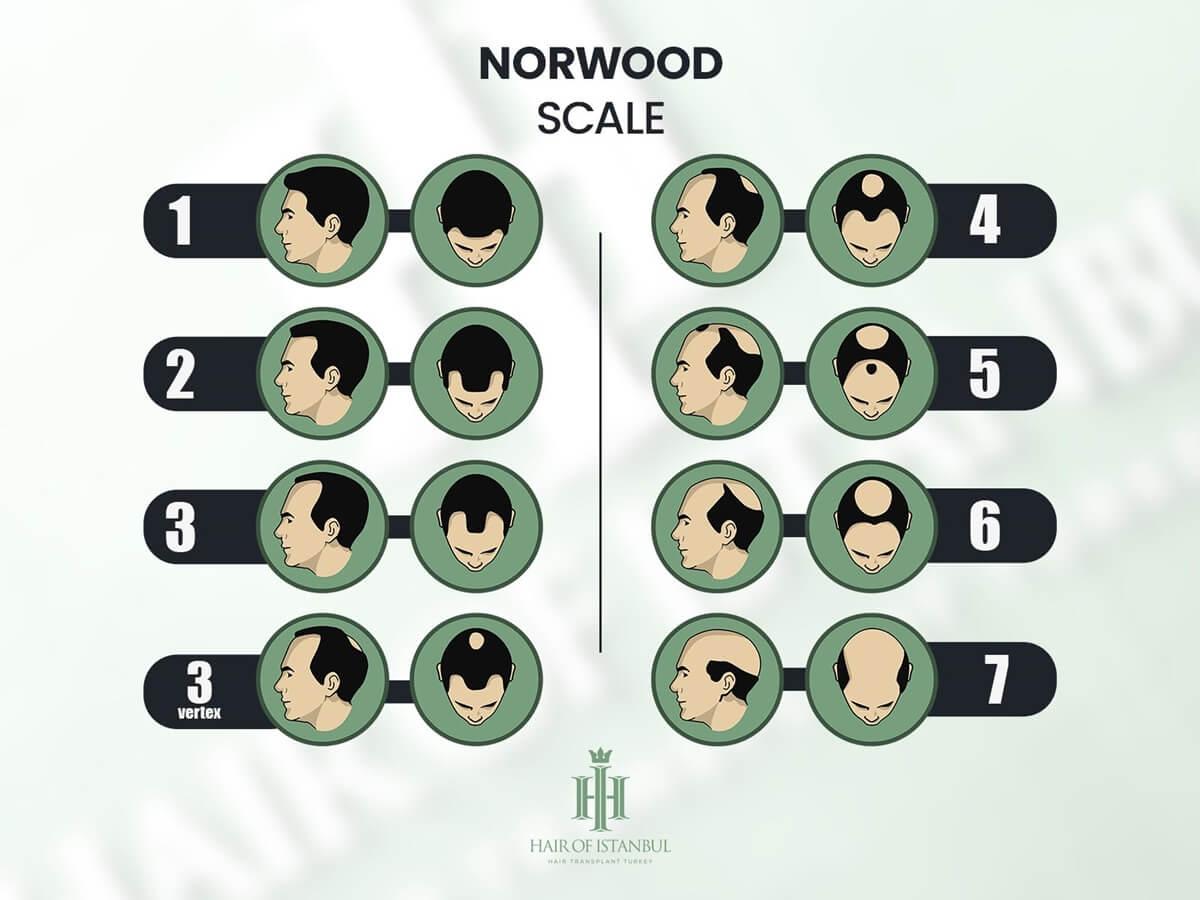
Norwood Scale Explained: Hair Loss Stages 1–7
Maybe your hairline looks unfamiliar in the mirror. Maybe you’ve noticed more scalp showing than before, or a small shift that keeps pulling your attention. That uncertainty has a name — and a framework. The Norwood Scale is the classification system specialist surgeons use to describe male pattern hair loss, from the earliest signs of recession to advanced thinning.
This guide explains each of the seven Norwood stages, what they mean clinically, and how they shape treatment decisions. It is written for patients who want clarity before speaking to a specialist, not for academic reference. Our goal is simple: after reading this, you should know which stage you are likely in, what your options look like at that stage, and what an honest conversation with a specialist would cover.
Written and reviewed by Hair of Istanbul’s medical team. Hair of Istanbul has served patients from more than 30 countries since 2013 from its clinic in Ataköy, Istanbul, with a consultation office in Dubai City Walk. All procedures are surgeon-led.
What Is the Norwood Scale?
The Norwood Scale — also called the Hamilton-Norwood Scale or Norwood-Hamilton Scale — is the most widely used clinical system for classifying male pattern hair loss (androgenetic alopecia). It describes seven progressive stages, from a full hairline with no visible thinning to advanced baldness affecting most of the scalp.
The system was first developed by Dr James Hamilton in the 1950s, who studied more than 700 men of different ages and backgrounds to describe hair loss patterns. Dr O’Tar Norwood refined and extended Hamilton’s work in the 1970s, producing the modern seven-stage classification that specialists still use today.
For a patient, the Norwood Scale answers three practical questions:
- Where am I right now? It identifies the current pattern and extent of hair loss.
- Where might I be heading? It hints at how hair loss is likely to progress if untreated.
- What are my realistic options? Each stage opens or closes certain treatment paths, from medical management to hair restoration surgery.
The scale is not a crystal ball. It will not tell you exactly when your hair loss will progress, or how fast. What it does is give you and your specialist a shared language for planning — which is the foundation of any personalised treatment plan.
Why the Norwood Scale Matters Before a Hair Transplant
Many patients arrive at a consultation asking “how many grafts do I need?” That is the wrong first question. The right first question is “what stage am I at, and where is my hair loss heading?” The answer to that shapes everything else — graft count, donor area management, hairline design, and whether surgery is the right choice at all.
At Hair of Istanbul, every consultation begins with donor area analysis and Norwood staging. The reason is straightforward: a 28-year-old at Norwood 3 with a family history of Norwood 6 has a very different treatment plan than a 55-year-old who is stable at Norwood 3. Surgery for the first patient, without proper planning for future progression, risks an unnatural result five years down the line. This is what separates a surgeon-led procedure from a technician-led one.
Understanding your Norwood stage also helps with realistic expectations. Hair restoration surgery does not stop ongoing male pattern baldness — it redistributes your existing donor hair. The scale helps you and your specialist talk honestly about what your donor area can and cannot deliver over a lifetime.
The 7 Norwood Stages Explained
Below is a stage-by-stage breakdown. Most patients fall between two adjacent stages rather than matching one perfectly. That is normal; the scale is a guide, not a checklist.
Norwood Stage 1 — Baseline (No Visible Loss)
At Stage 1, the hairline sits in its adolescent position, roughly in line with the uppermost forehead creases when you raise your eyebrows. There is no recession at the temples and no thinning at the crown. Hair density is uniform across the scalp.
What it means: This is the baseline. Most men in their late teens and early twenties are at Stage 1. Hair loss has not begun, or it has not yet become visible.
Treatment at this stage: No intervention is usually needed. If there is a strong family history of early or aggressive hair loss, some patients start preventive medical treatment (such as finasteride or topical minoxidil) under specialist supervision. Surgery is not indicated.
Norwood Stage 2 — The Mature Hairline
Stage 2 is where the hairline begins to recede slightly at the temples, forming a subtle M-shape. This is often called a “mature hairline” and is considered a normal part of ageing rather than pathological hair loss. The recession is symmetrical, minimal (typically less than a centimetre from the adolescent hairline), and the crown remains unaffected.
What it means: Many men at Stage 2 are not actually losing hair — they are simply transitioning from an adolescent hairline to an adult one. Distinguishing Stage 2 from early Stage 3 is a clinical judgement that requires examining follicle miniaturisation, not just the visible hairline.
Treatment at this stage: Reassurance for most patients. For those with a confirmed genetic predisposition or signs of miniaturisation under trichoscopy, preventive medical treatment may be discussed. Hair restoration surgery is rarely appropriate at this stage; operating too early commits donor hair before the long-term pattern is clear.
Norwood Stage 3 — The Tipping Point
Stage 3 is the stage at which hair loss becomes unmistakable. The temples recede deeply enough to form a clear M, U or V shape, and the recession now extends beyond what is considered a mature hairline. There is a separate sub-variant called Norwood 3 Vertex, in which the hairline itself is still close to Stage 2 but thinning has started at the crown.
For many men, Norwood 3 is the stage at which they first seriously consider treatment. The change is visible in photographs, noticeable under harsh lighting, and often emotionally significant. Patients at this stage typically start researching medical therapies, comparing clinics, and looking at before and after results.
What it means: Androgenetic alopecia is now clinically active. Without treatment, most patients at Norwood 3 will progress — the question is how fast and how far.
Treatment at this stage: Stage 3 is the classic decision point. Options usually include:
- Medical therapy (finasteride, minoxidil, sometimes combined) to slow progression
- Observation with follow-up trichoscopy every 6–12 months
- Hair restoration surgery, if the donor area is healthy, age and family history support a stable plan, and realistic expectations are set
This is the stage where a conservative, surgeon-led plan matters most. Overly aggressive grafting at Stage 3 in a young patient can create problems as hair loss continues behind the transplanted area.
Norwood Stage 4 — Deep Frontal Recession and Early Vertex Loss
At Stage 4, the frontal hairline has receded noticeably deeper than Stage 3, and the crown (vertex) now shows a separate area of thinning. A band of hair typically still connects the front to the sides, keeping the two bald regions visually distinct.
What it means: Androgenetic alopecia is established and active. The donor area — the horseshoe region of permanent hair around the back and sides of the scalp — is now under closer evaluation, because planning must account for both the frontal and crown regions.
Treatment at this stage: Medical therapy remains important for preserving what is left. Hair restoration surgery becomes a strong candidate at Stage 4 for patients whose donor supply supports the planned coverage. Graft distribution typically prioritises the hairline and frontal zone first; the crown may be addressed in the same session or a follow-up, depending on donor availability.
Norwood Stage 5 — The Bridge Narrows
Stage 5 is marked by the narrowing of the band of hair that previously separated the frontal and vertex bald areas. The two regions are moving towards each other, and the overall balding pattern now occupies a larger surface of the scalp.
What it means: Donor area management becomes the central planning challenge. The amount of grafts that can be safely harvested is finite, and it must cover a wider area than at earlier stages.
Treatment at this stage: Surgery is still a realistic option for well-selected patients, but planning becomes stricter. Decisions about which zones to prioritise — hairline, mid-scalp, or crown — depend on the patient’s goals, donor density, and the specialist’s assessment. A single session may not cover everything; multi-stage planning is discussed openly before any procedure.
Norwood Stage 6 — The Bridge Disappears
At Stage 6, the bridge of hair between the front and the crown has disappeared entirely. The two previously separate bald regions merge into one continuous area across the top of the scalp. Hair remains along the sides and back in a horseshoe pattern.
What it means: Stage 6 represents advanced pattern baldness. The aesthetic goal often shifts from full restoration to realistic frontal and mid-scalp coverage that frames the face naturally.
Treatment at this stage: Hair restoration is still possible and often meaningful for the right candidate, but expectations must be shaped carefully. Scalp micropigmentation is sometimes considered alongside or instead of surgery to add visual density. Multi-session planning is common.
Norwood Stage 7 — Advanced Baldness
Stage 7 is the most advanced presentation on the Norwood Scale. Hair loss covers the entire top of the scalp, and only a thin band of hair remains along the sides and back. The remaining donor hair may also be finer than at earlier stages.
What it means: At this stage, donor supply is usually limited, and traditional restoration is no longer feasible for every patient. A careful evaluation determines whether meaningful improvement is achievable.
Treatment at this stage: Options depend heavily on individual donor quality and patient goals. When surgery is appropriate, planning typically focuses on re-establishing a frontal framework rather than full coverage. Scalp micropigmentation, hair systems, or a combination approach may be discussed. An honest consultation matters more here than at any other stage.
Norwood 3 — Why This Stage Gets Most Attention
Across every hair transplant clinic in the world, Norwood 3 is the single most common stage at which patients book their first consultation. The reason is psychological as much as clinical: it is the first stage where loss becomes impossible to ignore.
At Norwood 3, patients typically notice three things:
- The hairline has clearly moved back from where it was at age 20–22
- Temples look “sharper” or more pronounced, often described as an M-shape
- Styling options become more limited — certain haircuts that used to work now emphasise the recession
The clinical picture at Norwood 3 is usually active androgenetic alopecia with ongoing miniaturisation behind the visible hairline. This matters because it means that in many cases, there is still hair in that area — but it is weaker, shorter, and thinner than it used to be. A specialist assessment determines whether medical therapy can stabilise this hair before considering surgery.
If you are at or near Norwood 3, the two most useful questions to ask a surgeon are:
- What is my donor density, and what would it support over 10–20 years?
- Is medical therapy appropriate as a first step before (or alongside) any surgical plan?
Graft Estimates by Norwood Stage
The table below gives indicative graft ranges for each Norwood stage. These are not quotes or guarantees — actual graft counts depend on donor density, hair characteristics (calibre, curl, colour contrast with scalp), age, family history, and the specific zones being treated.
| Norwood Stage | Typical Frontal Graft Range | Typical Total (if crown included) | Planning Note |
|---|---|---|---|
| Stage 1 | Not indicated | Not indicated | Monitor only |
| Stage 2 | 800–1,500 (hairline refinement only, selected cases) | — | Caution: preserve donor for future |
| Stage 3 | 1,800–2,800 | 2,200–3,200 | Common first-surgery stage |
| Stage 3 Vertex | 1,500–2,200 | 2,000–2,800 | Crown priority varies |
| Stage 4 | 2,500–3,500 | 3,000–4,000 | Strong surgical candidate if donor is healthy |
| Stage 5 | 3,000–4,000 | 3,500–4,500 | Multi-zone planning |
| Stage 6 | 3,500–4,500 (frontal framework) | 4,000–5,000 | Often multi-session |
| Stage 7 | Case-by-case | Often not feasible as single-session | Honest donor assessment essential |
For a more tailored estimate, try our hair graft calculator. The calculator is a starting point — a proper graft plan requires in-person or video consultation, donor area analysis, and often trichoscopy.
Does the Norwood Scale Apply to Women?
No — the Norwood Scale is specifically designed for male pattern hair loss. Women with hair loss typically present a different pattern: diffuse thinning across the top of the scalp with a widening parting line, rather than the frontal recession and crown pattern seen in men. For this reason, specialists use a different classification system for female hair loss.
The two most common systems for women are:
- The Ludwig Scale, which divides female pattern hair loss into three grades (Type I mild, Type II moderate, Type III severe). The hairline itself usually stays intact, and thinning is most visible on the top and around the parting.
- The Savin Scale, a similar three-stage system that also accounts for overall density loss. Some specialists prefer this for its more detailed density grading.
If you are a woman experiencing hair loss, the Norwood Scale will not accurately describe your pattern. A proper assessment with a specialist familiar with female pattern hair loss is the right starting point. Hair of Istanbul has dedicated pathways for women’s hair restoration, including revision cases for previous unsuccessful procedures.
Treatment Options at Each Stage
Hair loss treatment is not one-size-fits-all. What works at Norwood 2 is inappropriate at Norwood 6, and vice versa. Below is a general map. Every real-world treatment plan must be individualised.
Stages 1–2 (Preserve and Monitor)
For patients at these early stages, the priority is monitoring and prevention. Regular trichoscopic follow-up every 6–12 months tracks whether miniaturisation is beginning. Medical options such as finasteride or topical minoxidil may be introduced if there is a family history of aggressive loss. Hair restoration surgery is not indicated.
Stages 3–4 (Active Treatment Window)
This is the window where most clinical decisions happen. Medical therapy is usually the first line. Hair restoration surgery becomes a realistic option for patients with stable progression, healthy donor areas, and realistic expectations. Modern techniques include follicular unit extraction and direct hair implantation, which are detailed in our hair transplant techniques and DHI technique guides.
Stages 5–6 (Careful Planning Phase)
Surgery is still possible and often life-changing, but donor area management becomes central. Patients at these stages benefit most from specialists experienced in donor area planning and multi-session strategies. Medical therapy continues to play a supporting role in preserving remaining native hair.
Stage 7 (Honest Evaluation)
Not every patient at Stage 7 is a surgical candidate, and a responsible specialist will say so when appropriate. When surgery is feasible, expectations focus on re-establishing a natural frontal framework rather than full scalp coverage. Scalp micropigmentation can be a valuable adjunct or alternative.
When to Consult a Specialist
You do not need to wait until hair loss is severe to have a consultation. In fact, the opposite is true — the earlier you understand your Norwood stage and your donor area, the better your long-term options. Consider a specialist consultation if:
- You have noticed clear changes in your hairline over the past 12–24 months
- Your parting is widening or you are seeing more scalp under certain lighting
- There is a strong family history of hair loss on either side
- You are considering treatment and want an honest assessment before making any commitment
- You have had a previous hair transplant and are considering a revision procedure
At Hair of Istanbul, every consultation is free and surgeon-led, with donor area analysis, Norwood staging, and a realistic discussion of options — whether or not surgery is the right next step.
Book your free consultation: WhatsApp +90 532 650 51 51 or contact us here.
The Norwood Scale is a chart used by specialist surgeons to describe male pattern hair loss in seven stages, from a full hairline (Stage 1) to advanced baldness (Stage 7). It helps patient and specialist agree on where hair loss currently stands and what treatment options are realistic.
Yes. Dr James Hamilton introduced the original classification in the 1950s, and Dr O’Tar Norwood extended and refined it in the 1970s. The terms Norwood Scale, Hamilton-Norwood Scale, and Norwood-Hamilton Scale all refer to the same seven-stage system.
The most accurate answer comes from a specialist examination, not from photos alone. Broadly: intact hairline with no thinning is Stage 1; slight temple recession that looks symmetrical and minor is Stage 2; clearly visible recession forming an M or V shape is Stage 3; crown thinning or deeper frontal loss indicates Stage 4 or beyond. A free consultation with a specialist surgeon gives you a reliable staging.
Most patients who undergo hair restoration surgery are at Norwood 3, 4 or 5. Stages 1 and 2 are usually managed with observation or medical therapy. Stages 6 and 7 require careful donor-area planning and realistic expectations. The right stage for surgery depends on your age, family history, donor density, and personal goals — not the Norwood stage alone.
Medical treatments such as finasteride and minoxidil can stabilise hair loss and in some cases thicken miniaturised hair, which may give the appearance of a partial reversal. However, once a follicle has completed miniaturisation and been lost, it does not regenerate on its own. Hair restoration surgery can restore coverage but does not reverse underlying androgenetic alopecia.
No. Female pattern hair loss follows a different pattern — typically diffuse thinning along the parting rather than frontal and crown recession. Specialists use the Ludwig Scale or Savin Scale for women.
Norwood 3 vertex is a sub-variant in which the frontal hairline still resembles Stage 2 (mature hairline, minimal recession), but thinning has begun at the crown. It is a common early presentation, especially in men whose hair loss starts from the back rather than the front.
Typical ranges are 1,800–2,800 for Stage 3, 2,500–4,000 for Stage 4, 3,000–4,500 for Stage 5, and 3,500–5,000 for Stage 6. These are indicative only. Accurate graft counts require donor area analysis and a personalised treatment plan with a specialist surgeon.
Androgenetic alopecia tends to progress throughout life, though the pace varies widely. Some patients stabilise at Norwood 3 or 4 for decades; others continue progressing. Medical therapy and lifestyle factors influence the trajectory, but there is no stage at which progression is guaranteed to stop.
Yes. The Norwood-Hamilton Scale is the most widely accepted classification for male pattern baldness internationally. It is used by specialist surgeons, dermatologists, and researchers across Europe, the UK, the Gulf region, the Americas, and Asia, and is the standard system referenced by professional societies such as the International Society of Hair Restoration Surgery (ISHRS).
