
 en
en TR
TR  SK
SK  ITA
ITA  FR
FR  DE
DE  ES
ES  BG
BG  RO
RO 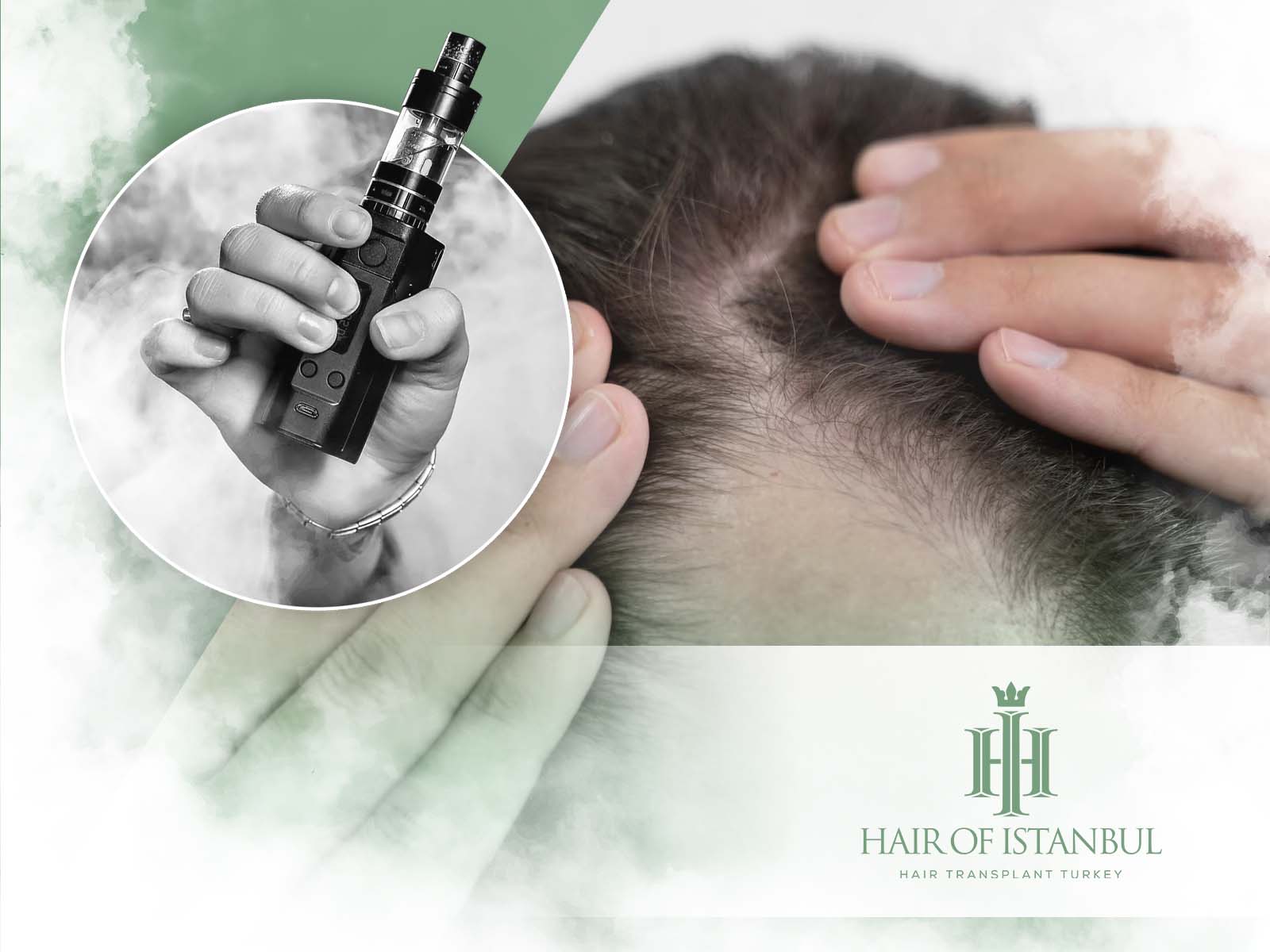
Does Vaping Cause Hair Loss? The Evidence and the Gaps
Does vaping cause hair loss? It is one of the most-asked questions about e-cigarettes and one of the least-answered, because the honest starting point is uncomfortable: no study has ever measured it.
That does not leave us with nothing. It leaves us with a mechanism that has been measured carefully, and a comparison that has not.
The short answer
There is no direct evidence. A literature search for vaping or e-cigarettes together with hair loss or alopecia returns no studies. Anyone giving you a confident yes or no is not reading research.
There is strong indirect evidence. Vaping measurably impairs vascular and microvascular function, and the hair follicle is one of the most blood-supply-dependent structures in the body. Smoking — which shares that mechanism — is an established risk factor for pattern hair loss.
Around surgery the answer is not ambiguous at all. Vaping is treated exactly like smoking, for reasons set out below.
Why there is no direct evidence
Vaping is roughly two decades old as a consumer product and only about a decade old at scale. The studies that established the smoking–hair loss link are cross-sectional surveys and cohorts built over many years; the equivalent work for vaping has not been done yet, and may not be for some time.
That absence should be stated plainly rather than filled in. A page that tells you vaping definitely causes hair loss is extrapolating; so is a page that tells you it definitely does not.
What has been measured: blood vessels
This is where the evidence is genuinely good, and it is the part that matters for hair.
A network meta-analysis of randomised controlled trials pooled 8 studies with 372 participants, comparing vaping with nicotine against vaping without it. Nicotine-containing e-cigarettes significantly increased pulse wave velocity (mean difference 3.09, 95% CI 1.51–4.68, p < 0.001) and the augmentation index (2.11, 1.02–3.21, p < 0.001) — both measures of arterial stiffness. The authors concluded that acute inhalation of e-cigarettes produces negative changes in vascular endothelial function, and that e-cigarettes should not be considered cardiovascular safety products.
A 2025 study went further and looked at the microvasculature, which is the level a hair follicle actually lives at. It compared 39 e-cigarette users, 39 tobacco smokers and 30 never-smokers. Both e-cigarette users and smokers had significantly lower coronary flow reserve at baseline than never-smokers (p < 0.001), a finding compatible with microvascular dysfunction. After acute exposure, e-cigarette use significantly reduced coronary flow reserve and increased pulse wave velocity.
The most important line in that study is what it did not find: no interaction between the type of exposure and the degree of vascular or microvascular dysfunction. On these markers, vaping and smoking behaved the same.
Why blood vessels matter to a hair follicle
A follicle in its growth phase is among the fastest-dividing tissues in the human body, and it runs entirely on what its small vessels deliver. Anything that narrows or stiffens those vessels reduces the supply that growth depends on.
Vasoconstriction is also the single mechanism that smoking and vaping demonstrably share. The others attributed to cigarettes — oxidative damage from combustion products, DNA adducts, accelerated follicular ageing — belong to burning tobacco and largely do not apply to an aerosol. Nicotine accumulates in the hair follicle and the hair shaft in people exposed to tobacco smoke, so the delivery route to the follicle is not in doubt; what is in doubt is the dose and the consequence.
What the smoking evidence implies
Since vaping has not been studied for hair, the nearest comparison is the mechanism it shares.
A 2026 meta-analysis of 31 studies, 11,224 people with androgenetic alopecia and 36,825 controls, found smoking associated with having the condition at an odds ratio of 1.46 (95% CI 1.06–2.01) and with its progression at 1.60 (1.29–1.99). Family history, for scale, carried odds ratios of 2.72 and 4.24.
Read carefully, that is a modest effect for smoking — and vaping removes most of the mechanisms behind it while keeping one. A reasonable expectation is that vaping’s effect on pattern hair loss, if it exists, is smaller than smoking’s. That is a reasonable expectation, not a finding. The full picture is on our page about nicotine and hair loss.
If your hair started shedding after you switched to vaping
This is a common sequence, and the most likely explanation is usually not the vape.
Quitting smoking is a physiological stressor, and diffuse shedding — telogen effluvium — characteristically appears two to three months after a trigger, not immediately. That delay is exactly long enough for the timing to look like the new habit caused it. Telogen effluvium resolves on its own once the trigger passes.
The distinction is worth making because the two look different and are treated differently:
| Telogen effluvium | Pattern hair loss | |
|---|---|---|
| Pattern | Diffuse, all over | Temples, crown, a recognisable shape |
| Onset | Sudden, 2–3 months after a trigger | Gradual over years |
| Hair calibre | Normal thickness | Progressively finer at the affected zone |
| Course | Recovers | Progresses without treatment |
Vaping before and after a hair transplant
Here the ambiguity disappears, and this is the part patients most often get wrong.
A newly transplanted graft has no blood supply of its own for the first days. It survives by diffusion from the recipient bed until new vessels grow into it. Anything that constricts those vessels during that window directly threatens graft survival — and in the largest published series of recipient site necrosis, two-thirds of the patients were smokers.
Our written instruction is to reduce nicotine as far as possible and ideally stop for at least two weeks. That instruction is about nicotine, not about cigarettes, so it covers vapes, pouches, gum and patches equally. Switching from cigarettes to a vape before surgery is not a workaround; the vascular measurements above show the two behave alike.
The wider surgical risks are in our entry on smoking and hair transplant risks, the necrosis evidence is on scalp necrosis after hair transplant, and the complete timetable is on the aftercare page.
What to do if you vape and your hair is thinning
- Get the pattern identified first. Whether it is androgenetic alopecia or a reversible shed changes everything about what to do next, and it cannot be judged from the habit.
- Check ferritin and thyroid. Correctable causes are missed constantly while people investigate their habits.
- Treat what is treatable. Pattern hair loss responds to minoxidil and, in men, finasteride. Stopping vaping is not a hair loss treatment and should not be sold as one.
- Stop before surgery regardless. That part is not about long-term hair loss; it is about whether this month’s grafts survive.
Frequently asked questions
Does vaping cause hair loss?
No study has measured it. Vaping does impair vascular and microvascular function measurably, and the follicle depends on that supply, so a contribution is plausible — but it has not been demonstrated.
Is vaping better than smoking for your hair?
Probably, since it removes the combustion mechanisms. But on the vascular markers that have been compared directly, e-cigarettes and tobacco produced no significantly different effect.
Can vaping cause hair thinning in females?
The same answer applies: no direct study, and the same vascular mechanism. Diffuse thinning in women has a wide differential — iron deficiency and thyroid disease among the most common — and should be investigated rather than attributed.
Will my hair grow back if I stop vaping?
Follicles miniaturised by pattern hair loss will not recover because you stop. A diffuse shed related to a recent trigger usually does, over months.
Can I vape after a hair transplant?
We ask patients to stop nicotine in all forms for at least two weeks, because nicotine constricts the vessels the new grafts depend on before they establish their own blood supply.
Does nicotine-free vaping affect hair?
The vascular changes in the pooled trials were measured against nicotine-free vaping as the comparator, which is what isolates nicotine as the driver. Nicotine-free aerosol has not been studied in relation to hair.
References
- Meng XC, Guo XX, Peng ZY, Wang C, Liu R. Acute effects of electronic cigarettes on vascular endothelial function: a systematic review and meta-analysis of randomized controlled trials. Eur J Prev Cardiol. 2023;30(5):425–435. PMID 36316290. pubmed.ncbi.nlm.nih.gov
- Celik FB, Irgi T, Guvenc TS, et al. Exposure to electronic cigarettes impairs vascular and microvascular function. Int J Cardiol. 2025;441:133789. PMID 40829750. pubmed.ncbi.nlm.nih.gov
- Li H, Li W, Zhang J, et al. Risk factors for androgenetic alopecia: a systematic review and meta-analysis. BMC Public Health. 2026;26(1):1000. PMID 41606541. pubmed.ncbi.nlm.nih.gov
- Babadjouni A, Pouldar Foulad D, Hedayati B, Evron E, Mesinkovska N. The Effects of Smoking on Hair Health: A Systematic Review. Skin Appendage Disord. 2021;7(4):251–264. PMID 34307472. pubmed.ncbi.nlm.nih.gov
- Ceran F. Recipient Site Necrosis After Follicular Unit Excision Technique For Hair Transplantation: Evaluation of 18 Patients. Aesthetic Plast Surg. 2024;48(19):3735–3740. PMID 39160404. pubmed.ncbi.nlm.nih.gov
In short
Does vaping cause hair loss? Nobody has measured it, and that absence is the most honest thing on this page. What has been measured is the mechanism: across 8 randomised trials and a 108-participant comparison, vaping stiffens arteries and impairs microvascular function — and on those markers it was not distinguishable from tobacco. Since the hair follicle runs on microcirculation, a contribution is plausible and probably smaller than smoking’s, because the combustion mechanisms are absent. Before and after a hair transplant there is no ambiguity: nicotine in any form constricts the vessels new grafts depend on, so vaping is stopped exactly as cigarettes are.
If your hair is thinning and you are not sure what kind of loss it is, send us photographs — that question has an answer, and your vape is not it.