 en
en TR
TR  SK
SK  ITA
ITA  FR
FR  DE
DE  ES
ES  BG
BG  RO
RO 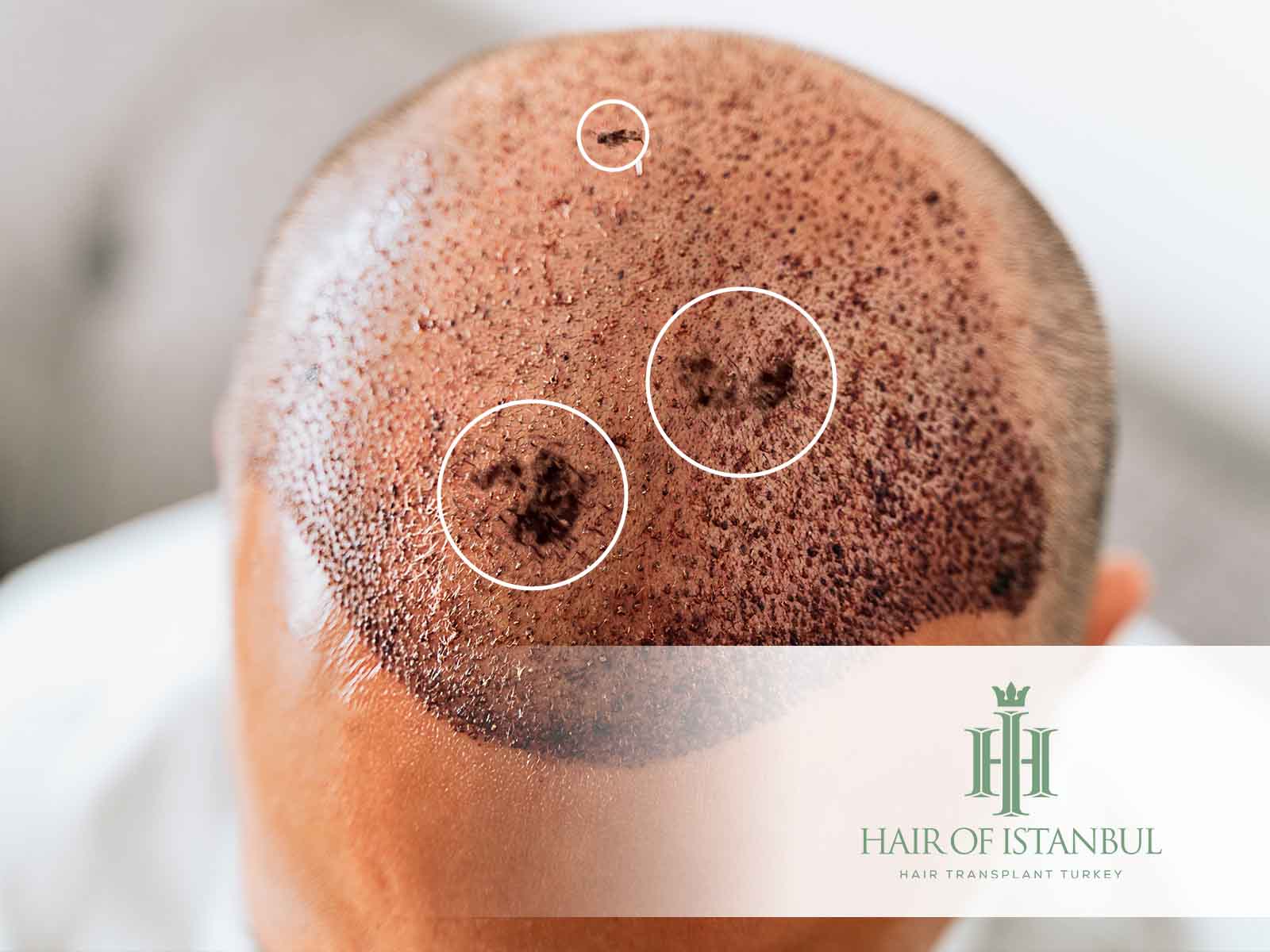
Scalp Necrosis After Hair Transplant: Causes, Signs and Prevention
Scalp necrosis after hair transplant surgery is the most serious thing that can go wrong. It is rare, it is largely preventable, and it is almost always the consequence of decisions made before and during the operation rather than of anything the patient did afterwards.
This page explains what it is, what causes it, how to recognise it early, and what the largest published series actually found.
What scalp necrosis after hair transplant surgery is
Necrosis means tissue death. In a hair transplant it occurs when the blood supply to an area of scalp is insufficient to keep the skin alive after surgery. The affected skin darkens, forms a black eschar, and separates — taking the grafts in that area with it and leaving a scar where hair will not grow again.
It is described in the literature as a rare but serious complication. A 2025 meta-analysis of 45 studies concluded that hair transplant surgery is generally safe, with pain, swelling and oedema the most commonly reported problems; in the observational studies reviewed, 442 patients out of 2,353 reported any complication at all, and necrosis was not among the common ones.
Rare is not the same as unimportant. When it happens, the damage is permanent.
What the largest published series found
The most informative study is a 2024 review of 18 patients who developed recipient site necrosis between 2017 and 2023 — described by its author as the largest complication series of its kind in the literature.
| Finding | Result in the 18-patient series |
|---|---|
| Mean age | 36.1 years (range 22–48) |
| Smoking | 66.7% (10 of 18) |
| Hypertension | 20% (3 patients) |
| Diabetes mellitus | 13.3% (2 patients) |
| Procedure type | All 18 were single-session FUE |
| Average grafts transplanted | 3,899 ± 94 follicular units |
| Outcome | Scarring and graft failure in all patients |
| Treatment | Debridement plus wound care in every case |
Three things in that table deserve attention. Every case was a single-session procedure. The average was close to 3,900 grafts in one sitting. And two-thirds of the patients smoked.
That is not a coincidental cluster. It is a description of the mechanism.
Where necrosis sits among hair transplant complications
It helps to see the whole list, because the complication people fear most is not the one they are most likely to meet.
| Complication | How common | Reversible? |
|---|---|---|
| Pain and swelling | The most frequently reported of all | Yes, days |
| Folliculitis | Common | Yes, treatable |
| Temporary numbness | Common | Usually |
| Shock loss | Common | Yes, regrows |
| Infection | Uncommon | Yes, treatable |
| Recipient site necrosis | Rare | No — permanent scarring |
Necrosis is at the bottom of that list on frequency and at the top on consequence. Everything above it resolves; necrosis does not.
Why it happens
The scalp has an unusually rich blood supply, which is why hair transplantation is safe at all. Necrosis occurs when several things reduce that supply at once:
- Too many incisions in too small an area. Every recipient site is a small wound. Packed densely enough, the surviving tissue between them cannot carry enough blood to keep the skin alive. This is the dose-dependent part, and it is why megasession numbers appear in the necrosis literature.
- Vasoconstriction from adrenaline in the tumescent solution. Adrenaline is used deliberately to reduce bleeding. Too much, or too concentrated, and the vessels it constricts do not reopen in time. Necrosis after tumescent infiltration with adrenaline is a documented scenario.
- Smoking. Nicotine constricts the same small vessels, on top of everything else. Two-thirds of the documented cases smoked.
- Diabetes and hypertension. Both impair small-vessel perfusion and wound healing.
- Deep or wide incisions. Technique that damages the vascular plexus rather than working within it.
Notice what is not on that list: anything the patient does at home afterwards. Washing, sleeping position and shampoo choice do not cause necrosis.
How to recognise it early
Normal healing and early necrosis look different, and the difference matters because early recognition changes the outcome.
| Normal after surgery | Needs assessment today |
|---|---|
| Pink or red recipient area, fading over 2–4 weeks | A patch that turns dusky, grey, purple or black |
| Small crusts over each graft, lifting by day 10 | A thick, hard, dark scab that does not lift with the rest |
| Tightness and mild soreness for a few days | Pain that increases after day 3 instead of settling |
| Swelling of the forehead in days 2–5 | Spreading redness, heat, or discharge with odour |
| Numbness in patches | An area that loses sensation completely and looks discoloured |
The single most useful instruction: if any area of the recipient zone changes colour towards grey, purple or black, photograph it in daylight and send it to your clinic the same day. Do not wait for a scheduled appointment.
Most alarming-looking scalps after a transplant are not necrosis — they are ordinary crusting, swelling, or folliculitis, which is far more common and treatable. Knowing the difference is the point of looking early rather than worrying quietly.
How it is treated
In the published series, every patient received both conservative wound care and surgical debridement of the dead tissue. Treatment is aimed at limiting the area lost and getting a clean wound that heals with the smallest possible scar.
What cannot be recovered is the grafts in the affected area. In all 18 cases, scarring and graft failure occurred. Reconstruction — usually transplanting into the scar once it is mature and stable — is a separate procedure, planned much later, and it uses more of a donor area that has already been drawn on.
How it is prevented
Prevention is entirely on the clinic’s side of the table, with one exception.
- Session size matched to the scalp. The necrosis series averaged nearly 3,900 grafts in a single session. Splitting large plans across staged sessions is the most direct protection there is — the reasoning is set out on our page about large graft numbers.
- Controlled adrenaline concentration in the tumescent solution, and a surgeon who is deciding it rather than a technician following a routine.
- Incision density planned, not maximised. Dense packing has a limit past which survival falls for every graft, not just the ones that die.
- Preoperative screening. Diabetes, hypertension and smoking are identified before the operation, not discovered afterwards.
- The patient’s part: stopping nicotine. Our written instruction is to reduce smoking as far as possible and ideally stop for at least two weeks, because nicotine constricts precisely the vessels the grafts depend on. The full protocol is on the aftercare page, and the wider risks are in smoking and hair transplant risks.
At Hair of Istanbul the operation is performed in a licensed clinic under the responsibility of our medical team, and graft numbers are set by what the scalp can support rather than by a package. The technical detail is on the FUE technique page.
Frequently asked questions
How common is scalp necrosis after a hair transplant?
Rare. A meta-analysis of 45 studies found complications in 442 of 2,353 patients overall, with pain and swelling the most common; necrosis was not among the frequently reported problems. The largest dedicated series collected 18 cases over six years.
What does scalp necrosis look like?
An area that turns dusky, grey, purple or black, often with a thick dark eschar that does not lift with the ordinary crusts, and pain that increases rather than settles after the third day.
When does necrosis appear?
Typically in the first days to two weeks after surgery, while normal crusting is still resolving — which is why the colour change, not the crust, is the signal to watch.
Does smoking cause scalp necrosis?
Smoking was present in 66.7% of the documented cases. It is a major risk factor rather than a sole cause, because nicotine constricts the small vessels the healing scalp depends on.
Will hair grow back after necrosis?
Not in the affected area. Scarring and graft failure occurred in all 18 patients in the published series. Transplanting into the mature scar later is possible but is a separate procedure.
Is my red scalp after a transplant necrosis?
Almost certainly not. Pink or red recipient skin that fades over two to four weeks is normal. Necrosis is a colour change towards grey, purple or black in a defined patch.
References
- Ceran F. Recipient Site Necrosis After Follicular Unit Excision Technique For Hair Transplantation: Evaluation of 18 Patients. Aesthetic Plast Surg. 2024;48(19):3735–3740. PMID 39160404. pubmed.ncbi.nlm.nih.gov
- Khatib M, Skorochod R, Wolf Y. Complications Following Hair Transplantation: A Systematic Literature Review and Meta-Analysis. Aesthetic Plast Surg. 2025;49(23):6393–6405. PMID 40913181. pubmed.ncbi.nlm.nih.gov
- Romera de Blas C, Vega Díez D, Ricart Vayá JM, Gómez Zubiaur A. Complications in follicular unit excision hair transplantation: current evidence and practical approaches. Front Med (Lausanne). 2026;13:1750989. PMID 41709896. pubmed.ncbi.nlm.nih.gov
- Zito PM, Raggio BS. Hair Transplantation. StatPearls, NBK547740. ncbi.nlm.nih.gov
In short
Scalp necrosis is rare, permanent where it occurs, and driven by a recognisable combination: a large single session, dense incisions, vasoconstriction from adrenaline and nicotine, and impaired perfusion from smoking, diabetes or hypertension. In the largest published series all 18 cases were single-session FUE averaging almost 3,900 grafts, two-thirds of the patients smoked, and every one of them was left with scarring and graft failure. The signal to act on is a colour change towards grey, purple or black — photographed in daylight and sent to the clinic the same day, not at the next appointment.
If you are recovering from a transplant and something about the colour of your scalp worries you, send us the photograph rather than waiting.