
 en
en TR
TR  SK
SK  ITA
ITA  FR
FR  DE
DE  ES
ES  BG
BG  RO
RO 
Is It Normal to See Your Scalp When Your Hair Is Wet?
If you see scalp when hair is wet, that is normal. Water makes strands stick together into separated clumps, so the same amount of hair covers less of the head. When you see scalp when hair is wet but it looks the way it always has once dry, this is a grouping effect, not hair loss.
The question is worth asking, though, because wet hair is also where thinning becomes visible earliest. The difference is not whether you see scalp when hair is wet — almost everyone does — but where you see it and whether it is still there once the hair dries.
Why you see scalp when hair is wet, and why hair looks thin when wet
Dry hair sits apart. Each strand carries a slight static charge and a cuticle surface that keeps it separated from its neighbours, so the strands spread across the scalp and cover it.
Water removes that separation. Wet hair absorbs water, becomes heavier, and the strands cling to one another and lie flat. Hair that was spread over the whole scalp now sits in a smaller number of thicker groups, and the skin between those groups becomes visible. The hair count has not changed; its distribution has.
Two things make the effect stronger: light coming from directly above, and fine or straight hair, which has less natural separation to begin with. This is why the same head can look full in a mirror and sparse in a bathroom photograph taken from above.
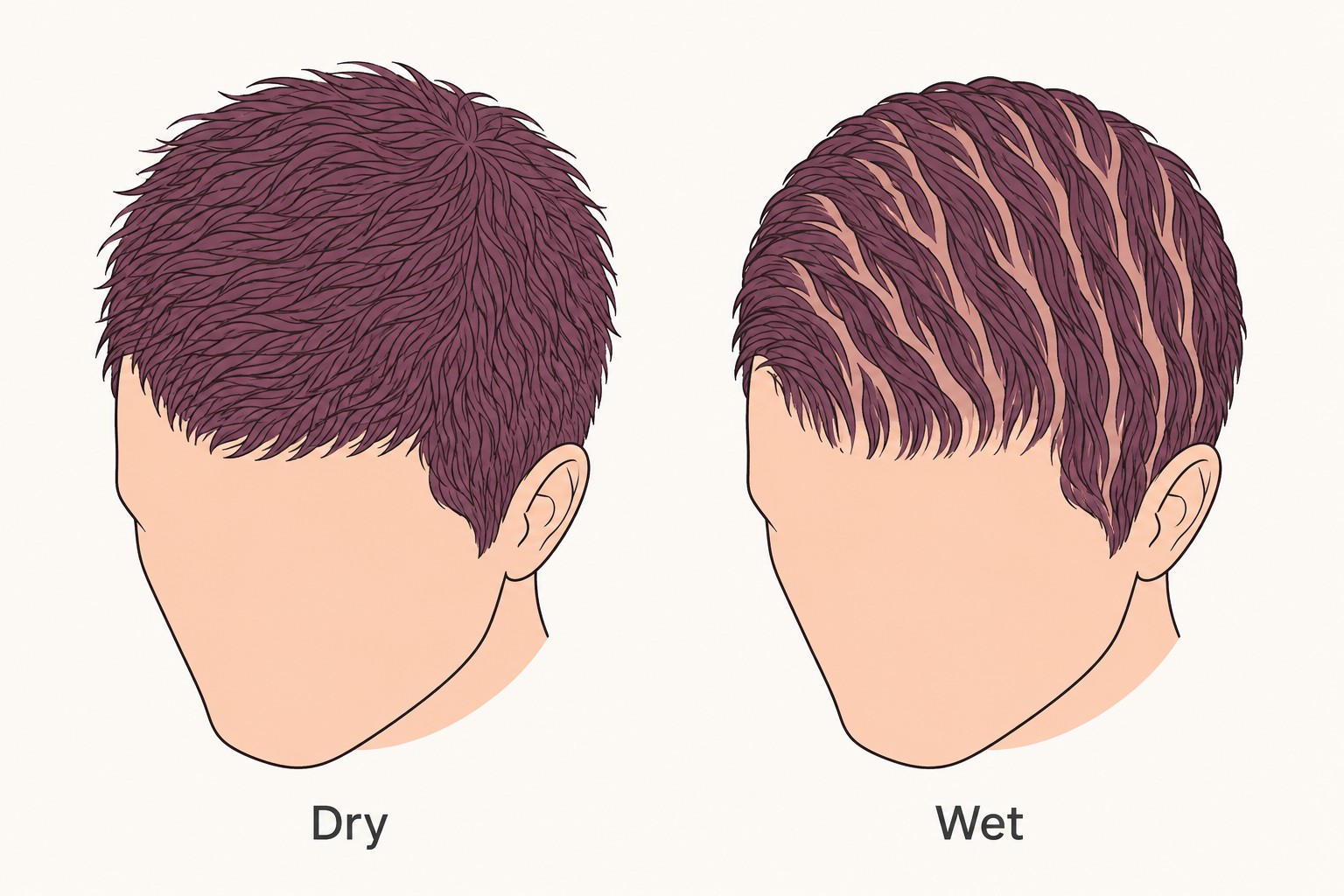
The same amount of hair in both panels. Dry, the strands spread and overlap; wet, they gather into clumps and leave channels of scalp between them. Nothing has been lost — it has been rearranged.
Normal, or the beginning of hair loss?
When you see scalp when hair is wet, the useful test is not how much you see, but the pattern — and whether it survives drying.
| Wet-hair effect | Pattern hair loss | |
|---|---|---|
| When visible | Only while wet; gone once dry | Visible dry as well, in certain light |
| Where | Evenly across the whole scalp | Concentrated at the temples, front or crown |
| Hair calibre | Unchanged | Individual hairs finer and shorter over time |
| Over months | Stable | The area slowly widens |
| Back and sides | Same as the top | Stay dense while the top thins |
That last row carries most of the information. Androgenetic hair loss is patterned: DHT shortens the growth phase of susceptible follicles from three to six years down to weeks or months, and the follicle miniaturises, “progressively producing fewer and finer hairs” (DermNet, Male pattern hair loss). The follicles at the back and sides are not susceptible, so they stay as they were. Wet hair, by contrast, treats every part of the head the same way.
If the thinning is even across the whole scalp rather than patterned, that points somewhere else — see diffuse thinning and telogen effluvium, which behave differently and often reverse.
How to check it yourself
Five checks that separate the ordinary reasons you see scalp when hair is wet from genuine thinning. None need equipment:
| Check | How to do it | What it tells you |
|---|---|---|
| The dry check | Look at the same area under the same light, dry, an hour later. | If the scalp is no longer visible, it was the wet-hair effect. This settles most cases on its own. |
| The photograph | Photograph your crown and hairline in the same room and light, every three months. | Memory is unreliable over months; photographs are not. Slow change is the signal, not any single image. |
| The calibre check | Compare a hair from the top of the head with one from the nape. | If the top hair is visibly finer and shorter, that is miniaturisation — the earliest reliable sign, well before any bald area appears. |
| The pull test | Grasp a lock of hair and pull firmly but without force. | Extracting 0–2 resting hairs is normal (DermNet). Consistently more than that, across several areas, suggests active shedding. |
| The parting test | Part your hair on the opposite side to usual. | If the scalp is markedly more visible along the new parting, density on that side is lower. |
If you want a reference for where a receding pattern sits, the Norwood scale maps the usual stages. A separate question — scalp visible under bright light rather than when wet — is covered in seeing your scalp through your hair.
How much hair should come out in the shower?
More than you expect. The American Academy of Dermatology states plainly: “It’s normal to shed between 50 and 100 hairs a day.” Washing does not create that shedding; it collects it. Hairs that were already detached and held in place by the surrounding hair are released together, which is why a wash after several days looks alarming and a daily wash does not.
What is worth noting is a sustained change: markedly more hair, every wash, for longer than about six weeks. Shedding of that kind usually follows an event — illness, surgery, a sharp weight change, a new medication — by two to three months, and usually resolves on its own. It is a different process from pattern loss, and the two are frequently confused: see hair shedding vs hair loss.
What not to do with wet hair
Wet hair is mechanically weaker — the fibre swells and stretches more easily before it breaks — so habits that are harmless on dry hair cause damage here.
| Instead of this | Do this |
|---|---|
| Rubbing it dry with a towel | Press and blot the water out. |
| Brushing or combing aggressively | Use a wide-tooth comb, working from the ends upwards. Forcing a brush through wet tangles snaps hairs mid-shaft. |
| Pulling at tangles | Apply conditioner or a detangler first, then work them out gently. |
| High heat on soaking hair | Let it dry most of the way, then style. |
| Tying it up tightly while wet | Leave it loose. Repeated tension on the same hairline over years causes traction alopecia — avoidable, and reversible if caught early. |
None of this prevents androgenetic hair loss, which is not caused by handling. It prevents breakage, which is a separate problem that makes hair look thinner without any follicle being lost.
Sleeping with wet hair
This is the single most asked question about wet hair, and most of the answers online are wrong in both directions.
What is true: wet hair is mechanically weaker. The fibre absorbs water, swells, and stretches further before it breaks, so hours of friction against a pillow cause more breakage than the same friction on dry hair. Breakage makes hair look thinner without a single follicle being lost — which is why it matters on a page about visible scalp.
What is not true: sleeping with wet hair does not cause colds or flu. Those are viral infections and damp hair does not produce them. The fungal-infection warning repeated on many sites is also overstated for most people; a scalp that is regularly damp for long periods under occlusion can favour yeast overgrowth, but a night with towel-dried hair is not that.
If you cannot avoid it, dry the hair to damp rather than soaking, use a silk or satin pillowcase to cut friction, and do not tie it up tightly while wet.
Wetting your hair every day
Wetting hair daily does not cause hair loss. Water alone does not damage the follicle. What daily washing can do — depending on the shampoo and your scalp — is strip sebum and leave the lengths dry and more prone to breakage. If you wash daily and your hair feels rough, the variable to change is the product, not the frequency.
When it is worth having it assessed
To see scalp when hair is wet needs no action at all. See a dermatologist or a hair restoration clinic if the scalp is visible when the hair is dry, if the area has widened over a year of photographs, if the hairs on top are visibly finer than those at the back, or if shedding has been heavy for more than six weeks.
An assessment is not the same as an operation. What it establishes is whether the pattern is androgenetic, how far it is likely to go, and whether medical treatment alone is enough — most early cases are managed without surgery. Acting early matters because miniaturised follicles can often be maintained, while follicles that have been gone for years cannot be brought back.
Frequently asked questions
Is it normal to see scalp when hair is wet?
Yes. Wet strands clump together and cover less surface, so almost everyone will see scalp when hair is wet. It only warrants attention if it is still visible once the hair has dried, or if it is concentrated at the temples or crown rather than spread evenly.
How much scalp should be visible when hair is wet?
There is no threshold, because it depends on hair calibre, density, curl and the light. Fine straight hair shows far more scalp than coarse wavy hair at exactly the same density. Judge the pattern and whether it survives drying, not the amount.
Is it bad to sleep with wet hair?
It causes breakage rather than hair loss, and it does not cause illness. Wet hair stretches and snaps more easily, so a night of friction against a pillow costs you length and thickness in the hair you already have. Dry it to damp first if you can.
Is it okay to wet your hair every day?
Yes. Water does not harm follicles. Daily washing can dry the lengths depending on the shampoo, but that is a breakage question, not a shedding one.
Why does my hair look thinner when wet?
Because volume comes from strands being separated from each other, and water removes that separation. The hair count is identical; the arrangement is not.
Can I tell if I am balding from wet hair alone?
No, and this is the most common mistake. You will see scalp when hair is wet on almost any head, whatever its density. Judge from dry hair, in consistent light, compared over months.
How much scalp should be visible when hair is wet?
There is no threshold that separates normal from abnormal, because it depends on hair calibre, density, curl and lighting. Fine straight hair shows far more scalp than coarse wavy hair at exactly the same density. Pattern, not amount, is what carries meaning.
Does washing hair cause hair loss?
No. Washing releases hairs that had already separated from the follicle. Washing less often does not reduce shedding; it concentrates it into fewer washes.
My scalp shows when wet but my hair feels thick. Which do I believe?
Feel is a poor measure and sight in the shower is worse. Use the calibre check — a hair from the top against a hair from the nape — and photographs taken three months apart.
If what you see has not changed over a year, it is simply how your hair sits when wet. If it has changed, the useful next step is measurement rather than watching: trichoscopy shows miniaturisation directly and separates pattern loss from temporary shedding. Hair of Istanbul is a licensed clinic operating in Ataköy, Bakırköy, Istanbul since 2013 — you can read about our medical team, and if you want to see what treatment actually looks like over time, our documented hair transplant journey follows one patient through 279 dated photographs.
References
- American Academy of Dermatology, Do you have hair loss or hair shedding?
- DermNet, Male pattern hair loss (androgenetic alopecia, balding)
- DermNet, Examination of hair and scalp
- DermNet, Telogen effluvium (hair shedding)