
 en
en TR
TR  SK
SK  ITA
ITA  FR
FR  DE
DE  ES
ES  BG
BG  RO
RO 
Black Female Hair Transplant: What the Diagnosis Decides
A black female hair transplant succeeds or fails on one thing that has nothing to do with the surgery: the diagnosis. Three very different conditions cause most hair loss in Black women — traction alopecia, central centrifugal cicatricial alopecia (CCCA) and female pattern hair loss — and they do not respond to grafting the same way. One is reversible without surgery. One can destroy transplanted grafts as readily as it destroyed the original ones. Only the third behaves the way a standard hair transplant expects.
Most pages on this subject skip straight to technique. Technique matters, and we cover it below. But a clinic that measures your donor area before it has named your condition is selling you an operation, not treating you.
The short answer
- Yes, hair transplants work on Afro-textured hair — with a punch designed for curved follicles. With conventional rotary punches, transection rates in tightly curled hair are unacceptable.
- Traction alopecia is reversible in its early stage and needs no surgery. Once follicles are scarred, only grafting restores them — and only if the tension stops first.
- CCCA is a scarring disease. It must be medically quiet before any transplant, and scarred tissue can still reduce graft survival.
- The hairline and edges are the most requested areas and also the most exposed to renewed tension after surgery.
- Keloid tendency is a consultation topic, not an automatic disqualification.
Why the diagnosis comes before the transplant
A hair transplant moves follicles from a donor area to a recipient area. It does not treat whatever is causing the loss. If the cause is still active — ongoing tension, or an inflammatory scarring process — it will act on the transplanted follicles too.
That is why the same operation produces excellent results in one Black woman and disappointing ones in another with a visually similar pattern. The three conditions below look alike in photographs and behave completely differently on the operating table.
Traction alopecia: reversible, until it isn’t
Traction alopecia comes from sustained pull on the follicle. StatPearls lists the implicated styles directly: ponytails, pigtails, chignons, braids, cornrows, twists, sister locks, dreadlocks, weaves, extensions and curlers, with chemical relaxers and heat styling as additional risk factors.
It is common enough that the numbers are worth seeing:
| Population studied | Reported prevalence |
| South African adult women | up to 31.7% showing hair changes |
| South African adult men | 2.3% |
| South African children, ages 6–15 | 8.6% – 21.7% |
| African American girls, ages 5.4–14.3 | 18% |
| African schoolchildren | 17.1% of girls, 0% of boys |
The clinical sign to look for is the fringe sign: a surviving band of finer, smaller-diameter hairs along the frontal or temporal hairline, which on biopsy are miniaturised vellus hairs. Its presence tells you the loss is tension-driven rather than genetic.
The stage is what decides the treatment. Early traction alopecia is non-scarring and reversible — the follicular units are still intact and hair returns once the pull stops. Chronic repeated traction produces follicular miniaturisation, perifollicular fibrosis and eventually permanent cicatricial alopecia through irreversible stem cell damage. At that point hair does not come back on its own, and transplantation becomes a reasonable option for longstanding disease.
One condition applies at every stage: the tension has to stop. Grafting into a hairline that will be pulled tight again in three months wastes the grafts. We cover the boundary between the two stages in more detail on traction alopecia: when is it too late.
CCCA: the one a transplant cannot outrun
Central centrifugal cicatricial alopecia is the most common type of scarring alopecia among middle-aged women of African descent, with reported prevalence between 2% and 7% depending on the study. Mean age of onset in women is 36.
It behaves unlike traction alopecia in every respect that matters surgically:
- It starts at the vertex — the crown — and spreads outward centrifugally, usually symmetrically, blending gradually into normal scalp. Traction alopecia starts at the margins.
- It is scarring from the beginning. Once a follicle is destroyed, it does not regrow, whatever treatment follows.
- Its cause is not settled. Relaxers, hot combs and traction styles were the historical explanation, but that theory was questioned when the condition appeared in women who used none of them. Environmental and genetic factors are both implicated.
Diagnosis is not made by looking. It requires 4 mm punch biopsies taken from the active margin, sectioned both vertically and horizontally, alongside dermoscopy showing loss of follicular ostia or a white peripilar halo. First-line treatment is topical or intralesional steroids — triamcinolone.
On transplantation, the literature is careful, and so are we: hair transplantation can be effective in advanced disease, but scarring may reduce the survival rate of transplanted grafts, and disease activity has to be brought under control before any surgery. A clinic that offers you a date without a dermatological assessment is skipping the step that determines whether the grafts live.
Female pattern hair loss
The third possibility is ordinary androgenetic thinning, which affects women of every background. It produces diffuse widening at the part with a preserved frontal hairline, rather than a receding margin or a spreading crown patch. It is graded on the Ludwig scale, and it is the pattern a conventional transplant plan is built around.
It can also coexist with either of the other two — which is exactly why the assessment matters more than the pattern you think you recognise in the mirror.
Telling them apart
The quickest way to separate the three is by where the loss begins, seen from above:
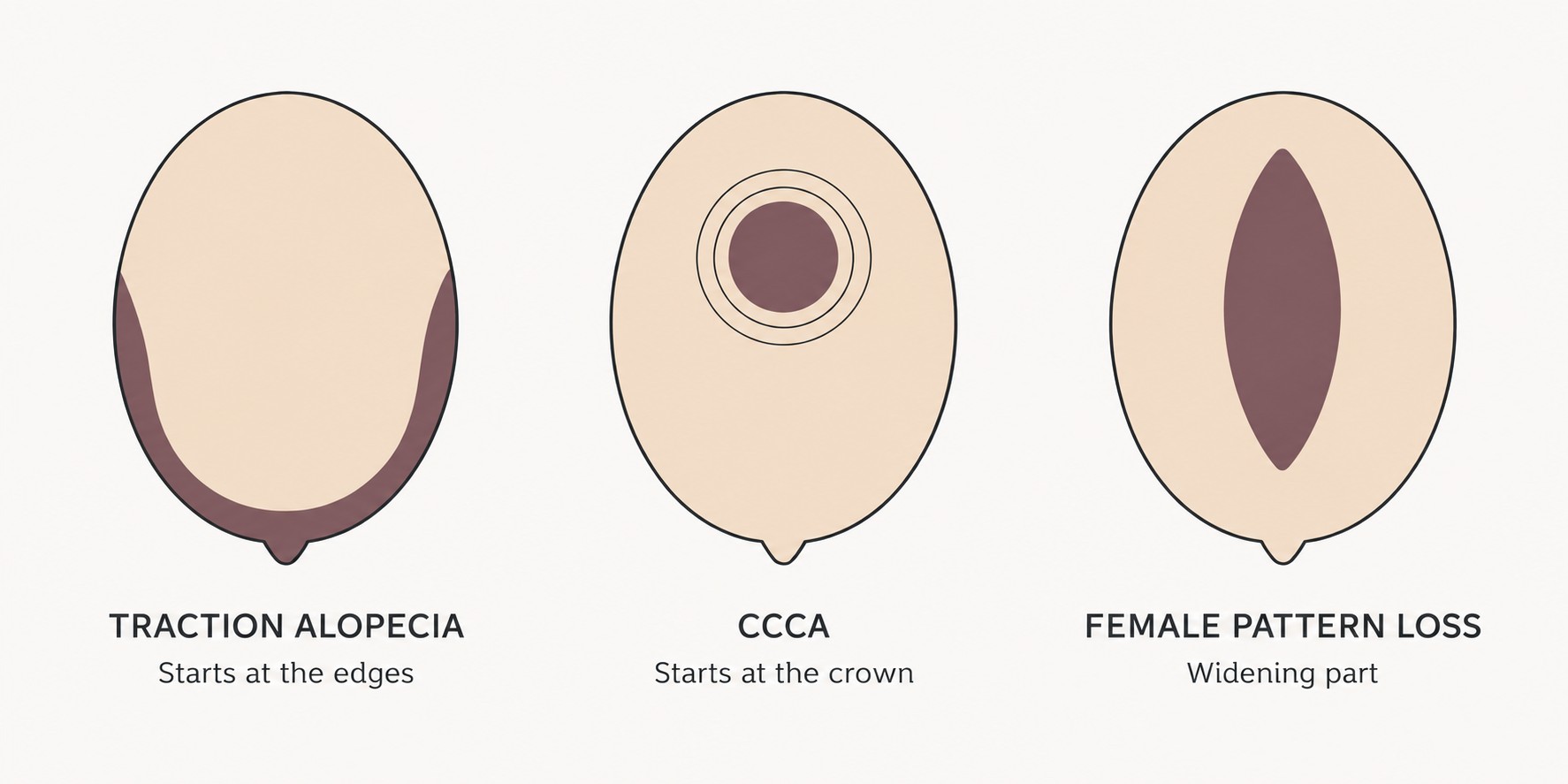
| Traction alopecia | CCCA | Female pattern loss | |
| Where it starts | Frontal and temporal margins, edges | Vertex (crown), spreading outward | Central part, widening |
| Scarring | Not at first; scarring if chronic | Scarring throughout | Non-scarring |
| Reversible without surgery | Yes, in the early stage | No, once follicles are lost | Partially, with medical therapy |
| Distinctive sign | Fringe sign along the hairline | Loss of follicular ostia, white peripilar halo | Preserved frontal hairline |
| Before any transplant | Tension must stop | Disease must be quiet | Loss should be stabilised |
Does a black female hair transplant actually work?
Yes. Hair transplants work on Afro-textured hair, and the reason the question is asked so often is that the answer used to be less certain — for a specific technical reason rather than a biological one. That reason has a name, and a measured solution.
The curved follicle, and the punch that solved it
In tightly curled hair the follicle does not run straight down under the skin; it follows the same curve below the surface that the hair shows above it. A cylindrical punch pushed straight down cuts across it. That cut is called transection, and a transected graft is a lost graft.
A comparative case series of 18 patients with tightly curled Afro-textured hair tested three extraction approaches in sequence, and the result is the clearest data we have:
| Punch used | Outcome in the series |
| Conventional sharp rotary punch | Failed completely or produced excessive transection in 8 of 18 patients |
| Conventional dull rotary punch | Outperformed the sharp punch in 9 patients, with fewer restrictions |
| Two-pronged curved non-rotary punch | Under 5% transection in every instance |
This is the whole of the “specialised technique” question, stated concretely. It is not about experience in the abstract — it is about whether the clinic owns and uses instrumentation that follows the curve. It is a fair and specific thing to ask before you book, and the answer should be a description of the punch, not a reassurance. The general extraction principles are covered on our FUE technique page, and the geometry involved on graft extraction angle.
Density: what is realistic
There is a compensation worth understanding. Curled hair covers more scalp per follicle than straight hair, because each shaft occupies volume rather than lying flat. In practice this means a given graft count reads as fuller coverage than the same count would in straight hair.
What it does not do is expand the donor area. The number of grafts available is set by donor density and scalp laxity, not by texture, and it is finite. Any clinic quoting a graft number before examining the donor area is quoting a price, not a plan. Our graft calculator gives a rough range; the real figure comes from measurement.
Keloid risk, stated honestly
Keloid incidence in darker-pigmented populations is reported between 4.5% and 16%, and surgery is among the triggers, alongside piercings, acne, burns and other cutaneous injury. Lesions can appear anywhere from one to three months after injury up to a year later.
Two points keep this in proportion. First, the sites where keloids form most often are the deltoid, the pre-sternal chest, the upper back and the ears — the scalp is not among them. Second, a personal or family history of keloids is a reason for a careful consultation and, where appropriate, a test area, not an automatic refusal. What it is not is something to discover after the operation, so raise it yourself if the clinic does not ask.
The hairline and the edges
Restoring thinned edges is the most requested procedure among Black women, and it carries a specific tension: the frontal and temporal margins are exactly where traction acts. Grafts placed there are permanent, but they are not immune to being pulled out of a scarred, weakened scalp by the same styling that removed the originals.
Hairline design also has to respect what a woman’s hairline actually is. A female frontal hairline is generally lower, rounder and without the temporal recession seen in men, and it should be planned from facial proportion rather than transferred from a male template. We cover the female frontal approach on women’s hair transplant, and the specific case of an M-shaped pattern in women on how to fix an M-shaped hairline for females.
Who is a candidate, and who is not
Likely a good candidate:
- Longstanding traction alopecia where the tension has genuinely stopped and the loss has been stable for months.
- Female pattern loss that has been assessed and stabilised.
- CCCA that a dermatologist confirms is inactive, with realistic expectations about graft survival in scarred tissue.
- An adequate donor area — confirmed by examination, not by photograph.
Not yet a candidate:
- Anyone still wearing the styles that caused the loss.
- Active, untreated CCCA, or any scarring alopecia that has not been biopsied.
- Anyone whose hair loss has not been diagnosed at all.
- Anyone who has been quoted a graft number over a photograph, without a scalp examination.
What to ask before you book
- What is my diagnosis, and how was it reached? If a scarring alopecia is suspected, was a biopsy done?
- What punch will be used on my hair, and why that one?
- What transection rate does the team expect in tightly curled hair?
- What is my measured donor density, and what graft number does it support?
- How long before I can braid, weave or relax again?
- Can I see results on Afro-textured hair specifically — not general before-and-afters?
That last one is fair to insist on. Our documented cases are on the before and after page, and a single patient’s full 23-month course is photographed month by month in the hair transplant journey.
Going back to protective styles
The transplanted follicles are permanent. The scalp they sit in is not indifferent to what you do next. Returning to the same tension that caused traction alopecia will, over time, produce the same result in the same place — this is the single most common way a technically good result is lost.
Looser styles, larger sections, rotation between styles and rest periods without extensions are what protect the investment. Heat and chemical relaxers should be discussed with the surgical team rather than resumed on a guessed timetable, because the answer depends on how the recipient area healed.
Frequently asked questions
Can Black women get hair transplants?
Yes. A black female hair transplant is a routine procedure in clinics equipped for it. The requirement is a punch and technique suited to curved follicles, and a diagnosis established before surgery. Neither hair texture nor skin tone is a barrier in itself.
Is a hair transplant for African American women different?
The surgical principles are the same; the instrumentation and the diagnostic workup differ. The follicle curves below the skin, so extraction must follow that curve, and the conditions that dominate in this group — traction alopecia and CCCA — need to be identified and settled before grafting.
Can a transplant restore thinned edges?
Yes, where the follicles are genuinely gone rather than temporarily miniaturised. If the fringe sign is present and the tension is recent, hair may return without surgery once the pull stops — which is why the assessment comes first.
Can you transplant into CCCA?
Only once the disease is inactive, and with the understanding that scarring may reduce graft survival. Transplantation into active CCCA risks losing the grafts to the same process that caused the original loss.
When can I braid or weave my hair again?
Not on a fixed calendar date, and not into the tension that caused the problem. The timing depends on healing and on whether traction was the original cause; your surgical team should give you a date and a style limit, not just a date.
Can I still relax my hair after a transplant?
This is a question for the team that operated on you, because it depends on the state of the recipient area. Chemical relaxers are listed among the risk factors for both traction alopecia and, historically, CCCA, so it is worth reviewing the practice itself rather than only its timing.
How many grafts will I need?
That comes from measured donor density, scalp laxity and the size of the area, not from a photograph. Curled hair does give more visual coverage per graft than straight hair, but it does not increase how many grafts you have.
Will my head be shaved?
The donor area normally needs to be trimmed for extraction. How much beyond that depends on the technique and the size of the recipient area, and it is a reasonable thing to settle in writing before the day.
Will the transplanted hair be curly?
Yes. A follicle keeps its own characteristics after transplantation, so hair moved from your donor area grows with the texture it had there. We cover this in more detail on hair transplant for curly hair.
References
- StatPearls, Traction Alopecia (National Center for Biotechnology Information) — implicated styles including braids, cornrows, twists, sister locks, dreadlocks, weaves, extensions and curlers, plus chemical relaxers and heat; prevalence up to 31.7% in South African adult women versus 2.3% in men, 8.6%–21.7% in South African children aged 6–15, 18% in African American girls aged 5.4–14.3, and 17.1% of African schoolgirls versus 0% of boys; the fringe sign; early stage non-scarring and reversible with follicular units intact, chronic traction producing miniaturisation, perifollicular fibrosis and permanent cicatricial alopecia; transplantation viable in longstanding disease, with tension reduction as the primary intervention at every stage. ncbi.nlm.nih.gov/books/NBK470434
- StatPearls, Central Centrifugal Cicatricial Alopecia (National Center for Biotechnology Information) — most common cicatricial alopecia among middle-aged women of African descent, prevalence 2%–7% across studies, mean age of onset 36; begins at the vertex and progresses centrifugally and symmetrically; permanent, with no regrowth from destroyed follicles; historical association with relaxers, hot combs and traction styles later questioned, environmental and genetic factors implicated; diagnosis by 4 mm punch biopsy with vertical and horizontal sectioning plus dermoscopy showing loss of follicular ostia or white peripilar halo; topical or intralesional triamcinolone first line; transplantation possibly effective in advanced disease but scarring may reduce graft survival, and disease activity must be controlled first. ncbi.nlm.nih.gov/books/NBK559187
- Comparative study of a novel tool for follicular unit extraction in individuals with Afro-textured hair (PubMed 27757365) — retrospective case series, 18 patients with tightly curled hair; conventional sharp and dull rotary punches failed or produced excessive transection in 8 patients, the dull punch outperforming the sharp in 9; a two-pronged curved non-rotary punch produced under 5% transection in all instances. pubmed.ncbi.nlm.nih.gov/27757365
- StatPearls, Keloid (National Center for Biotechnology Information) — incidence of 4.5% to 16% in darker-pigmented populations; most frequent sites the deltoid region, pre-sternal chest, upper back and ears; triggers including surgery, piercings, acne, burns and other cutaneous inflammation; onset from one to three months after injury up to one year. ncbi.nlm.nih.gov/books/NBK507899
In short
A black female hair transplant is a good option for the right condition and a poor one for the wrong condition, and the two are not distinguishable from a photograph. Traction alopecia may not need surgery at all if it is caught early; CCCA needs a dermatologist before it needs a surgeon; pattern loss needs stabilising first. Once the diagnosis is settled, the technical question narrows to one thing — whether the extraction instrument follows the curve of the follicle, where a curved non-rotary punch has been shown to hold transection under 5% while conventional rotary punches failed outright in a third of patients. Ask for the diagnosis first and the punch second, and the rest of the plan follows. If you want the procedure itself explained for Afro-textured hair, our Afro-type hair transplant page covers it.