








Medically reviewed by Dr Mahmut Satekin, Medical Aesthetics Physician — 1 August 2026.
Dandruff does not destroy hair follicles. What it can do is increase how much hair you shed while the scalp is inflamed. In a six-month randomised study of 150 men who had both dandruff and pattern hair loss, treating the dandruff reduced shedding by between 10% and 17% depending on the shampoo used — but hair density did not change. That single finding is the honest answer to the question most people are asking, and the rest of this page explains it.
This guide covers what seborrheic dermatitis is, how it differs from ordinary dandruff, why an inflamed scalp sheds more hair, what treatment does and does not achieve, and how the condition affects hair transplant planning. It is an educational overview and does not replace individual medical advice.
Does dandruff cause hair loss?
Dandruff and seborrheic dermatitis are non-scarring conditions. They inflame the skin around the follicle, but they do not replace it with scar tissue, so the follicle survives and can produce hair again once the inflammation settles.
What they do cause is increased shedding. Two mechanisms are involved:
- Inflammation. Inflammatory activity around the follicle can push hairs out of their growing (anagen) phase and into the resting and shedding (telogen) phase earlier than they otherwise would — a pattern known as telogen effluvium. How the phases normally work is covered in our note on the hair growth cycle.
- Scratching. Persistent, forceful scratching damages hair shafts mechanically and irritates the skin further, which sustains the inflammation.
So the accurate statement is narrow: dandruff contributes to how much you shed. It does not, on its own, cause permanent baldness.
Itchy scalp and hair loss: what the connection actually is
An itchy scalp with thinning hair is one of the most common ways this problem is first noticed, and the two are related — but not in the way most people assume. The itch is not pulling hair out. The itch is a symptom of the inflammation, and it is the scratching that adds the mechanical component.
Forceful, repeated scratching does three things: it breaks hair shafts partway along their length, it damages the skin barrier so the inflammation continues, and in some cases it introduces infection into broken skin. Someone who has been scratching heavily for months can therefore have hair that looks thinner from breakage as well as hair that is genuinely shedding.
Two practical consequences follow. First, controlling the itch is not just about comfort — it removes one of the two mechanisms. Second, an itch that does not respond to treatment is a reason to get a diagnosis, because several conditions that itch are not seborrheic dermatitis and a few of them do destroy follicles.
Is dandruff a sign of hair loss?
No — dandruff is a sign of scalp inflammation, not of pattern hair loss. The two frequently occur in the same person, which is where the association comes from, but one does not indicate the other.
What dandruff can tell you is that a portion of any shedding you are seeing may be reversible. If flaking, redness and itch are present alongside increased shedding, treating the inflammation will usually reduce the shedding. Whatever loss remains after that is a separate question with a separate cause.
Dandruff or seborrheic dermatitis — what is the difference?
They sit on the same spectrum. Dandruff is generally used to describe flaking of the scalp without obvious redness. Seborrheic dermatitis describes the same process when it is more inflamed: visible redness underneath the scale, greasier yellowish flakes, and itch, and it can extend beyond the scalp to the eyebrows, the sides of the nose, the beard area, the chest and behind the ears.
It is common. A 2024 systematic review and meta-analysis in JAMA Dermatology pooled 121 studies covering 1,260,163 people and estimated a global prevalence of 4.38% (95% CI 3.58–5.17), rising to 5.64% in adults. Prevalence varied by region, from 2.62% in India to 8.82% in South Africa.1
In other words, roughly one adult in eighteen has clinician-diagnosed seborrheic dermatitis. Milder dandruff is far more common still.
Why an inflamed scalp sheds more hair
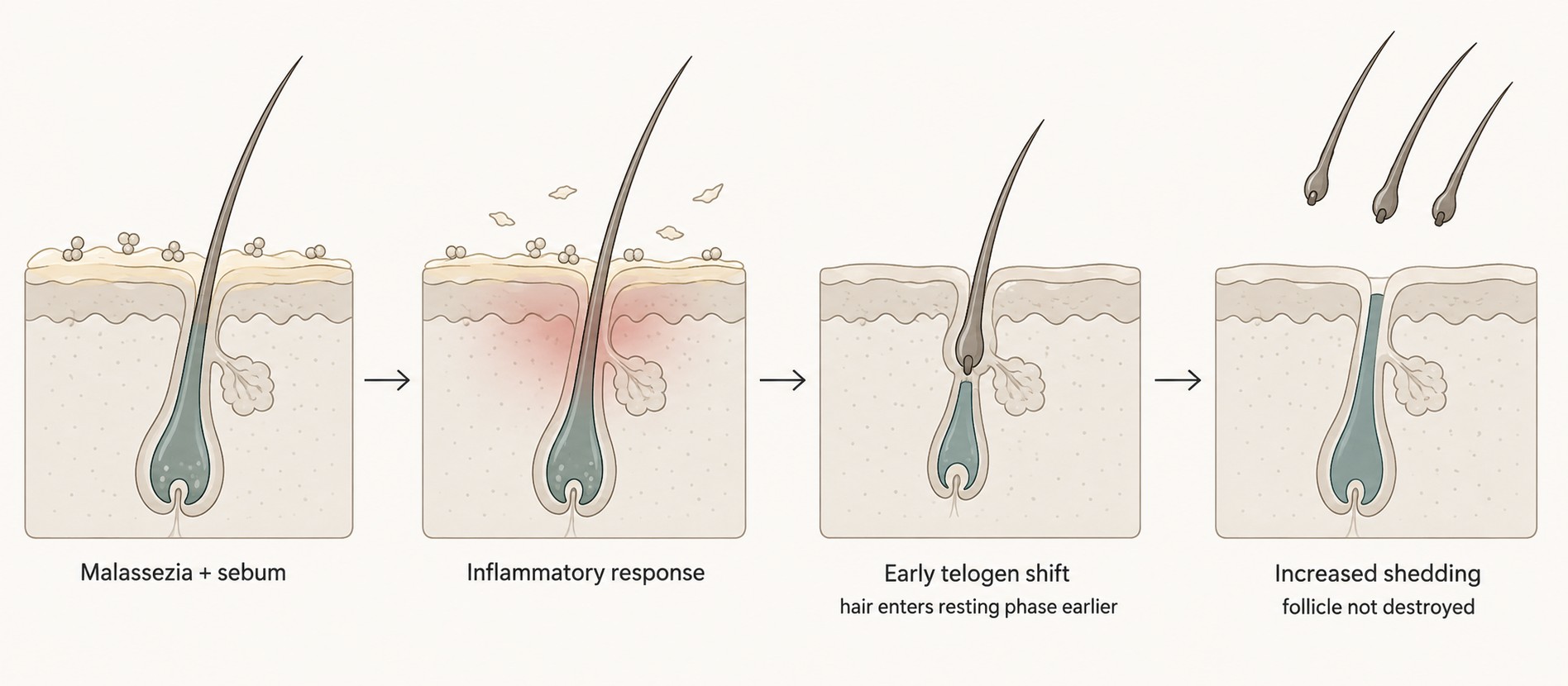
The condition is multifactorial. Current reviews describe an interaction between three things: Malassezia yeasts that live normally on human skin, the composition and quantity of sebum they feed on, and an individual immune response to the fatty acid by-products this produces.2 Genetic predisposition, cold or dry weather, stress, fatigue and certain neurological and immune conditions all influence how severe the response is.
The yeast is not an infection in the usual sense — it is present on almost everyone’s skin. What differs between people is the inflammatory reaction to it.
That reaction is what matters for hair. Sustained inflammation at the level of the follicular opening is what shortens the growth phase and increases the proportion of hairs sitting in telogen at any given time.
Does treating dandruff regrow hair?
This is where the evidence is unusually specific, and where most articles overstate what is known.
Piérard-Franchimont and colleagues studied 150 men who had telogen effluvium related to androgenetic alopecia together with dandruff. Participants were randomised to one of three shampoos — 1% ketoconazole, 1% piroctone olamine, or 1% zinc pyrithione — used two to three times a week for six months. Shedding, hair density, the percentage of hairs in anagen and mean hair shaft diameter were all measured.3
| Measured after 6 months | Ketoconazole 1% | Piroctone olamine 1% | Zinc pyrithione 1% |
|---|---|---|---|
| Hair shedding | −17.3% | −16.5% | −10.1% |
| Hairs in anagen (growing) phase | +4.9% | +7.9% | +6.8% |
| Mean hair shaft diameter | +5.4% | +7.7% | −2.2% |
| Hair density | unchanged in all three groups | ||
All three shampoos cleared the itch and the flaking quickly. All three reduced shedding and increased the proportion of growing hairs. None of them increased hair density.
The practical reading is this: controlling seborrheic dermatitis slows a loss you are currently experiencing. It does not reverse loss that has already happened, and it does not treat pattern hair loss. Anyone promising regrowth from an anti-dandruff shampoo alone is describing something this evidence does not support.
Can anti-dandruff shampoo cause hair loss?
This is a common worry, and the trial above is the most direct answer available: it measured exactly this. Across 150 men using 1% ketoconazole, 1% piroctone olamine or 1% zinc pyrithione two to three times a week for six months, shedding went down in every group, not up.3
The confusion usually has a simple explanation. People start an anti-dandruff shampoo because they have noticed shedding, and they often start washing more frequently than before. Hairs that have already entered the resting phase are released during washing — so washing more often means seeing more hairs at once, in the drain or on the towel. Those hairs were going to be shed regardless; the shampoo made them visible on a different schedule. It did not create them.
Two genuine cautions are worth separating from the myth. Some people develop irritation or contact dermatitis from a specific product, which makes an inflamed scalp worse rather than better — that is a reason to change product, not to stop treating. And on freshly grafted skin after a hair transplant, timing matters a great deal; that is covered further down.
Will hair grow back after seborrheic dermatitis?
In most cases, yes — because the follicle is still there. Seborrheic dermatitis is non-scarring, so hair shed during a flare is generally hair that has been pushed into the resting phase early rather than hair that has been permanently lost.
Recovery follows the normal biology of the growth cycle rather than the speed of the treatment. A hair that has entered telogen sits there for roughly three months before a new one begins to emerge, and it then grows at about a centimetre a month. So the sequence patients typically experience is: itch and flaking settle within weeks, shedding slows over the following one to two months, and visible density recovery is a matter of several months after that. Someone judging their treatment at week six is measuring too early.
Two things limit that recovery, and both are worth knowing in advance. If pattern hair loss is also present, the hair it has already miniaturised does not come back with treatment of the dermatitis. And if the diagnosis is actually a scarring alopecia, the follicles are gone and no amount of anti-inflammatory treatment restores them — which is why a scalp that keeps deteriorating deserves a proper examination rather than another product.
Seborrheic dermatitis and pattern hair loss often occur together
The study above deliberately recruited men who had both conditions, because the overlap is common. That overlap is also the main reason people misjudge their own situation.
If you have androgenetic alopecia, hair is miniaturising over years for reasons unrelated to your scalp condition. If you also have seborrheic dermatitis, you will additionally be shedding more during flares. Treating the dermatitis removes the second component. The first continues regardless, and needs to be assessed on its own terms — the pattern and stage of that loss is what the Norwood scale describes, and for women the Ludwig scale.
Ketoconazole has been examined for effects beyond dandruff control, including in androgenetic alopecia, and remains a subject of ongoing review.5,6 The evidence base is limited, and it should not be regarded as a treatment for pattern hair loss.
Can seborrheic dermatitis cause permanent hair loss?
Not by itself. Because the condition is non-scarring, follicles are not destroyed and hair generally recovers once inflammation is controlled.
There are two situations where permanent loss becomes a genuine concern, and both involve something other than seborrheic dermatitis:
- The diagnosis is wrong. Several scarring alopecias can look inflamed and scaly in their early stages. These do destroy follicles, and time matters.
- Secondary infection. Skin that is broken by prolonged scratching can become infected, and hair in that area may be lost until the infection is treated.
This is why a flaky, itchy scalp that is not responding to treatment deserves a proper diagnosis rather than another shampoo.
Is it seborrheic dermatitis or something else?
Not every flaky scalp is seborrheic dermatitis. The conditions below are frequently confused with it, and they are managed differently.
| Condition | Features that distinguish it | Scarring? |
|---|---|---|
| Seborrheic dermatitis | Greasy yellowish scale, redness underneath, oil-rich areas, relapsing | No |
| Scalp psoriasis | Thicker, drier, silvery plaques with sharp borders; often extends past the hairline; nail changes | No |
| Tinea capitis (fungal) | Patchy scaling with broken hairs; more common in children; contagious | Can be |
| Atopic or contact dermatitis | Follows an exposure or an atopic history; itch dominates | No |
| Folliculitis | Discrete pustules or inflamed bumps centred on follicles, rather than diffuse scale | Usually no |
| Scarring alopecias | Loss of visible follicular openings within affected patches; often tenderness or burning | Yes |
The single most useful sign a clinician looks for is whether the follicular openings are still visible within the affected skin. If they are, the follicle is still there.
How seborrheic dermatitis is treated
Treatment is directed at the inflammation and at the yeast that drives it. It is ongoing rather than curative: the condition relapses, and management is about keeping it controlled.8
Medicated shampoos
The active ingredients with the best-established role are antifungals such as ketoconazole and ciclopirox, and agents including piroctone olamine, zinc pyrithione and selenium sulfide. Keratolytics such as salicylic acid help lift adherent scale, and coal tar preparations are used in selected patients.
Two practical points are often missed. First, contact time matters — these are medicated products and generally need to stay on the scalp for several minutes rather than being rinsed straight off. Second, frequency is prescribed, not improvised.
How to choose a product: read the active ingredient, not the brand
There is no single best brand, and brand ranges differ between countries — the same name can carry a different formulation in the UK, the US and continental Europe. What travels is the active ingredient, which is printed on every medicated shampoo. That is the line worth reading.
| Active ingredient | Typical strength | Note |
|---|---|---|
| Ketoconazole | 1% over the counter; 2% on prescription | The 2% strength has been trialled specifically in severe dandruff and seborrheic dermatitis4 |
| Piroctone olamine | 1% | Performed comparably to ketoconazole on shedding in the six-month trial3 |
| Zinc pyrithione | 1% | Widely available; smallest effect on shedding of the three tested3 |
| Selenium sulfide | varies by product | Established anti-dandruff agent, common in over-the-counter ranges |
| Ciclopirox | varies by product | Antifungal alternative where an azole is not tolerated |
| Salicylic acid | varies by product | Keratolytic — lifts adherent scale rather than treating the cause |
If a product is not working after several weeks of correct use, the usual next step is a different active ingredient rather than a different brand of the same one — and if that also fails, an assessment, because the diagnosis may not be seborrheic dermatitis.
How often should you wash your hair with seborrheic dermatitis?
There is no single correct frequency, and it is set by the treating clinician rather than by a rule. What can be said is what the evidence used: in the six-month trial described above, the medicated shampoos were applied two to three times a week, and that was the schedule under which shedding fell and the itch and flaking cleared.3
Two points people commonly get wrong. Washing less often to “protect” the hair is usually counterproductive, because sebum and scale accumulate and feed the process. And a medicated shampoo used once a week because the label allows it will often underperform the same product used as prescribed — for most people that means more frequent washing than they were doing before, not less.
Topical anti-inflammatory treatment
Where inflammation is more marked, short courses of a mild topical corticosteroid or a non-steroidal anti-inflammatory preparation may be prescribed. These are for defined periods under medical supervision. Prolonged unsupervised use of potent steroids on the scalp causes its own problems.
Everyday scalp care
Supporting measures do not replace treatment but they reduce flare frequency: washing at the prescribed frequency, avoiding heavy styling products during a flare, not picking at scale, and addressing sleep and stress where that is possible.
Diet has been examined as a factor. A cross-sectional study of more than 4,000 adults found a high fruit intake associated with a 25% lower likelihood of seborrheic dermatitis, and a “Western” dietary pattern associated with a 47% higher likelihood.7 This is an observational association rather than a demonstrated cause, and diet is not a treatment for the condition — but it is a real finding and it costs nothing to act on.
On everyday hair practices, the honest position is that there is little trial evidence either way. Hair dye, heat styling and scalp oils have not been shown to cause seborrheic dermatitis, but any of them can irritate skin that is already inflamed. The usual clinical caution is to leave them alone during an active flare, and to reintroduce them once the scalp is settled — dye in particular is better postponed until the skin is intact, since it is applied directly to the scalp.
Can you have a hair transplant with seborrheic dermatitis?
In most people, seborrheic dermatitis is not an absolute barrier to FUE-based hair transplantation. The requirement is that it is reasonably controlled at the time of surgery.
Operating on an actively inflamed scalp raises the risk of delayed healing, more crusting and itching afterwards, and scratching around new grafts at exactly the point they are most vulnerable. It also makes the recipient area harder to assess.
Because seborrheic dermatitis commonly affects the back and sides of the scalp as well, it can involve the donor area. A settled donor zone matters for extraction quality. Where the condition is stable and the skin is not acutely inflamed, extraction can normally proceed. Where it is flaring, the sensible course is to stabilise it first — which usually means a course of treatment from a dermatologist rather than an indefinite postponement. Conditions that genuinely rule out surgery are set out separately in when a hair transplant is not recommended.
Telling post-operative itching apart from a flare
Some itching is a normal part of healing. A returning seborrheic dermatitis flare is different: greasy scale, redness underneath, and itch that continues or worsens weeks after surgery rather than settling. New or worsening symptoms at that stage should be assessed before restarting any medicated product.
Timing of medicated shampoos matters. In the early period after surgery, the clinic’s washing protocol takes precedence; introducing an anti-dandruff product too early can irritate healing skin and disturb grafts. Once grafts are secure and the skin has recovered, treatment is reintroduced in a controlled way. Our aftercare guidance sets out the normal healing sequence, and related post-operative scalp problems are covered in dry scalp after a hair transplant and folliculitis after a hair transplant.
When an itchy, flaking scalp needs prompt attention
Seek medical assessment rather than continuing to self-treat if:
- Itch is severe, continuous, or disturbing your sleep
- There are painful or pus-filled lesions, yellow crusting or weeping
- Hair is shedding in clumps, or patches are appearing quickly
- Follicular openings appear to be disappearing within affected patches
- Over-the-counter treatment has not helped after several weeks of correct use
- Scaling and redness are spreading beyond the scalp
Considering a hair transplant with a scalp condition?
Seborrheic dermatitis is managed by a dermatologist, and this page is not a substitute for that assessment.
What we can tell you is whether your scalp is currently suitable for surgery. Scalp condition, donor area and the stability of any inflammation are assessed as part of the pre-operative evaluation at Hair of Istanbul. Where a flare is active, we will say so and recommend stabilising it first — treating an inflamed scalp is not in the patient’s interest, and it is not in ours either.
Contact the medical team if you would like your scalp assessed, or read the 2025 Annual Clinical Report for how the clinic records and publishes its own outcomes.
References
- Polaskey MT, Chang CH, Daftary K, Fakhraie S, Miller CH, Chovatiya R. The Global Prevalence of Seborrheic Dermatitis: A Systematic Review and Meta-Analysis. JAMA Dermatology. 2024;160(8):846–855. doi:10.1001/jamadermatol.2024.1987
- Rau A, Silva G, Margolis D. Adult and infantile seborrheic dermatitis: update on current state of evidence and potential research frontiers. International Journal of Dermatology. 2024. doi:10.1111/ijd.17324
- Piérard-Franchimont C, Goffin V, Henry F, Uhoda I, Braham C, Piérard GE. Nudging hair shedding by antidandruff shampoos. A comparison of 1% ketoconazole, 1% piroctone olamine and 1% zinc pyrithione formulations. International Journal of Cosmetic Science. 2002;24(5):249–256. doi:10.1046/j.1467-2494.2002.00145.x
- Piérard-Franchimont C, Goffin V, Decroix J, Piérard GE. A Multicenter Randomized Trial of Ketoconazole 2% and Zinc Pyrithione 1% Shampoos in Severe Dandruff and Seborrheic Dermatitis. Skin Pharmacology and Physiology. 2002;15(6):434–441. doi:10.1159/000066452
- Piérard-Franchimont C, De Doncker P, Cauwenbergh G, Piérard GE. Ketoconazole Shampoo: Effect of Long-Term Use in Androgenic Alopecia. Dermatology. 1998;196(4):474–477. doi:10.1159/000017954
- Gupta AK, De Doncker P, Talukder M. Role of Topical Ketoconazole in Therapeutic Hair Care Beyond Seborrhoeic Dermatitis and Dandruff. JEADV Clinical Practice. 2025. doi:10.1002/jvc2.70026
- Sanders MGH, Pardo LM, Ginger RS, Kiefte-de Jong JC, Nijsten T. Association between Diet and Seborrheic Dermatitis: A Cross-Sectional Study. Journal of Investigative Dermatology. 2019;139(1):108–114. doi:10.1016/j.jid.2018.07.027
- Seborrheic Dermatitis. StatPearls. Treasure Island (FL): StatPearls Publishing. NCBI Bookshelf NBK551707
Dandruff increases shedding but does not destroy hair follicles. In a six-month randomised study of 150 men with both dandruff and pattern hair loss, treating the dandruff reduced shedding by 10.1% to 17.3% depending on the shampoo used, while hair density stayed unchanged. Dandruff adds to how much you shed; it does not cause permanent baldness on its own.
The evidence points the other way. In the six-month trial of 150 men, shedding decreased in every group using 1% ketoconazole, piroctone olamine or zinc pyrithione — by 10.1% to 17.3%. The usual explanation for the impression is that people start a medicated shampoo because they have already noticed shedding, and often wash more frequently; hairs already in the resting phase are released during washing, so more appear at once. A specific product can irritate some scalps, which is a reason to change product rather than to stop treating.
Usually yes, because the follicle is not destroyed. Recovery follows the hair cycle rather than the treatment: a hair pushed into the resting phase sits there for around three months before a new one emerges, then grows roughly a centimetre a month. Itch and flaking settle within weeks, shedding slows over one to two months, and visible density takes several months more. Hair already miniaturised by pattern hair loss does not return with treatment of the dermatitis.
There is no single correct frequency; it is set by the treating clinician. In the six-month trial that measured shedding, medicated shampoos were used two to three times a week. Washing less often to protect the hair is usually counterproductive, because sebum and scale accumulate and feed the process — for most people effective treatment means washing more frequently than before, not less.
There is little trial evidence either way. Hair dye has not been shown to cause seborrheic dermatitis, but it is applied directly to the scalp and can irritate skin that is already inflamed. The usual clinical caution is to avoid dyeing during an active flare and to wait until the skin is settled and intact. The same principle applies to heat styling and scalp oils.
No. Dandruff indicates scalp inflammation, not pattern hair loss. The two often occur in the same person, which is where the association comes from, but one does not predict the other. What dandruff does suggest is that part of any current shedding may be reversible: treat the inflammation, and whatever shedding remains afterwards has a separate cause.
Not by itself. Seborrheic dermatitis is a non-scarring condition, so follicles are not destroyed and hair usually recovers once inflammation is controlled. Permanent loss becomes a concern in two situations: if the diagnosis is actually a scarring alopecia, or if broken skin becomes infected. A scaly scalp that does not respond to treatment should be assessed properly.
It reduces shedding rather than restoring density. In the six-month comparison of 1% ketoconazole, piroctone olamine and zinc pyrithione shampoos, all three reduced shedding and increased the proportion of hairs in the growing phase, but hair density did not change in any group. Treatment slows a loss that is currently happening; it does not reverse loss that has already occurred, and it does not treat pattern hair loss.
A 2024 meta-analysis in JAMA Dermatology pooled 121 studies covering 1,260,163 people and estimated a global prevalence of 4.38%, rising to 5.64% in adults — roughly one adult in eighteen with clinician-diagnosed disease. Milder dandruff without visible inflammation is considerably more common.
Dandruff and seborrheic dermatitis are the same process at different severities: flaking without obvious redness at one end, greasy yellowish scale with redness and itch at the other. Scalp psoriasis produces thicker, drier, silvery plaques with sharply defined borders that often extend past the hairline, and may come with nail changes. Both are non-scarring, but they are treated differently, so the distinction is worth confirming.
In most people it is not an absolute barrier, provided the condition is reasonably controlled at the time of surgery. Operating on an actively inflamed scalp increases the risk of delayed healing, crusting and scratching around new grafts. Because the condition often affects the back and sides of the scalp, the donor area is assessed as well. Where there is an active flare, treatment to stabilise it first is the usual course.
Sustained inflammation around the follicle can move hairs out of their growing phase into the resting and shedding phase earlier than normal — telogen effluvium. Forceful scratching adds mechanical damage to the hair shaft and keeps the inflammation going. The follicle itself is not destroyed, which is why shedding is usually reversible once the inflammation is controlled.