
 en
en TR
TR  SK
SK  ITA
ITA  FR
FR  DE
DE  ES
ES  BG
BG  RO
RO 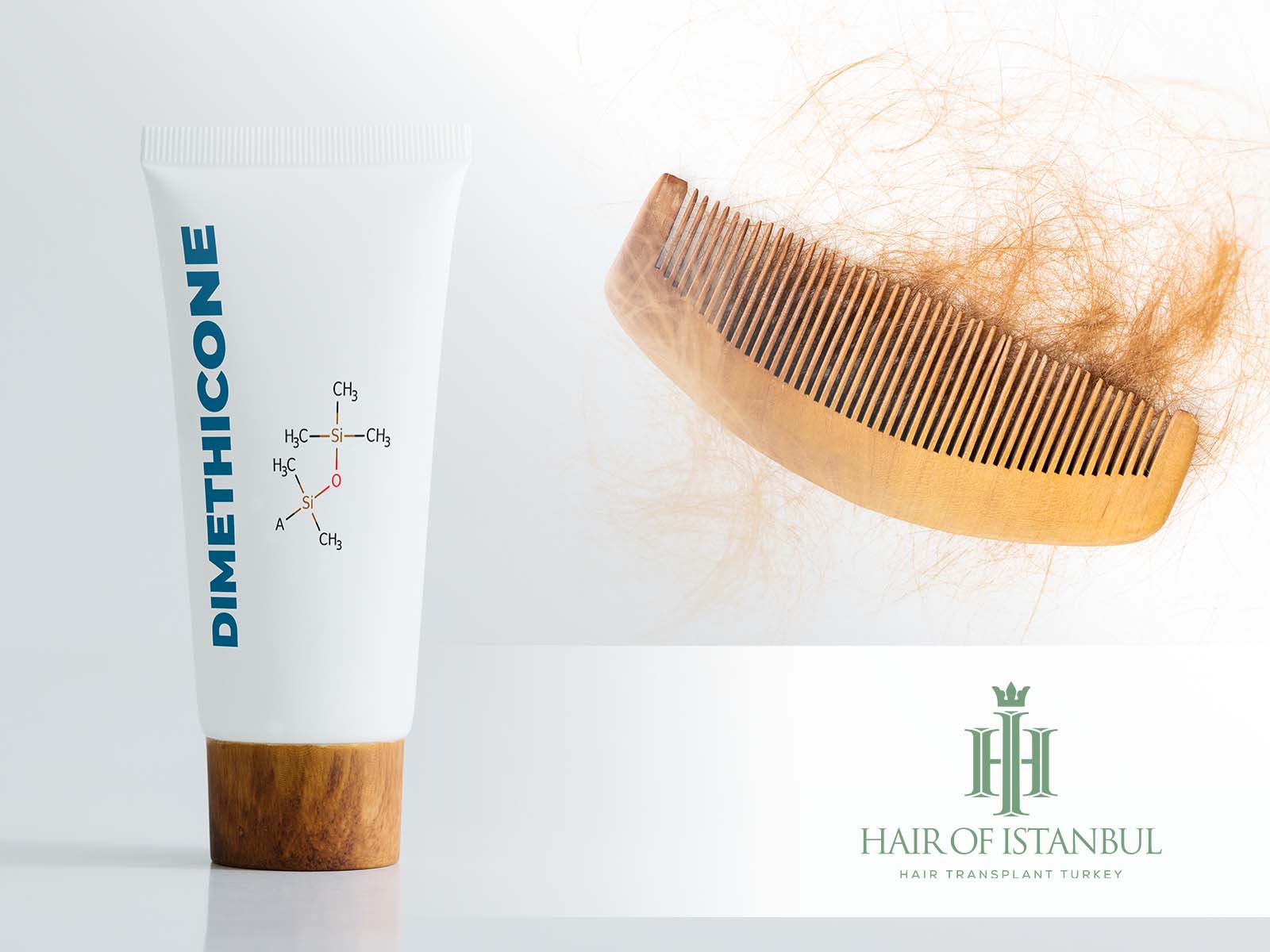
Is Dimethicone Bad for Hair? What Silicones Actually Do
Dimethicone is a silicone. It appears in most conditioners, in nearly every 2-in-1 shampoo, and in a large share of leave-in products — and it has become one of the most confidently blamed ingredients in hair care. The claim is that it coats the hair, builds up, suffocates the follicle and causes hair loss.
So: is dimethicone bad for hair? The evidence says no, and the formulation literature is fairly specific about why.
The short answer
Dimethicone does not cause hair loss. No study links it to alopecia of any kind. It sits on the hair shaft, which is dead keratin; it does not enter the follicle, and there is no mechanism by which it would affect the growing matrix beneath the skin.
Build-up is real but overstated, and it depends heavily on which silicone and which product type. It affects how hair looks and feels, not whether it grows.
What dimethicone actually is
Dimethicone is a polydimethylsiloxane — a charge-neutral silicone polymer used as a conditioning agent. Its job is to deposit a thin film along the cuticle, which reduces friction between hairs, seals down lifted cuticle scales, adds slip and shine, and makes combing easier.
A shampoo contains 10 to 30 ingredients across four groups: cleansing surfactants, conditioning agents, special care ingredients and additives. Considerable formulation effort goes into the conditioning agents, because they are what deliver lustre, smoothness and volume — the qualities consumers judge a product by.
Conditioning ingredients are also matched to hair type. Silicone content in conditioners is typically 3–5% for Asian hair and around 0.5% for Caucasian hair, because coarser, denser fibres need more slip.
Does dimethicone build up?
This is where the claim and the chemistry diverge.
The foundational work on 2-in-1 shampoo technology, which is what put dimethicone into everyday shampoo, addressed this directly. Dimethicone is held as microfine droplets suspended in a crystal lattice within the shampoo; during rinsing, excess water breaks the lattice and deposits the droplets onto the hair. The authors reported that build-up is not encountered, because subsequent washes first remove soil and previously deposited dimethicone, and that neutral dimethicones show no reaction with sebum.
Two caveats keep this honest. That work is from 1994 and was conducted by the industry that developed the technology. And not all silicones behave alike: heavier, non-volatile silicones in leave-in products are far more persistent than the dimethicone dispersed in a rinse-off shampoo. If you use leave-in serums daily and never use a clarifying shampoo, you may well accumulate a film. That film weighs hair down and dulls it. It does not reach the follicle.
Dimethicone, dimethiconol, amodimethicone — what’s the difference?
| Ingredient | Behaviour | Washes out with |
|---|---|---|
| Dimethicone | Charge-neutral, spreads evenly along the fibre | Ordinary shampoo |
| Dimethiconol | Heavier, more persistent film, higher shine | Ordinary shampoo, may need more than one wash |
| Amodimethicone | Amino-functional, binds preferentially to damaged areas of the cuticle | Ordinary shampoo; deposits selectively rather than uniformly |
| Cyclomethicone | Volatile — evaporates after application | Does not remain to build up |
Amodimethicone is worth understanding, because it is the one that behaves most usefully. Being charged, it targets the weathered parts of the cuticle rather than coating uniformly — the same principle that makes conditioners work where hair is most damaged, which is the ends rather than the roots.
Dimethiconol: the heavier one
Dimethiconol is dimethicone with hydroxyl groups at the ends of the chain. In practice it forms a heavier, more persistent film with higher shine, and it is the silicone most often behind the “my hair feels coated” complaint.
It still rinses out with ordinary shampoo, but it may take more than one wash, and it is more noticeable on fine hair. If a conditioner leaves your hair limp by the second day, check the ingredient list for dimethiconol before you blame silicones as a category.
Amodimethicone: the one that behaves differently
Amodimethicone is amino-functional — it carries a positive charge. That changes everything about how it deposits.
Instead of coating the whole fibre uniformly, it is attracted to the negatively charged, weathered parts of the cuticle. Damage is concentrated at the ends of the hair, so amodimethicone concentrates there too, which is the same targeting principle that makes conditioners work where hair actually needs them. It also means less accumulates on the healthy hair near the root, where you would not want weight.
For anyone worried about build-up but wanting the smoothing and detangling that silicones deliver, amodimethicone is generally the better-behaved choice.
Is dimethicone bad for your hair?
Not on the evidence. In fact the opposite has been tested.
A leave-on formulation combining caffeine, niacinamide, panthenol, dimethicone and an acrylate polymer was studied specifically for thinning hair. It increased the diameter of individual terminal scalp fibres by 2 to 5 µm — roughly a 10% increase in cross-sectional area — and the thickened fibres were more supple and better able to withstand force before breaking.
The authors were careful about what that means, and so are we: cosmetic treatments will not reverse hair loss. What they can do is make existing hair thicker, stronger and less prone to mid-shaft breakage — and breakage is genuinely part of why thinning hair looks thinner. Dimethicone was part of the formulation that achieved it, not the problem it was solving.
When it is reasonable to avoid silicones
There are legitimate reasons, and none of them is hair loss:
- Very fine hair that goes limp. A film adds weight. If your hair loses volume after conditioning, lighter or volumising formulations suit you better. How often to condition at all is covered in our conditioning guide.
- Curly hair routines. Many curl methods avoid non-water-soluble silicones because they interfere with moisture uptake and with the cast that defines curl. This is a styling decision, not a health one.
- Daily leave-in use with no clarifying wash. If you use serums every day, a clarifying shampoo periodically resets the film.
- Before a scalp treatment or procedure. A clean, product-free scalp is preferred before medical assessment or surgery — our own instruction is to wash on the morning of a procedure and apply no styling product.
Is silicone-free shampoo better?
Silicone-free shampoos and conditioners are a large and growing category, and the honest answer is that they are better for some people and irrelevant for most.
They help if: your hair is fine and goes flat, you follow a curl routine that depends on moisture uptake, or you use leave-in products daily and never clarify.
They make no difference if: your concern is hair loss. Removing silicone from your routine will not change the density of hair growing out of your scalp, because silicone never reached the part of the follicle that decides that.
One trade-off worth knowing: silicones reduce friction, and friction is what causes mechanical breakage during combing and styling. Going silicone-free without replacing that slip with another conditioning system can leave hair rougher and more prone to breaking — which looks like thinning without being it.
What is actually causing your hair loss
If hair is thinning, the cause is almost never an ingredient in your conditioner. The common causes are:
- Androgenetic alopecia — genetic, hormone-driven, progressive, and by far the most common. It presents as a pattern, not as overall thinning.
- Telogen effluvium — diffuse shedding two to three months after a trigger such as illness, surgery, crash dieting or severe stress. It resolves.
- Iron deficiency, thyroid disease and other systemic causes, which is why a ferritin and thyroid panel is worth doing before blaming a product. The same logic applies to every ingredient scare — we went through the evidence on parabens and reached the same place.
- Traction and breakage from tight styling or heat — the one category where hair care habits genuinely matter, though the culprit is mechanical stress rather than silicone.
Switching shampoo will not change any of these. Identifying which one you have will.
Frequently asked questions
Does dimethicone cause hair loss?
No. There is no study linking dimethicone to alopecia. It deposits on the hair shaft, which is dead keratin, and does not reach the living follicle.
Is dimethicone bad for hair?
No. It reduces friction, seals the cuticle and reduces breakage. It can weigh very fine hair down, which is a cosmetic issue rather than a health one.
Does dimethicone clog hair follicles?
The formulation literature reports that neutral dimethicones do not react with sebum and that build-up is removed by subsequent washes. There is no evidence of follicular occlusion causing hair loss.
Is dimethiconol worse than dimethicone?
It forms a heavier and more persistent film, so it may take more than one wash to remove. That affects feel and volume, not follicle health.
Is dimethicone bad for curly hair?
Many curl routines avoid non-water-soluble silicones because they interfere with moisture uptake and curl definition. That is a styling preference, not a safety concern.
How do I remove silicone build-up?
A clarifying shampoo. Ordinary shampoo removes most silicone deposits in normal use; a clarifying wash resets a heavier film from daily leave-in products.
Should I use silicone-free products after a hair transplant?
Use the shampoo and foam the clinic provides, exactly as instructed, for the first ten days. After that, ordinary products are fine — see the shampoo after hair transplant protocol.
References
- Rushton H, Gummer CL, Flasch H. 2-in-1 shampoo technology: state-of-the-art shampoo and conditioner in one. Skin Pharmacol. 1994;7(1-2):78–83. PMID 8003328. pubmed.ncbi.nlm.nih.gov
- Davis MG, Thomas JH, van de Velde S, et al. A novel cosmetic approach to treat thinning hair. Br J Dermatol. 2011;165(Suppl 3):24–30. PMID 22171682. pubmed.ncbi.nlm.nih.gov
- D’Souza P, Rathi SK. Shampoo and Conditioners: What a Dermatologist Should Know? Indian J Dermatol. 2015;60(3):248–254. PMID 26120149. pubmed.ncbi.nlm.nih.gov
- Trüeb RM. Shampoos: ingredients, efficacy and adverse effects. J Dtsch Dermatol Ges. 2007;5(5):356–365. PMID 17451380. pubmed.ncbi.nlm.nih.gov
In short
Dimethicone is a conditioning silicone that coats the hair shaft to reduce friction and breakage. No study links it to hair loss, and the mechanism usually proposed — clogged follicles — is contradicted by the formulation literature, which reports no sebum interaction and removal of previous deposits by ordinary washing. Heavier silicones in leave-in products can build up and weigh fine hair down; a clarifying shampoo resolves that. Dimethicone even appears in a formulation shown to thicken existing fibres by 2 to 5 µm. If your hair is thinning, the cause is in the follicle, not in the bottle.
If you want to know which kind of hair loss you actually have, send us photographs — that question is answerable, and changing conditioner will not answer it.