
 en
en TR
TR  SK
SK  ITA
ITA  FR
FR  DE
DE  ES
ES  BG
BG  RO
RO 
M-Shaped Hairline in Women: Natural, or Something Changing?
An m shaped hairline female patients notice in the mirror is one of two entirely different things, and they call for opposite responses. Either it is the hairline you have always had — in which case nothing is wrong and nothing needs fixing — or it is a shape that has appeared or deepened, in which case the question is not how to style it but what is causing it.
The distinction matters more in women than in men, because deep recession at the temples is not part of normal female hairline ageing. When it appears in a woman it usually has a name, and one of the possible names needs excluding before anyone discusses surgery.
The short answer
- Have you always had it? A natural M shape or widow’s peak is common and permanent. Research on hairline development records a widow’s peak remaining in 81% of women.
- Has it changed? Deep bitemporal recession of the male type is uncommon in women, so a new or deepening M is not “maturation” and should be assessed.
- Four explanations cover most cases: a lifelong natural shape, traction alopecia, frontal fibrosing alopecia, and female pattern hair loss.
- Eyebrows are the fastest clue. Thinning eyebrows alongside a receding frontal line points to frontal fibrosing alopecia, which is scarring and needs a dermatologist before a surgeon.
First question: has it always been there?
Look at photographs of yourself at fifteen and at twenty-five. A hairline that has the same shape in both is a natural variant, not a loss pattern.
Natural female hairlines vary widely, and a peak at the centre with slight indentations either side is one of the ordinary shapes. It can be inherited, it can be asymmetric, and it does not progress. If that is what you have, styling is a legitimate answer and medicine has nothing to add.
What is not typical is a hairline that used to be rounded and is now angled. That is a change, and changes have causes.
If it is changing, it is not maturation
In men, a rounded juvenile hairline moving back into a slight M is normal maturation. In women it is not the same story: the female hairline tends to move upward while preserving the frontal fringe, and deep bitemporal recession of the male type is uncommon.
So a woman with a genuinely receding frontal line should not have it filed under normal ageing. We set out that distinction in full on mature vs receding hairline; here the useful point is simply that “it is just maturing” is not the default answer for a woman.
The four explanations
An m shaped hairline female patients ask about almost always has one of four explanations. Three of them are conditions; one of them is simply your face.
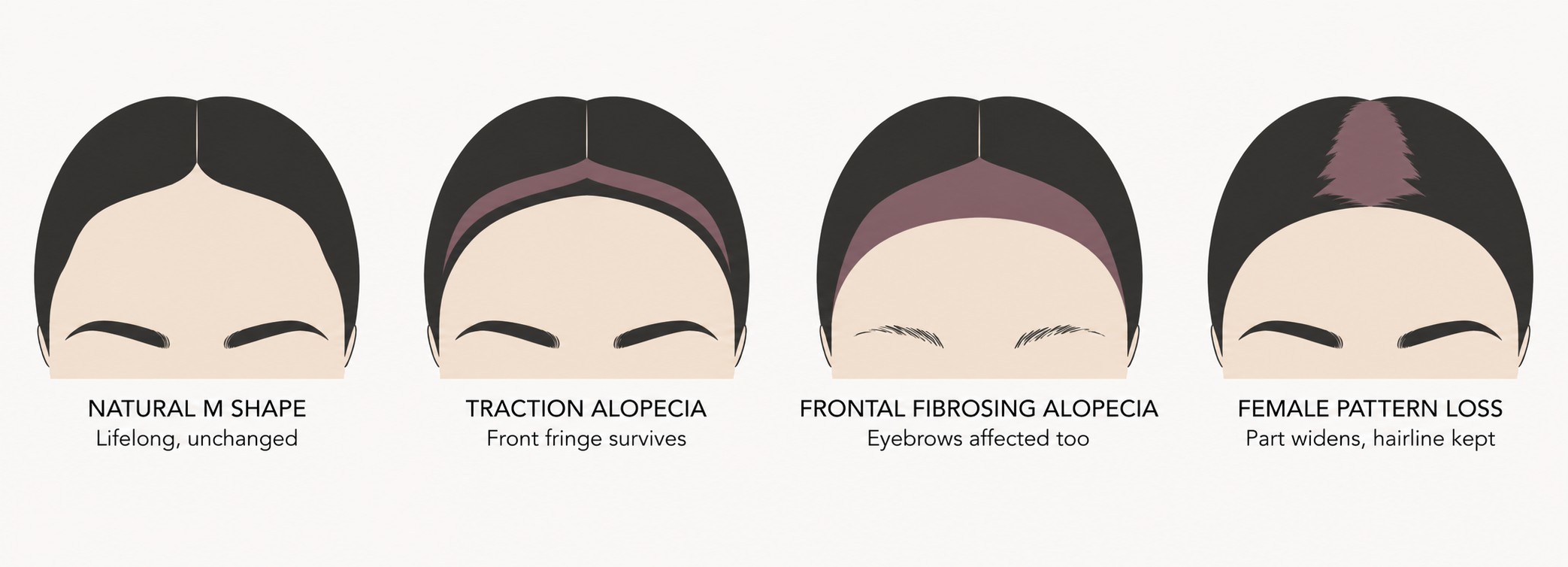
| Cause | How it behaves | Reversible? |
| Natural M shape or widow’s peak | Lifelong, unchanged, often inherited | Nothing to reverse |
| Traction alopecia | Loss at the margins from tension; fringe of finer hairs often survives at the very front | Yes in the early stage, if the tension stops |
| Frontal fibrosing alopecia | Band-like recession across the frontotemporal zone; eyebrows often affected | No — scarring |
| Female pattern hair loss | Widening part and diffuse thinning; frontal line usually preserved | Partly, with medical therapy |
Frontal fibrosing alopecia: the one to exclude first
This is the diagnosis that changes everything, and it is the reason a woman with a receding frontal hairline should see a dermatologist before a hair transplant surgeon.
Frontal fibrosing alopecia is a form of lichen planopilaris affecting the frontal area in women, most often after menopause, with typical onset around age 60 — though it occurs in premenopausal women too, the youngest reported case being 21. It produces a band-like scarring alopecia across the frontotemporal zone, which is precisely the region that reads as an M shape.
Three features make it recognisable:
- Eyebrows. Total or partial eyebrow loss affected 81% of patients in one series and 100% in a more recent one — and eyebrow loss may appear before the frontal hair loss.
- The skin itself. Follicular openings disappear, with marked perifollicular hyperkeratosis and redness around the remaining follicles.
- Lonely hairs. Isolated hairs left standing in an otherwise cleared band are characteristic.
It is scarring, which means the loss is permanent. And the transplant data is sobering: in a small case series of three grafted patients, grafts grew well for two years and then more than half disappeared by year three. The published position is that grafts may be considered only in stabilised disease, preferably after test grafts followed for at least three years.
None of that means a woman with an M-shaped hairline has FFA. It means the question has to be asked and answered before any surgical plan, and our page on frontal fibrosing alopecia covers the condition itself.
Traction alopecia
Tension from tight styling is the most common avoidable cause of frontal and temporal loss in women. Braids, cornrows, twists, locs, weaves, extensions, tight ponytails and curlers are all implicated, along with chemical relaxers and heat.
Its distinguishing sign is the opposite of FFA’s: in traction alopecia the anterior frontal hair often persists as a surviving band of finer hairs — the fringe sign — and there is no scarring or perifollicular inflammation. Early traction alopecia is reversible when the tension stops; chronic traction eventually produces permanent scarring. The boundary between the two is covered on traction alopecia: when is it too late.
Female pattern hair loss
Female pattern loss usually does the opposite of what people expect: it widens the part and thins the crown while leaving the frontal line largely intact. Intermediate and vellus hairs persist along the anterior border, there is no scarring or inflammation, and the eyebrows are spared.
It is graded on the Ludwig scale. If your part is widening and your hairline is unchanged, this is the more likely explanation — and an M shape at the temples is probably something you have always had.
Telling them apart
| Traction alopecia | Frontal fibrosing alopecia | Female pattern loss | |
| Front hairline | Fringe of finer hairs often survives | Band cleared, follicular openings gone | Usually preserved |
| Inflammation | None | Perifollicular redness and scale | None |
| Eyebrows | Unaffected | Frequently lost, sometimes first | Spared |
| Scarring | Only if chronic | Yes, from the start | No |
| Typical age | Any, including childhood | Most often post-menopausal | Any adult age |
This table is for orientation, not diagnosis. Scarring alopecias are confirmed on examination and, where needed, biopsy — which is exactly why the first appointment should be dermatological.
Fixing it without surgery
- Remove the tension first. If styling is contributing, nothing else works until that stops. Looser styles, larger sections, rest periods without extensions.
- Get the cause named. Thyroid disease, iron deficiency and telogen effluvium are all more likely in women than in men and are treated medically, not surgically.
- Discuss approved medical therapy for pattern loss with a doctor rather than starting something found online.
- Give it time before judging. Early traction alopecia can recover once the pull is removed, and that recovery takes months.
If surgery is the answer
Two different operations get confused here, and they solve different problems.
A hair transplant moves follicles into the recessed area. It suits a stable, non-scarring situation with adequate donor supply — see women’s hair transplant.
Hairline lowering advances the whole hairline surgically and is aimed at a high forehead rather than a receding one; it is a different candidacy question, covered on hairline lowering surgery and alongside forehead proportion on average forehead size.
Neither is appropriate while an active scarring process is running, and neither is appropriate while tension is still being applied to the same area.
Styling, if the shape is simply yours
If the hairline has always been M-shaped and nothing is changing, this stops being a medical question. Softening the angles is a matter of where the parting sits, how much weight is left at the temples, and whether the front is blunt or textured — we set out the options in detail on haircuts for an M-shaped hairline.
Frequently asked questions
Is an m shaped hairline normal in a female?
A lifelong one, yes — natural hairline shapes vary and a central peak with slight temple indentations is one of them. A new or deepening one is not typical, because deep bitemporal recession of the male type is uncommon in women.
How do I fix my m shaped hairline as a female?
It depends entirely on which of the four causes applies. A natural shape is styled, not treated. Traction is reversed by removing the tension, early. Scarring alopecia is stabilised medically before anything else. Pattern loss is assessed and treated on its own terms.
What does an M hairline look like on a woman?
A central peak with the hairline set back on each side above the temples, forming two shallow angles. The clinically useful detail is not the shape itself but whether the skin at the recession is normal, or red, scaly and missing follicular openings.
My eyebrows are thinning too. Does that matter?
Yes, considerably. Eyebrow loss with frontal hairline recession is the combination that points to frontal fibrosing alopecia, and eyebrow loss can come first. It is a reason to see a dermatologist promptly rather than wait.
Can I have a hair transplant for an M-shaped hairline?
If the cause is non-scarring and stable, and your donor area supports it. If the cause is frontal fibrosing alopecia, the published experience is cautious — grafts that grew well at two years, with more than half lost by three.
Could my braids have caused this?
They can. Tension styles are the leading avoidable cause of frontal and temporal loss in women, and the early stage is reversible if the pull stops before scarring sets in.
Is a female M-shaped hairline the same as a man’s?
The shape can look similar; the meaning is not. In men it is often ordinary maturation or androgenetic recession. In women deep temple recession is uncommon, so the same shape carries more diagnostic weight.
My daughter has an M-shaped hairline. Should I worry?
A hairline shape present from childhood is a natural variant. What is worth watching in young girls is tension from tight styling, which affects children as well as adults.
References
- StatPearls, Frontal Fibrosing Alopecia (National Center for Biotechnology Information) — a form of lichen planopilaris affecting the frontal area in women, most often after menopause, typical onset around age 60 with the youngest reported case at 21 and rare occurrence in men; band-like cicatricial alopecia of the frontotemporal zone that may extend to preauricular and retroauricular regions; total or partial eyebrow alopecia in 81% of patients in one series and 100% in a more recent series, sometimes preceding frontal alopecia; disappearance of follicular orifices with marked perifollicular hyperkeratosis and erythema, and isolated “lonely” hairs in affected areas; distinguished from traction alopecia, which shows persistence of anterior frontal hair without scarring or perifollicular inflammation, and from androgenetic alopecia, in which intermediate and vellus hair persist at the anterior border, there is no scarring or inflammation and the eyebrows are spared; in a series of three grafted patients grafts grew well at two years with more than 50% disappearing after three years, and grafts may be considered for stabilised disease preferably after test grafts followed for at least three years. ncbi.nlm.nih.gov/books/NBK519001
- StatPearls, Traction Alopecia (National Center for Biotechnology Information) — tension styles including ponytails, braids, cornrows, twists, locs, weaves, extensions and curlers, with chemical relaxers and heat as additional risk factors; the fringe sign as a surviving band of finer hairs along the frontal or temporal hairline; early disease non-scarring and reversible, chronic traction producing miniaturisation, perifollicular fibrosis and permanent cicatricial alopecia. ncbi.nlm.nih.gov/books/NBK470434
- Nusbaum BP, Nusbaum AG. Phenotype of normal hairline maturation — hairline development study recording a widow’s peak remaining in 81% of women, with deep bitemporal recession of the male type uncommon in women. pubmed.ncbi.nlm.nih.gov/24017973
In short
An m shaped hairline in a female is either something you have always had or something that is happening, and the whole of the answer follows from which. If old photographs show the same shape, it is a natural variant and styling is the only intervention needed. If the shape is new or deepening, it is not maturation — deep temple recession is uncommon in women — and it needs a name before it needs a surgeon. The name to exclude first is frontal fibrosing alopecia, and the quickest clue is the eyebrows.