 en
en TR
TR  SK
SK  ITA
ITA  FR
FR  DE
DE  ES
ES  BG
BG  RO
RO 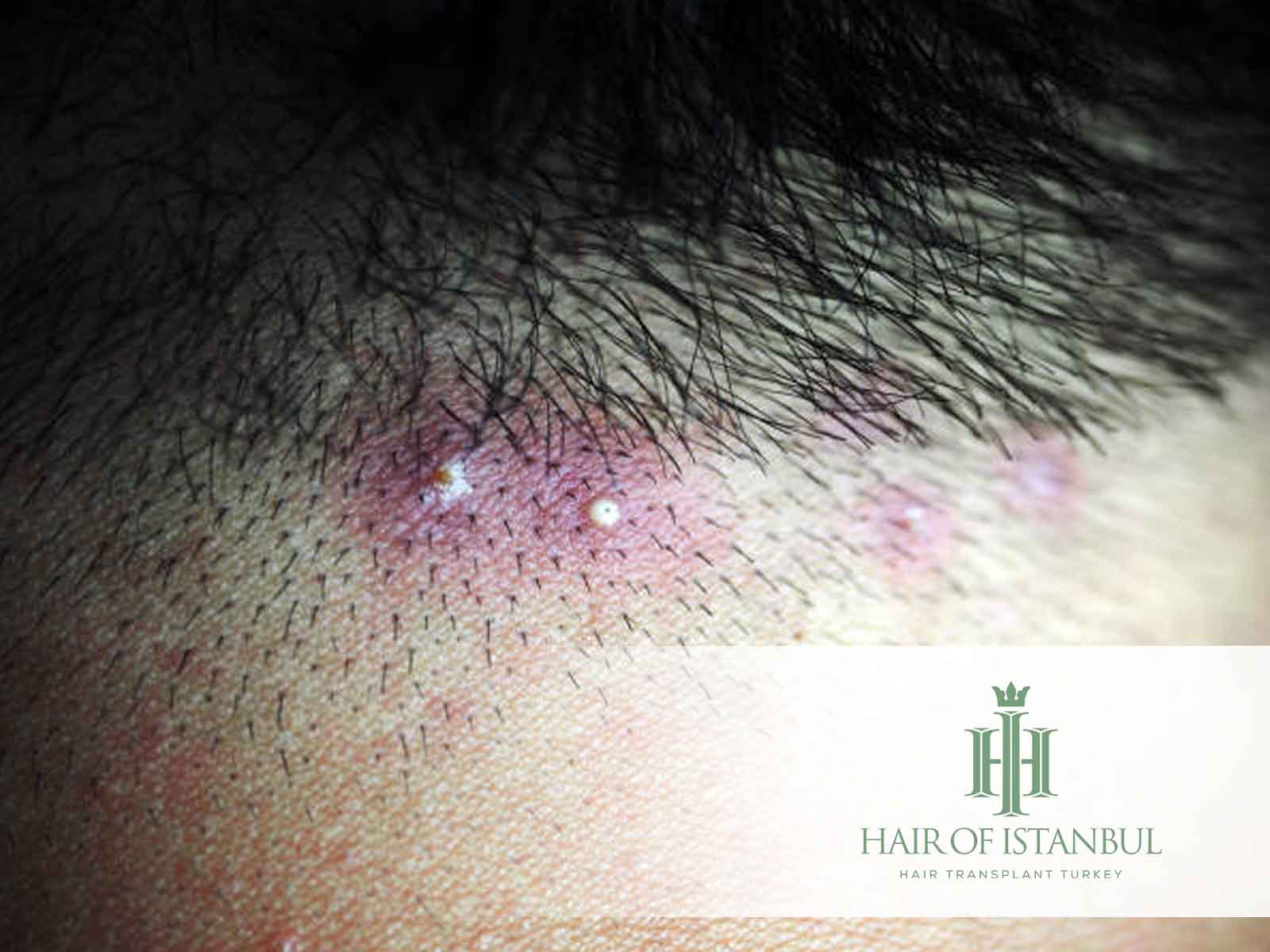
Ingrown Hairs After Hair Transplant: Telling the Bumps Apart
Small bumps in the recipient area a few weeks after surgery are common, alarming, and almost always misidentified. Ingrown hairs after hair transplant are one of four things that look nearly identical to a worried patient in a bathroom mirror, and they are not the one that needs antibiotics.
Telling them apart is the useful skill, so that is where this page starts.
Four Bumps That Look Alike
| What it is | When | What you see | What it needs | |
|---|---|---|---|---|
| Ingrown hair | A hair that re-entered the skin instead of emerging | Usually from week 3 onward, as regrowth starts | A single firm bump, sometimes with a dark hair visible under the surface | Warm compress and patience |
| Folliculitis | Mostly a sterile foreign-body reaction to trapped material, not an infection | Weeks 1–4 | Crops of small red or white-headed spots around emerging hairs | Usually settles; wash as instructed |
| Epidermal cyst | A graft buried too deep, sealing over | Weeks 2–8 | A smooth, firm lump under intact skin, no head | Clinic review; some need draining |
| Infection | Genuine bacterial infection — uncommon, under 1% | Any time | Pus, spreading redness, warmth, pain, sometimes fever or swollen glands | Call your clinic |
The distinguishing question is not what the bump looks like but how many there are and whether it hurts. One firm lump with a hair under it is an ingrown. A scattering of small spots is folliculitis. Pain, pus and spreading redness is infection, and that is the one that cannot wait.
Why Transplanted Hair Ingrows More Readily
An ingrown hair happens when a hair grows back into the skin rather than out of it. There are two established routes, described in the literature on razor bumps, and both apply here:
- Extrafollicular penetration — the sharp-tipped hair grows downwards or parallel to the surface and re-enters the skin a few millimetres from its own follicle.
- Transfollicular penetration — the tip retracts into the follicle and pierces the follicular wall below the surface.
After a transplant, three things stack the odds. The hair emerges at the angle and direction the surgeon chose, which may not match the way it grew before. New hair comes through fine, soft and sometimes kinked in the first months, which makes it easier to deflect. And the skin it is pushing through has healed over thousands of tiny incisions, so it is not the smooth surface it was.
Hair type matters more than any of that. Curly hair and whorls increase the risk of ingrown-hair inflammation by around 50%, which is why our pages on curly hair transplants and Afro-type hair transplants treat this as a planning issue rather than an afterthought.
How Common Are Ingrown Hairs After Hair Transplant Surgery?
Isolated ingrown hairs are not separately counted in the literature; what is counted is the inflammation they sit inside. Post-operative folliculitis has been reported at around 12.1% across multicentre data, typically appearing one to four weeks after surgery, while true infection runs at under 1%.
The timing is worth holding on to. Bumps in weeks one to four generally belong to the healing process. A single new lump at month three or four, when regrowth is coming through, is much more likely to be a genuine ingrown hair — the hair has arrived and taken a wrong turn.
What to Do
- Leave it alone first. Most ingrown hairs release themselves within days to a couple of weeks.
- Warm compress. A clean, warm, damp cloth held gently against the area for a few minutes, once or twice a day. It softens the skin over the hair. No pressure, no rubbing.
- Keep washing normally — by the protocol you were given if you are still inside the first ten days. Delayed washing is a recognised risk factor for exactly this kind of inflammation. See shampoo after a hair transplant.
- Nothing on the recipient area that your clinic has not approved — no exfoliants, no acids, no antiseptic creams applied on a hunch.
- Give it two weeks. Still there, growing, or painful? That is the point to send a photograph to your clinic rather than to keep waiting.
Popping, Squeezing and Tweezers
The short answer is no, and in the first nine days the answer is emphatic.
Graft anchoring has been tested directly: on days one and two pulling a hair removed the graft every time, through day five pulling an adherent scab removed the graft every time, and grafts were only out of danger by day nine. Digging at a bump with tweezers in that window is the most reliable way to lose a graft you have paid for.
After day nine the graft is secure, but the reasons not to squeeze remain: breaking the skin over an inflamed follicle turns a self-limiting bump into a wound, which is how a sterile reaction becomes an actual infection, and how a small mark becomes a lasting one. If a hair is clearly visible lying loose above the skin surface, it can sometimes be lifted free with clean tweezers without digging — if you have to break skin to reach it, stop.
Ingrown Hairs in Old Plug Grafts
This search comes up often enough to deserve its own answer, because it usually is not about a modern transplant at all.
“Plugs” are the old-style punch grafts of the 1970s to 1990s — large circular grafts carrying many hairs each, placed in rows. They are what produced the doll-hair appearance that still shapes public opinion of hair transplants. Modern follicular unit work transplants natural groupings of one to four hairs, which is why the result looks different.
If you have older plugs and one of them is inflamed, two things are usually happening. Hairs grouped tightly in one large graft emerge at similar angles from a scarred base, which encourages ingrowing. And the raised, cobblestoned skin around old plugs traps sebum and debris more readily than flat skin does.
Genuine infection is treated as infection — see infection after a hair transplant. But if the underlying complaint is the plugs themselves, the modern answer is not antibiotics: old grafts can be removed and redistributed, and scarred zones softened, which is the work described on our revision hair transplant page. Raised graft sites in general are covered under cobblestoning.
Prevention
- Wash on schedule. The single most protective habit, and the one patients skip out of caution.
- No blades on the recipient area early. Close shaving is the main driver of ingrown hairs in any skin. Our rule is no razor on a recipient area for three months.
- Nothing occlusive. Wax, heavy pomade and thick creams sit over emerging hairs — see hair wax after a transplant.
- Keep sweat off it for the first month. Heat and moisture feed the same inflammation — see exercise after a hair transplant.
- Do not pick at scabs before your clinic says so. A crust removed early leaves a hair with nowhere clean to emerge.
When to Contact Your Clinic
- Pus, spreading redness, warmth, or increasing pain.
- Fever or tender swollen glands in the neck.
- A lump that keeps growing, or is still there after two to three weeks.
- Many bumps appearing at once rather than one or two.
- Any bump that has been squeezed and has since got worse.
- A pale, hard or darkening patch, which is not an ingrown hair at all — see scalp necrosis.
Photographs are genuinely useful here. A clinic that has seen thousands of these can usually tell an ingrown hair from folliculitis from a cyst in one image, and it saves you two weeks of worrying.
Frequently Asked Questions
Are ingrown hairs normal after a hair transplant?
Yes, particularly once regrowth begins from around month three. New hair emerges at a surgeon-chosen angle through recently healed skin, which makes deflection easier.
How long does an ingrown hair take to heal?
Most release themselves within days to two weeks with nothing more than warmth and time. One that persists beyond two to three weeks, or grows, should be looked at.
Should I pop an ingrown hair after a hair transplant?
No. In the first nine days you risk losing the graft outright — tested directly, grafts were still lost through day five. After that, breaking the skin over an inflamed follicle is how a self-limiting bump becomes an infection or a lasting mark.
Can I use tweezers on an ingrown hair?
Only if the hair is already lying loose above the skin surface and can be lifted without digging. If you have to break skin to reach it, stop and ask your clinic.
How do I tell an ingrown hair from folliculitis?
Count them. One firm bump, often with a hair visible beneath it, is an ingrown hair. A crop of small spots around several emerging hairs is folliculitis, which affects roughly one patient in eight and is usually a sterile reaction rather than an infection.
Is it an ingrown hair or a cyst?
A cyst is smooth and firm under intact skin with no visible hair and no head, and it often follows a graft placed too deep. It needs clinic review rather than home treatment.
What about old plug grafts?
“Plugs” are old-style large punch grafts. Ingrowing is common around them because hairs emerge tightly grouped from scarred, raised skin, and if the plugs themselves are the problem, revision surgery rather than antibiotics is the answer. If what you are seeing looks infected rather than ingrown, that is covered on infected hair transplant.
Do ingrown hairs damage the transplant?
An ordinary ingrown hair does not. Repeatedly squeezing or digging at one can, both by damaging the follicle and by scarring the skin around it.
References
- Ogunbiyi A. Pseudofolliculitis barbae; current treatment options. Clin Cosmet Investig Dermatol. 2019;12:241–247. dovepress.com — pseudofolliculitis barbae
- Complications in follicular unit excision hair transplantation: current evidence and practical approaches. Front Med (Lausanne). 2026. frontiersin.org — complications in FUE hair transplantation
- Bernstein RM, Rassman WR. Graft anchoring in hair transplantation. Dermatol Surg. 2006. pubmed.ncbi.nlm.nih.gov/16442039
- Complications in Hair Transplantation. J Cutan Aesthet Surg. pmc.ncbi.nlm.nih.gov/articles/PMC6371733
In Short
Ingrown hairs after hair transplant are one of four bumps that look alike, and the way to tell them apart is to count them and ask whether they hurt: one firm lump with a hair beneath it is an ingrown hair, a crop of small spots is folliculitis, a smooth lump under intact skin is a cyst, and pus with spreading redness and pain is infection. They happen because new hair emerges at a surgeon-chosen angle through recently healed skin, and curly hair raises the risk by around half. Warmth and patience resolve most within two weeks. Do not squeeze and do not dig — grafts were still being lost with an adherent scab through day five and were only secure by day nine, and after that breaking the skin is how a harmless bump becomes an infection. If you are dealing with older plug grafts rather than a modern transplant, the answer is usually revision rather than antibiotics.