
 en
en TR
TR  SK
SK  ITA
ITA  FR
FR  DE
DE  ES
ES  BG
BG  RO
RO 
Average Forehead Size: Big Forehead or Receding Hairline?
Medically reviewed by Dr. Mahmut SATEKİN, Medical Aesthetics Physician.
There is no ideal or average forehead size that you should be aiming at, and any page that gives you one number is guessing. Forehead height varies widely between healthy adults and is set mostly by inherited facial proportions. What is clinically meaningful is not the measurement itself but whether it has changed — because a forehead that is getting taller is not a forehead at all. It is a hairline that is moving.
This page explains how forehead height is actually measured, what the finger test can and cannot tell you, and how to work out whether you have a naturally high hairline or an active one.
The Short Answer
- No single normal value. Adult forehead height spans a wide range. Being above or below any published average is not a finding.
- Proportion beats measurement. Facial analysis conventionally divides the face into three parts — hairline to brow, brow to base of nose, base of nose to chin. A forehead reads as tall when the upper part is noticeably larger than the other two, not at a particular centimetre value.
- The question that matters. Has it always been like this, or is it increasing? A stable high hairline is a variation. An increasing one is recession.
- How to answer it. Two identical photographs twelve months apart, or trichoscopy in a clinic, which answers the same question in minutes.
- If it is stable and you dislike it, hairline lowering and forehead reduction are cosmetic options — but they are the wrong operations for a hairline that is still receding.
Why Forehead Height Gets Measured at All
Most people searching for the average forehead size are not really asking about their forehead. They are asking whether their hairline has moved, and the forehead is the only part of the change that is easy to put a ruler against.
That instinct is sound. In men the frontal hairline changes shape during late adolescence and early adulthood — research on hairline development records that all children begin with a concave hairline and that in men it becomes convex between the ages of 18 and 29. Forehead height increases as part of that normal change, and then stops. When it does not stop, the cause is usually androgenetic alopecia, in which the pattern typically begins with bitemporal thinning of the frontal scalp before involving the crown.
So forehead height is worth measuring — not to compare yourself to an average, but to compare yourself to yourself a year ago.
How to Measure Your Forehead
Average forehead size is quoted as a height: measured vertically, in the midline, from the highest point of the eyebrow to the point where the hair begins. Two practical rules make the number usable:
- Relax your eyebrows. Raising them shifts the skin and can change the reading by a centimetre. Measure with a neutral expression.
- Use the same landmark every time. The brow crease moves with expression; the upper edge of the eyebrow does not.
The Finger Method
The common shortcut is to lay your fingers flat across the forehead between eyebrow and hairline and count how many fit. Three to four fingers is the range most people fall into; five or more is where people usually start asking questions.
Treat this as a rough self-check, not a measurement. Finger width varies by roughly a centimetre between a small and a large hand, so “four fingers” is not the same distance on two different people, and it is not a figure any clinician works from. Its one genuine use is consistency: if the same hand covered four fingers last year and covers five now, that change is real even though the unit is crude.
Measuring in Centimetres and Inches
A ruler or tape gives a repeatable number, and it is the only way to compare your own average forehead size with your own earlier reading. Measure in the midline, eyebrow to hairline, eyebrows relaxed, and write the figure down with the date. The value on its own means little; the same value taken twice, a year apart, means a great deal.
| Record | How | Why |
|---|---|---|
| Date | Written down each time | Without it the reading is unusable |
| Height in cm | Midline, eyebrow to hairline, brows relaxed | Repeatable; comparable to your own past reading |
| Front photograph | Dry unstyled hair, indirect daylight, no flash, same distance | Shows edge quality and asymmetry a tape cannot |
| Temple photographs | Both sides in profile | Recession is often uneven |
| Crown photograph | Top-down | Pattern loss frequently starts there too |
| Repeat interval | Every 12 months | Shorter intervals show noise, not change |
Photograph it as well. A tape reading and a standardised photograph together are more reliable than either alone, and the photograph will show you things the tape cannot — asymmetry between the temples, or a soft, wispy edge where a sharp one used to be.
What Is the Average Forehead Size?
The honest answer is that average forehead size describes a wide band rather than a point. Healthy adults differ substantially, men and women overlap heavily, and the range is influenced by inherited facial proportions, skull shape and where the hairline happened to settle after maturation.
This is why we do not publish a single average forehead size as though it were a target, and why you should be sceptical of pages that do. There is no medical threshold above which a forehead becomes a problem, and a high hairline that has been there since childhood is a variation in appearance, not a condition.
The convention that clinicians actually use is proportional rather than absolute. Facial analysis divides the face into three parts — hairline to brow, brow to the base of the nose, base of the nose to the chin — and reads them against each other. A forehead looks tall when the upper third is visibly larger than the other two. That is an observation about proportion on your own face, not a measurement to be compared with anybody else’s.
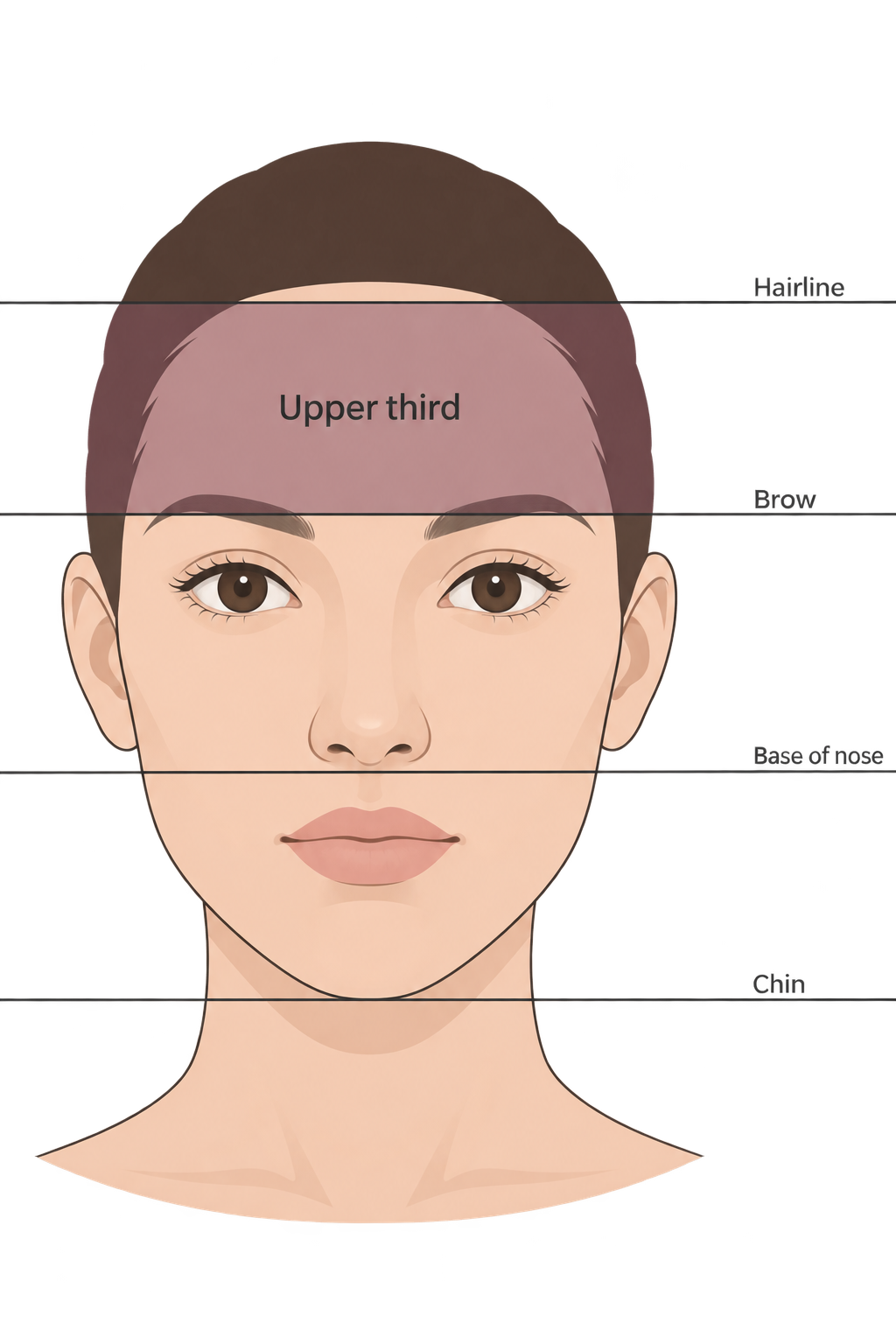
Forehead height is the upper third — hairline to brow. What makes a forehead read as tall is that band being larger than the other two, not any particular measurement in centimetres.
Big Forehead or Receding Hairline?
This is the distinction the whole page exists for, and the two need completely different responses.
| Naturally high hairline | Receding hairline | |
|---|---|---|
| History | Present since childhood; visible in old photographs | Appeared or worsened in adulthood |
| Change over time | Stable for years | Measurably further back after 12 months |
| Shape | Even, follows the original outline | Deepening at the temples; M or V outline |
| Edge | Sharp, full-calibre hair right up to the line | Soft and wispy; fine pale hairs in front |
| Rest of scalp | Crown and mid-scalp unaffected | Thinning at the crown or through the mid-scalp |
| What it is | A variation in appearance | Androgenetic alopecia until proven otherwise |
| Needs treatment | No | Yes — earlier is better |
Old photographs settle this faster than any measurement. If your hairline sits where it sat at twenty, it is high, not receding. If the temples have opened since, see our guides to mature vs receding hairline and the M shaped hairline, which set out the tests in full.
Forehead Height and Hair Loss
A rising hairline is one of the earliest visible signs of male pattern hair loss, and it is common. In a community-based sample of men aged 18 to 49, 42% had moderate to extensive loss — Norwood type III or greater — rising from 16% of men aged 18 to 29 to 53% of men aged 40 to 49. Looking specifically at the frontal hairline, recession was recorded in 25% of men aged 40 to 55 and 31% of men aged 65 to 69.
Two consequences follow. Most men will see some frontal change, so noticing it is not a reason to panic. And in most of those men it progresses, so noticing it early is worth acting on — medical therapy protects existing hair far more effectively than it recovers lost hair.
When to Get It Assessed
- The hairline has visibly moved compared with photographs from one to two years ago.
- The temples are receding unevenly, or an M outline is deepening.
- The hair immediately in front of the line has become fine, short or pale.
- There is thinning at the crown or through the mid-scalp as well.
- Shedding is heavy, sudden, or affecting areas outside the usual pattern — this may not be pattern loss at all.
- In women, any marked frontal recession, which is less typical of female pattern hair loss and warrants investigation.
Trichoscopy measures miniaturisation directly and distinguishes androgenetic alopecia from telogen effluvium and other causes that look similar at the hairline.
How Hairline Position Is Planned
Forehead height is measured at consultation, but it is not the number that decides where a new hairline goes. Three things do:
- The mature position, not the juvenile one. A hairline restored to where it sat at fifteen looks wrong on an adult face and spends donor hair that will be needed later.
- Donor capacity. The available supply sets what is achievable. Lowering a hairline across a wide, tall forehead is expensive in grafts, and those grafts are finite.
- Future loss. The plan has to remain coherent if recession continues behind the new line. This is why an unstable hairline is stabilised medically before surgery rather than after.
Shape matters as much as height. Adult male hairlines have softened temporal recession; a straight line drawn across the forehead reads as artificial. The transition zone is built with single-hair grafts placed irregularly — see micro-irregular hairline design — and the technique used to place them, FUE or DHI, does not change that plan.
Can Forehead Height Be Reduced?
| Option | What it does | Who it suits |
|---|---|---|
| Hairline lowering / forehead reduction | Advances the hairline surgically in a single procedure | Stable, non-receding high hairline with good scalp laxity |
| Hair transplant | Rebuilds the line with grafts, gradually | Recession, or reshaping where laxity is limited |
| Medical therapy | Slows or partly reverses miniaturisation | Active androgenetic loss — before any surgery |
| Styling, fibres, pigment | Changes appearance only | Anyone, at any stage |
The distinction in the first two rows is the important one. Forehead reduction advances a hairline that is staying put; it is the wrong operation for a hairline that is still moving, because the line will continue to recede behind the new position. Which is why the assessment comes first in every case.
There is no non-surgical way to lower a hairline. Products that claim to reduce forehead height do not.
Styling a High Forehead
Cuts that add volume and length at the front reduce how tall a forehead reads; very short, swept-back styles increase it. Because the practical advice is the same whether the cause is a naturally high hairline or early recession, it is set out in one place rather than repeated here — see haircuts for an M shaped hairline, which matches each cut to face shape and to the stage at which it stops working.
Frequently Asked Questions
Is 5 fingers a big forehead?
It is at the taller end of the usual range, but finger width differs between people by around a centimetre, so the count is not a measurement. It only becomes meaningful if the same hand covered fewer fingers a year ago — that change points to recession rather than to a large forehead.
What is the average forehead size for a 13 or 14 year old?
There is no useful figure, because the hairline has not finished changing at that age. In men the frontal hairline moves and reshapes into the late teens and twenties. Measuring a forehead at 13 or 14 tells you nothing about where the hairline will settle, and a hairline that has not matured yet cannot be assessed for recession.
Do forehead proportions differ between populations?
Facial proportions vary between individuals and between populations, which is one more reason a single “ideal” figure is not meaningful. It is also why assessment compares you with your own earlier photographs rather than with a published norm.
Can I make my forehead smaller?
Surgically, yes — by advancing the hairline, either with hairline lowering surgery or with grafts. Non-surgically, no. Styling changes how tall a forehead looks but not how tall it is.
Is there a non-surgical way to lower a hairline?
No. Medical therapy can protect and partly restore hair behind an existing hairline, but it does not move the line forward onto bare forehead skin.
Does a high hairline mean I am going bald?
Not on its own. A high hairline that has been stable since your twenties is a variation. A hairline that is higher than it was a year ago, with a softening edge or crown thinning, is recession and should be assessed.
Is a high forehead different in women?
Female pattern hair loss usually widens the part and thins the crown while preserving the frontal line, so a high hairline in a woman is more often a natural feature. Marked frontal recession in a woman is less typical and warrants assessment rather than reassurance.
References
- Nusbaum BP, Nusbaum AG. Phenotype of Normal Hairline Maturation. Dermatologic Surgery, 2013 — all children begin with a concave hairline; in men the frontal hairline changes from concave to convex between ages 18 and 29. pubmed.ncbi.nlm.nih.gov/24017973
- Rhodes T, Girman CJ, Savin RC, et al. Prevalence of Male Pattern Hair Loss in 18–49 Year Old Men. Dermatologic Surgery, 1998 — 42% of men aged 18–49 had moderate to extensive loss (Norwood type III or greater); 16% of men aged 18–29 and 53% of men aged 40–49. pubmed.ncbi.nlm.nih.gov/9865198
- Ellis JA, Sinclair RD, Harrap SB. Male Androgenetic Alopecia. Endotext, National Center for Biotechnology Information — receding frontal hairline recorded in 25% of men aged 40–55 and 31% of men aged 65–69. ncbi.nlm.nih.gov/books/NBK278957
- StatPearls, Androgenetic Alopecia (National Center for Biotechnology Information) — in men the pattern typically begins with bitemporal thinning of the frontal scalp followed by involvement of the vertex. ncbi.nlm.nih.gov/books/NBK430924
In Short
Average forehead size varies widely between healthy adults and there is no ideal figure. The finger test is a rough self-check, not a measurement, because hands differ. What carries information is change: a forehead that is taller than it was a year ago is a hairline that is receding, and that is assessed rather than measured. A stable high hairline needs nothing unless you want it changed, in which case hairline lowering or grafts are the options and styling is the free one.
Hair of Istanbul is a licensed clinic operating in Ataköy, Bakırköy, Istanbul since 2013. If you are unsure which of the two you are looking at, send us photographs — including an older one — and our medical team will tell you before you decide anything.