
 en
en TR
TR  SK
SK  ITA
ITA  FR
FR  DE
DE  ES
ES  BG
BG  RO
RO 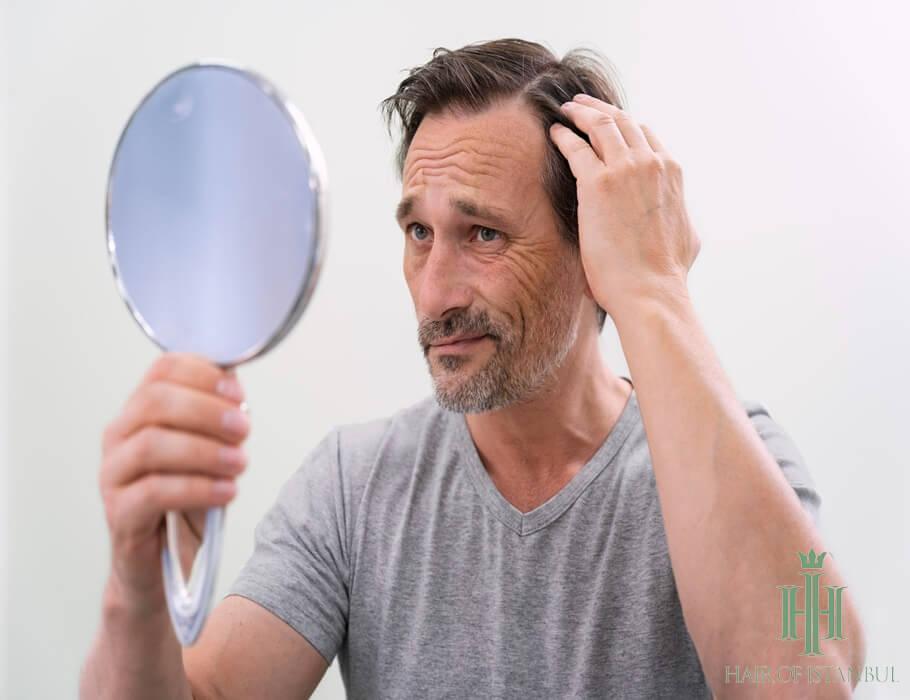
I Can See My Scalp Through My Hair: What It Means
“I can see my scalp through my hair” — on its own, that is not a sign of balding. Scalp is visible on most heads under the right light and at the right angle. Whether it means anything depends on six things, and only two of them involve hair loss.
This page is about the version of “I can see my scalp through my hair” that happens with dry hair, in ordinary light. If it only shows when your hair is wet, that is a separate and far more common effect, covered in seeing your scalp when your hair is wet.
When “I can see my scalp through my hair” is normal
Hair does not grow as a continuous sheet. It grows in follicular units of one to four hairs with skin between them, so light arriving from directly above will always reach some of that skin. The reason some people notice it and others never do comes down to contrast and calibre, not to how much hair they have lost.
Two people with identical hair counts can look completely different. Fine, straight, dark hair over pale skin shows scalp readily; coarse, wavy hair over similar-toned skin hides it almost entirely.
Six reasons I can see my scalp through my hair
| # | Reason | What it looks like | Hair loss? |
|---|---|---|---|
| 1 | Hair calibre | Fine strands cover less surface each. Same follicle count, less coverage. | No — often lifelong |
| 2 | Colour contrast | Dark hair on light skin, or light hair on dark skin, makes every gap read as a gap. | No |
| 3 | Light angle | Overhead light reaches between follicular units. Front-on light does not. | No |
| 4 | Wet hair, product or a tight style | Strands clump or are pulled flat, so the same hair covers less area. Reverses completely. | No — temporary |
| 5 | Pattern hair loss | Concentrated at the temples, front or crown. Hairs there become finer and shorter over months. Back and sides stay dense. | Yes |
| 6 | Diffuse shedding | Even thinning across the whole scalp, often 2–3 months after illness, surgery, weight change or a new medication. | Yes, usually temporary |
Reasons one to four are fixed features of your hair and your bathroom. Reasons five and six are the ones worth acting on, and they look different from each other — see androgenetic alopecia and telogen effluvium.
“I can see my scalp through my hair under light”
Bright overhead light is the single most common reason people think I can see my scalp through my hair. A bathroom downlight, a supermarket ceiling, a phone camera flash from above — each sends light down the parting and between the follicular units, and the skin lights up.
This is not an illusion in the sense that nothing is there; the gaps are real. It is an illusion in the sense that they were always there and the light is simply showing them. The check is to look at the same area in diffuse, front-facing light — a window, not a ceiling. If the scalp disappears, the light was the variable.
What is not normal is scalp that stays visible in every light, in one region only, and more so than a year ago.
How much scalp visibility is normal?
There is no number, and any page that gives you one is inventing it. Coverage depends on follicular density, hair calibre, curl, colour contrast and the light you are standing under — five variables that differ between two people with the same follicle count.
What can be judged is relative visibility, and there are two places to look.
| Where | Normal | Worth checking |
|---|---|---|
| Crown visibility | Some scalp shows at the whorl, because hair spirals outward from a single point there and cannot cover its own centre. This is anatomy, not loss. | The visible area extends beyond the whorl and has grown over a year. |
| When parting hair | A parting exposes skin by definition. Both sides look the same, and the width has not changed. | The parting has widened, or one side shows more than the other. |
| Hairline and temples | Density thins gradually towards the edge in everyone. | A defined recession that has moved back since older photographs. |
| Whole scalp | See-through hair under strong light, evenly, with no region worse than another. | See-through hair in ordinary light that was not there a year ago. |
The whorl point is worth understanding on its own, because it produces more false alarms than any other part of the head — see hair whorl.
The difference that matters: patterned or even
When “I can see my scalp through my hair” does mean hair loss, the shape tells you which kind. Androgenetic hair loss is patterned. DHT shortens the growth phase of susceptible follicles and miniaturises them, so they produce “fewer and finer hairs” (DermNet). Only follicles at the top and front are susceptible; those at the back and sides are not, which is why the back stays dense while the top thins.
In women the pattern is different. DermNet notes that female pattern hair loss “presents quite differently from the more easily recognisable male pattern baldness, which usually begins with a receding frontal hairline” — instead there is “diffuse thinning of hair on the scalp due to increased hair shedding or a reduction in hair volume, or both”. The frontal hairline is usually kept and the parting widens, which is why women often see it first in a photograph taken from above.
Diffuse shedding is different again: it affects the whole scalp evenly, comes on after an identifiable event, and usually reverses. The American Academy of Dermatology puts the normal baseline at “between 50 and 100 hairs a day”.
The cycle underneath it
Every follicle runs the same three phases independently of its neighbours, which is why hair does not all fall out at once.
| Phase | What happens | Duration |
|---|---|---|
| Anagen | Growing phase; hair lengthens by roughly 1 cm a month | 3–6 years |
| Catagen | Transition; the follicle shrinks and detaches from its blood supply | 2–3 weeks |
| Telogen | Resting phase, ending in the hair being shed naturally | About 3 months |
Pattern hair loss does not remove follicles. It shortens anagen, so each cycle produces a shorter, finer hair than the last until the strand no longer reaches the surface in a way that covers anything. That process is miniaturisation, and it is reversible for as long as the follicle is still cycling.
What makes hair thin in the first place
| Cause | How it shows |
|---|---|
| Genetics | Inherited sensitivity to DHT. Patterned, gradual, and the most common cause by a wide margin. |
| Hormonal change | Pregnancy, postpartum, menopause, thyroid disease, stopping or starting hormonal contraception. |
| Physical or emotional stress | Pushes follicles into telogen early. The shedding appears two to three months after the event, not during it. |
| Nutrient deficiency | Iron and ferritin most often; also protein, vitamin D and zinc. Worth a blood test rather than a guess. |
| Styling and tension | Tight styles, repeated heat and chemical processing. Causes breakage and, over years, traction alopecia at the hairline. |
| Illness and medication | Surgery, high fever, rapid weight loss, and some medicines. Usually reverses once the cause is resolved. |
Telling which reason applies to you
Five checks that separate the ordinary reasons I can see my scalp through my hair from the two that matter:
| Check | How | What it shows |
|---|---|---|
| Change the light | Same area, ceiling light then window light. | If it disappears in window light, the light was the cause. |
| Compare top to nape | Hold a hair from the crown next to one from the back of the neck. | If the crown hair is finer and shorter, that is miniaturisation — the earliest sign of pattern loss. |
| Widen the parting | Part the hair down the middle and photograph it from above. | A parting that has widened over a year is the clearest early sign in women. |
| Map the region | Note whether it is temples, crown, parting, or everywhere. | Localised means patterned. Everywhere means diffuse. |
| Photograph quarterly | Same room, same light, every three months. | Direction of travel, which no single photograph can show. |
The Norwood scale maps the male pattern stages; diffuse thinning covers the even kind.
Is the scalp itself healthy?
Visible scalp is a question of coverage, not of skin health — but the two get confused, so it is worth separating them. A healthy scalp looks like this:
| Clean and odour-free | Balanced sebum production and ordinary hygiene. |
| No itching or irritation | No bacterial or fungal overgrowth. |
| Even skin tone | No redness or inflammation. |
| Smooth texture | No excessive dryness, flaking or oiliness. |
| Ordinary shedding | Within the 50–100 hairs a day range when brushing or washing. |
| Steady growth | Hair lengthens and feels strong along the shaft. |
| No sores or bumps | No scabs, pustules or persistent lesions. |

Flaking, redness, itching or soreness are scalp conditions and are treated on their own terms. They can cause shedding, but they are not the same thing as pattern hair loss and improving them will not by itself restore density.
How to hide visible scalp with thin hair
Appearance can be changed today, independently of anything medical. These work by reducing contrast or increasing separation between strands.
| Method | Why it works |
|---|---|
| Shorter, layered cut | Less weight pulling strands flat, so they stand apart and cast shadow across the scalp. |
| Colour closer to skin tone | Reduces the contrast that makes each gap read as a gap. The single most effective change for dark hair on pale skin. |
| Matte, volumising products | Add separation. Heavy or greasy formulations clump strands and make coverage worse. |
| Blow-dry upside down | Lifts hair at the root, which is where coverage is decided. |
| Scalp concealer | Tinted powder or spray that darkens the skin rather than adding hair. |
| Hair fibres | Electrostatic keratin fibres that cling to existing hairs and thicken their apparent diameter. |
| Change the parting | Moving a parting slightly off its usual line covers a widened one immediately. |
| Accessories | Headbands, scarves and hats, for occasions rather than as a routine. |
What actually helps
If reasons one to four explain why I can see my scalp through my hair, nothing needs treating and the cosmetic changes above are the whole answer.
If the cause is pattern loss, the useful window is early. Miniaturised follicles can often be held where they are with medical treatment; follicles that stopped cycling years ago cannot be restored by anything other than transplantation. That is the entire argument for looking properly rather than waiting until you are certain.
If shedding started after an identifiable event and the thinning is even, the usual course is recovery over six to nine months without intervention. Investigate it if it has not settled by then.

An assessment is not the same as an operation. What it establishes is whether the pattern is androgenetic, how far it is likely to progress, and whether medical treatment alone is enough — which, in early cases, it usually is.
Frequently asked questions
I can see my scalp through my hair — am I balding?
Not necessarily. Visible scalp is normal under overhead light and with fine hair. It suggests hair loss when it is confined to the temples, crown or parting, when it persists in every light, and when the hairs in that area are finer than those at the back.
I can see my scalp through my hair under light — why?
Because light from above passes between the follicular units and reaches the skin. Diffuse light from the front does not. Judge density in window light, not under a ceiling lamp.
My hair is so thin I can see my scalp. Has it always been like this?
Photographs answer this and memory does not. Find an image from two or three years ago in similar light. Fine hair that has always been fine looks the same then; pattern loss does not.
I can see my scalp through my hair and I am a woman — why?
Female pattern hair loss usually spares the frontal hairline and widens the parting instead, which is why it is noticed from above rather than in the mirror. Diffuse shedding after childbirth, illness or a change in medication produces even thinning and normally recovers.
Am I going bald if I can see my scalp?
Not on that evidence alone. Balding is a change over time in a specific region, not a level of visibility at one moment. If the same area looked the same in a photograph a year ago, nothing is happening; if it has widened, something is.
Are you supposed to see your scalp through your hair?
Yes, to a degree. Hair grows in separated follicular units with skin between them, so the scalp is visible on every head under overhead light. See-through hair becomes a signal only when it is confined to one region or has changed.
Why can I see my scalp more on one side than the other?
Two ordinary reasons and one that matters. Most people part their hair on the same side for years, which exposes that side and flattens the hair against the scalp on it; and almost everyone sleeps predominantly on one side, which wears the hair there. Both are mechanical and reverse when the habit changes. What is worth checking is asymmetry that appears without a change in parting or styling, because pattern hair loss does not always progress evenly on both sides — compare the two temples in the same photograph rather than in the mirror, which reverses them.
Is it normal to see scalp through short hair?
Yes, and more so. Short hair lies closer to the scalp and casts less shadow across it, so the same density shows more skin. A change in cut is not a change in density.
Does seeing my scalp mean my scalp is unhealthy?
No. Visible scalp is about coverage, not health. Flaking, redness, itching or soreness are scalp conditions and are treated separately from hair density.
Seeing scalp through your hair is only meaningful alongside two other things: whether the pattern is even or concentrated, and whether it has changed since last year. Both are measured rather than judged in a mirror. Hair of Istanbul is a licensed clinic operating in Ataköy, Bakırköy, Istanbul since 2013 — our medical team assesses miniaturisation with trichoscopy, and our documented hair transplant journey records one patient month by month across 279 dated photographs.
References
- American Academy of Dermatology, Do you have hair loss or hair shedding?
- DermNet, Male pattern hair loss (androgenetic alopecia, balding)
- DermNet, Female pattern hair loss
- DermNet, Telogen effluvium (hair shedding)