
 en
en TR
TR  SK
SK  ITA
ITA  FR
FR  DE
DE  ES
ES  BG
BG  RO
RO 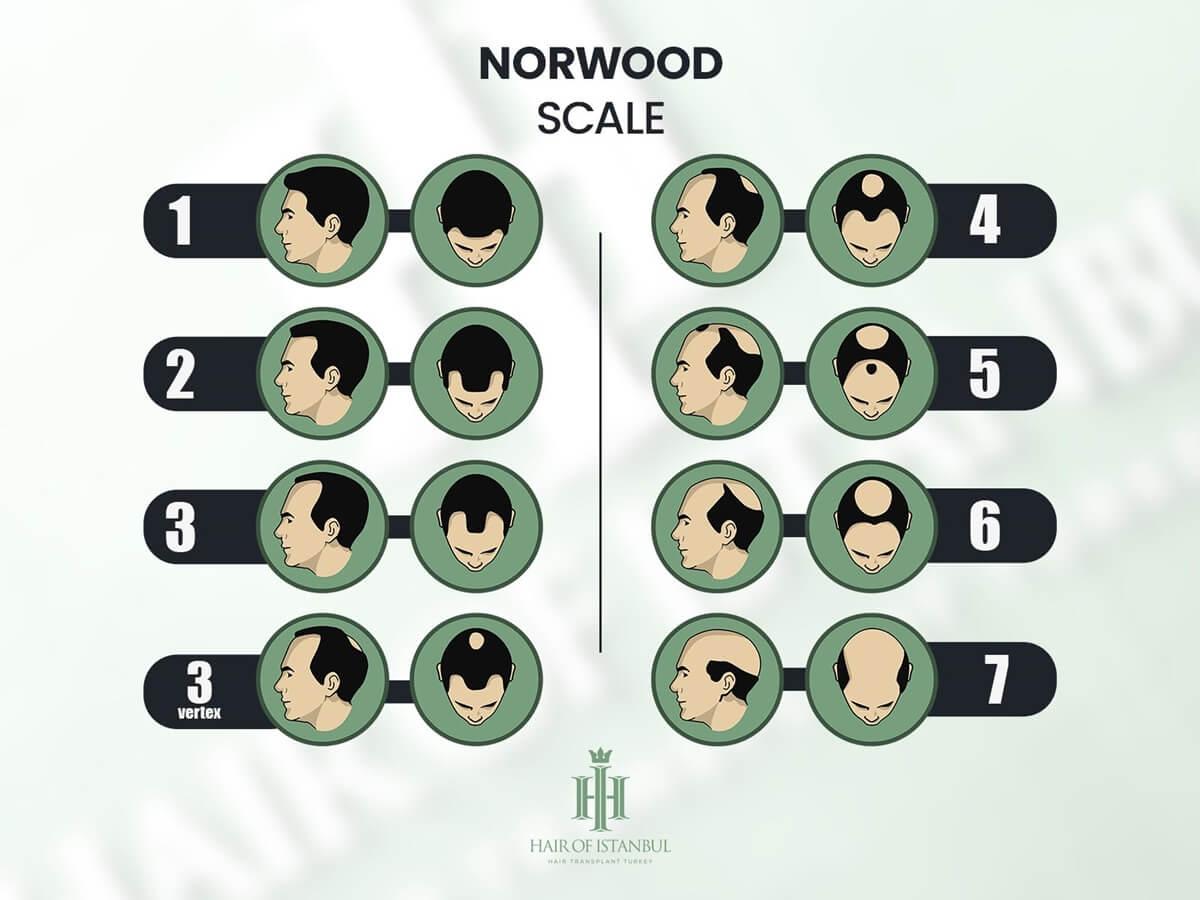
Norwood Scale Explained: Hair Loss Stages 1–7
The Norwood scale — properly the Hamilton–Norwood scale — is the seven-stage classification doctors use to describe male pattern hair loss. Stage 1 is a full adolescent hairline. Stage 7 is a narrow horseshoe of hair around the sides and back. Every stage in between is defined by two things: how far the hairline has receded, and whether a band of hair still separates the front from the crown.
It matters because it is the shared language of a consultation. When a surgeon plans a hair transplant, the stage sets how many grafts the case will need, whether the donor area can supply them, and whether one session is enough. This page shows all seven stages, gives the graft ranges that go with each, and links to a real patient result at that stage from our own archive.
What Is the Norwood Scale?
James Hamilton published the original classification of male pattern baldness in 1951. O’Tar Norwood revised and extended it in 1975, and that revision is what clinics use today. You will see it called the Norwood scale, the Hamilton–Norwood scale or simply the Norwood chart; they are the same thing.
The scale describes pattern, not cause. Androgenetic alopecia — the hormone-driven miniaturisation of follicles that produces this pattern — is what the stages are tracking. Hair loss that does not follow this pattern, such as diffuse shedding across the whole scalp or patchy circular loss, is not measured on the Norwood scale at all and usually points to a different diagnosis.
How common is each stage? In a community-based sample of men aged 18–49, 42% had moderate to extensive loss — Norwood type III or greater — rising from 16% of men aged 18–29 to 53% of men aged 40–49 (Rhodes et al., 1998). Across a full lifetime the figures are higher: roughly half of men are affected by age 50 and around 80% by age 70 (StatPearls, 2024). That threshold is the reason Stage 3 matters more than the number suggests: it is where Norwood’s own classification stops calling the change maturation and starts calling it balding.
The one detail that separates the middle stages: from Stage 4 onwards there are two distinct areas of loss — the front and the crown. What tells 4, 5 and 6 apart is the band of hair running across the top between them. Stage 4: the band is solid. Stage 5: the band is narrow and sparse. Stage 6: the band is gone.
Quick reference
| Stage | What it looks like | Crown | Typical action |
|---|---|---|---|
| 1 | Adolescent hairline, no recession | Full | No treatment |
| 2 | Slight symmetrical temple recession | Full | Monitor and measure |
| 3 | Deep temple recession, M shape | Usually full | First surgical candidacy |
| 3 vertex | Stage 3 front plus early crown thinning | Thinning | Plan front and crown together |
| 4 | Two separate bald areas, solid band between | Distinct bald area | Donor planning becomes critical |
| 5 | Same two areas, band now narrow and sparse | Larger | Priorities set before surgery |
| 6 | Band gone, front and crown merged | Merged with front | Often staged over two sessions |
| 7 | Narrow horseshoe of thin hair only | None | Realistic expectations first |
The 7 Norwood Stages Explained
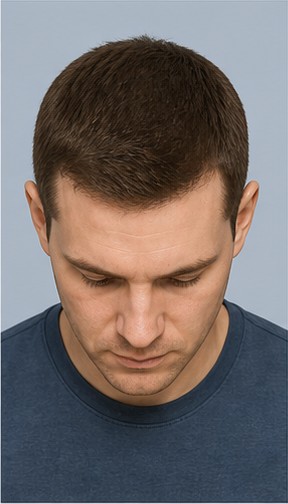
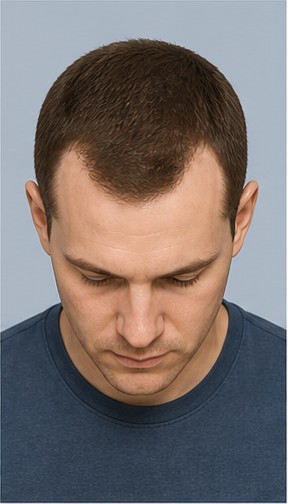
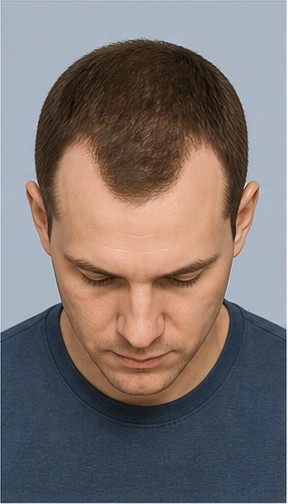
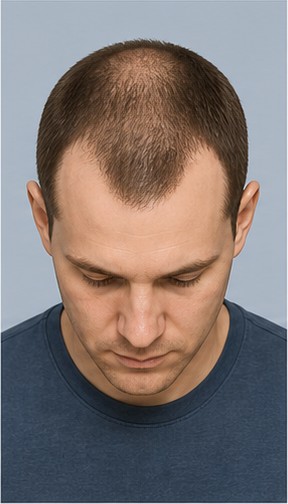
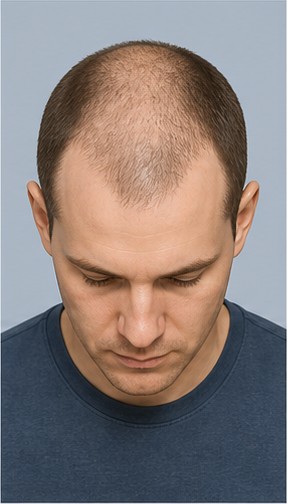
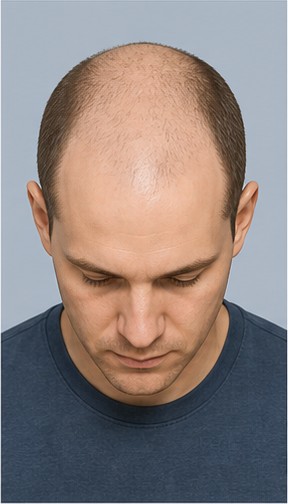
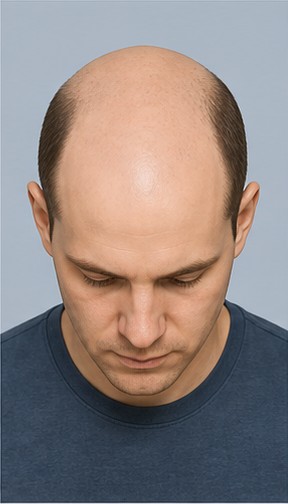
These are illustrations of the Hamilton–Norwood classification, not photographs of our patients. Real results, with graft counts and month-by-month timelines, are published on our hair transplant before and after page.
Norwood Stage 1 — Baseline, No Visible Loss
The hairline sits where it did in adolescence: a straight or gently curved line across the forehead, no recession at the temples, full density at the crown. Norwood 1 is the reference point the other six stages are measured against rather than a stage of balding.
Men at this stage sometimes arrive convinced they are losing hair. Usually what they are seeing is normal daily shedding, or a hairline that has always been naturally high. A density measurement of the donor and recipient zones settles it in minutes — and if you are unsure whether your own line has moved, the difference between a mature and a receding hairline is the place to start.
The planning question at Norwood 1 is not what to transplant but whether to operate at all. A hairline that has always been high is not a balding hairline, and surgery on a scalp that is not losing hair spends donor grafts that cannot be replaced. Age weighs more than appearance here: a man in his early twenties has decades of possible progression ahead, and a line placed to suit a face of twenty-two can read wrong on the same face at forty while the hair behind it thins away. That is why Stage 1 is measured and re-measured rather than operated on, and why surgery in younger patients is planned on different assumptions from the same pattern in a man of forty-five.
- No recession
- Crown intact
- Surgery not indicated
Norwood Stage 2 — The Mature Hairline
A small, symmetrical recession appears at both temples, moving the hairline back by roughly a centimetre and leaving a gentle V in the middle. Most men pass through this in their twenties. Norwood 2 on its own is not evidence of progressive loss.
The question that matters is whether the line has settled or is still moving. A mature hairline stays put for years; a receding one keeps going and the temples keep opening. Two consultations twelve months apart, with the same measurement method, answer it better than any single opinion.
Norwood 2 carries the most common planning error on the scale: treating a mature hairline as a balding one and rebuilding it where it used to sit. A juvenile hairline runs low and straight across the forehead; an adult one sits slightly higher with softened temples. Restoring the juvenile line commits grafts to an area that was always going to change, and those grafts are then not available for the crown a decade later. Holding the adult line, treating the temples conservatively if at all, and keeping the donor budget intact is the safer course — what a natural hairline looks like at thirty-five is not what it looked like at eighteen.
- Symmetrical temple recession
- Crown intact
- Measure, wait, re-measure
See a real Norwood 2 result — 2,500 grafts, FUE, single session
Norwood Stage 3 — The First Stage Classified as Balding
The temporal recession is now deep and clearly symmetrical, leaving the familiar M shape. This is the first stage Norwood classified as balding rather than maturing, and it is the stage at which most men book their first consultation.
It is also the stage with the most options. The recession is visible but the donor area is untouched, so a single session can usually rebuild the frontal third with room left for the future. If you are living with this shape rather than treating it yet, the haircuts that work with an M-shaped hairline buy time without pretending the pattern is not there.
Stage 3 is where the donor supply first has to be treated as a lifetime figure rather than a single-operation one. The frontal third can usually be rebuilt in one sitting, but the crown behind it may still thin over the following decade, and grafts placed generously at the hairline are grafts unavailable for that later work. Planning here therefore sets a line that will still read correctly if the pattern advances two more stages, and leaves reserve in the safe donor zone rather than harvesting to its limit. How that reserve is calculated is set out in long-term planning.
- M-shaped hairline
- Crown usually intact
- Most common consultation stage
See a real Norwood 3 result — 3,100 grafts, FUE, single session
Norwood Stage 4 — Two Separate Areas of Loss
The frontal line has moved back further than in Stage 3 and a distinct bald area has opened at the crown. The defining feature of Stage 4 is what sits between them: a moderately dense band of hair still runs across the top of the scalp, joining the hair at the sides and keeping the two areas separate.
That band is the detail to look for when placing yourself between Stage 3, 4 and 5. Two distinct bald zones with solid hair bridging them is Norwood 4. From here on, the arithmetic changes — the case needs more grafts than the frontal third alone, and the donor area has to be assessed before anything is promised. Our guide to how many grafts you need walks through that calculation.
From Stage 4 the constraint shifts from what the recipient area needs to what the donor area can give. Two zones now draw on the same finite supply, and the assessment is arithmetic: measured donor density and the size of the safe zone, set against the surface area to be covered. The error to avoid at this stage is a graft number quoted before that measurement — a figure read off a photograph rather than off the scalp. The safe donor area is anatomically bounded and does not widen because more grafts are wanted; harvesting beyond it produces visible thinning at the sides that no later procedure repairs.
- Two separate zones
- Band across the top intact
- Donor assessment essential
See a real Norwood 4 result — 4,200 grafts, FUE, single session
Norwood Stage 5 — The Band Narrows
The same two areas of loss as Stage 4, but both are larger and the band between them has become narrower and sparser. The regions are beginning to merge; they have not merged yet. Seen from above, the band reads as a thinning bridge rather than a solid strip.
Stage 5 is where donor capacity starts to set the ceiling on what one session can achieve. Coverage decisions — hairline first or crown first — are made here, and they are made from a density measurement rather than by eye. Framing the face usually returns more than spreading the same grafts thinly across everything.
At Stage 5 the question is no longer whether to operate but where to spend the grafts, and the answer is usually the front. Coverage is a matter of perception as much as surface: the frontal third frames the face and appears in every mirror and photograph, while the crown is mostly seen by other people. One session spread thinly across both tends to convince in neither. Density is the second half of the decision — packing grafts more tightly does not raise survival in proportion, and the evidence points the other way, with better survival at moderate densities than at the highest ones. Both questions are set out in crown versus frontal priority and density planning.
- Band narrow and sparse
- Zones not yet merged
- Donor capacity is the constraint
See a real Norwood 5 result — 4,500 grafts, FUE, single session
Norwood Stage 6 — The Bridge Is Gone
The band has disappeared. Front and crown have joined into one continuous region of loss, and what remains is a horseshoe of hair around the sides and back with only sparse coverage across the top.
A single session at Norwood 6 is about priorities, not full restoration. Many Stage 6 cases are planned across two sessions twelve months apart, the first rebuilding the hairline and frontal zone, the second adding density to the crown once the donor area has recovered.
Stage 6 is where staging becomes a donor-supply decision rather than a scheduling preference. The safe zone does not regenerate: follicles moved to the top are gone from the back permanently, and a session that harvests aggressively to cover everything at once leaves nothing for correction later. The twelve months between sittings are not caution for its own sake — they let the donor area settle so the second harvest can be measured against what actually remains rather than what was assumed. The failure to avoid is donor depletion: a scalp with a rebuilt hairline, a crown still thin, and no reserve left to finish.
- Zones merged
- Horseshoe fringe
- Often staged over two sessions
See a real Norwood 6 result — 4,450 grafts, FUE, single session
Norwood Stage 7 — Advanced Loss
The most advanced pattern on the scale. Only a narrow band of hair remains, running from ear to ear around the sides and back, and that remaining hair is often itself thin and fine. There is no meaningful coverage anywhere on top.
Norwood 7 is where an honest consultation matters most. Donor supply is limited and does not regenerate, so the question is not whether a transplant is technically possible but what it can realistically deliver. Some Stage 7 patients are better served by a partial restoration that frames the face, and some are better served by being told the operation is not worth it.
At Stage 7 the donor area is frequently part of the problem rather than the solution. The remaining horseshoe is often itself miniaturised, which reduces both the number of usable grafts and the density they can reach once moved. That changes the goal: a realistic Stage 7 plan frames the face and accepts a thinner result across the top, or concludes that the available supply does not justify surgery. Saying so is part of the assessment rather than a failure of it. What is achievable at this stage is set out in hair transplant for advanced baldness, and the grounds for declining in when a transplant is not recommended.
- Horseshoe only
- Donor often thinned
- Expectations set before surgery
Norwood 1.5, 2.5 and 3 Vertex — the In-Between Patterns
Not every scalp lands neatly on a whole number, and three half-steps come up often enough to have their own names.
| Pattern | What it means | Why it is treated separately |
|---|---|---|
| Norwood 1.5 | The hairline has moved, but less than a full Stage 2. A few millimetres at the temples, often only visible in photographs taken a year apart. | It is the earliest point at which progression can be confirmed rather than guessed. |
| Norwood 2.5 | Between the mature hairline and the true M shape. The temples are open but the frontal tuft is still intact. | Often the last stage where medical treatment alone can hold the line. |
| Norwood 3 vertex | Stage 3 frontal recession combined with early thinning at the crown, with a band of hair still crossing the mid-scalp between them. | Donor planning is different: two zones to consider, not one. |
Norwood also described a Type A variant, in which the hairline recedes back in a straight line without leaving the M shape and without a separate crown patch. It progresses differently and is planned differently, which is why an assessment looks at the shape of the loss as well as its extent.
Graft Estimates by Norwood Stage
These are planning ranges, not quotes. The number that ends up on your surgical plan depends on donor density, hair calibre, hair-to-skin contrast and how much of the crown you choose to cover — two men at the same Norwood stage can need very different graft counts.
| Stage | Typical planning range | Usual priority | One session? |
|---|---|---|---|
| 2 | 1,500 – 2,800 grafts | Temples and hairline | Yes |
| 3 | 2,000 – 3,500 grafts | Frontal third | Yes |
| 3 vertex | 2,500 – 4,000 grafts | Front, then crown | Usually |
| 4 | 3,000 – 4,500 grafts | Front, partial crown | Usually |
| 5 | 3,800 – 5,000 grafts | Front prioritised | Often, donor permitting |
| 6 | 4,000 – 5,500 grafts | Hairline and frontal zone | Sometimes staged |
| 7 | Case by case | Facial framing only | Rarely |
Our published cases sit inside these ranges: 2,500 grafts for a Norwood 2, 3,100 for a Norwood 3, 4,200 for a Norwood 4, 4,500 for a Norwood 5 and 4,450 for a Norwood 6 — every one of them a single session, each documented month by month on the before and after page. For how the count is calculated from your own scalp rather than from a table, see how many grafts do I need, and for what those numbers cost, hair transplant cost in Turkey.
A word on very high graft counts. Any clinic quoting 6,000–7,000 grafts in a single session for an advanced stage is describing something the donor area usually cannot supply safely. Over-harvesting thins the donor permanently and cannot be undone. If a quote looks generous, ask what the measured donor density was.
How to Place Yourself on the Scale
You can get close on your own with two photographs and one question.
- Photograph the front. Face-on, hair dry, pushed back off the forehead, natural light. This shows how far the temples have opened and whether the frontal tuft is intact.
- Photograph the top. Head tilted forward, camera above and slightly in front. This is the only view that shows the crown honestly.
- Then ask: is there a band? If there are two separate areas of loss with hair running between them, you are at Stage 4 or 5 depending on how wide that band is. If they have joined, you are at 6 or 7. If there is only recession at the front and the top is covered, you are at 2 or 3.
What self-assessment cannot tell you is donor capacity, and that is the number the plan actually depends on. Two men can both be Norwood 5 and only one of them be a good candidate for a single session. That measurement takes a trichoscope and a few minutes; you can start it by sending those two photographs to our clinic team.
Does the Norwood Scale Apply to Women?
No. Female pattern hair loss rarely produces a receding hairline or a bald crown. It usually presents as diffuse thinning that widens the parting while the frontal hairline stays intact, and it is classified on the Ludwig scale — three grades rather than seven stages.
Applying Norwood to a woman’s scalp will usually misread the problem, and misreading it matters, because diffuse loss in women more often has a treatable underlying cause: thyroid disease, iron deficiency, or a medication. Our page on hair transplant for women covers candidacy and the workup that comes before any surgical discussion.
What Each Stage Usually Calls For
| Stage | Medical treatment | Surgery |
|---|---|---|
| 1 – 2 | Monitoring; medical treatment only if progression is documented | Not indicated |
| 3 | Worth starting, to protect what is behind the hairline | Good candidacy; frontal third |
| 4 – 5 | Strongly advised alongside surgery — it protects the untransplanted hair | Yes, with donor assessment first |
| 6 | Limited benefit on bald areas; still protects the fringe | Yes, sometimes staged |
| 7 | Little to preserve | Case by case; partial goals |
Transplanted follicles are taken from the back and sides, where they are genetically resistant to DHT, so they keep growing wherever they are moved. The hair around them is not resistant, which is why medical treatment usually continues after surgery — it is protecting the native hair, not the grafts. The technique itself, FUE or DHI, is chosen from the recipient area and hair characteristics rather than from the Norwood stage. If an earlier procedure has left you with an unnatural hairline or depleted donor, revision surgery is planned differently again.
Norwood Scale: Frequently Asked Questions
What Norwood stage am I?
Compare two photographs — one face-on, one of the top of your head — against the chart above, then look for the band. Recession at the temples with a covered top is Stage 2 or 3. Two separate bald areas with hair between them is Stage 4 or 5. One merged area is Stage 6 or 7.
Which Norwood stage is best for a hair transplant?
Stages 3 to 5 give the best ratio of visible improvement to grafts used, because the donor area is still full and there is a defined area to rebuild. Surgery is possible earlier and later; it is simply less efficient at the extremes.
How fast does hair loss progress through the stages?
There is no fixed timetable. Some men move one stage in a decade, others move two in three years. Family history and the age at which loss started are the two strongest predictors, which is why planning a hairline for a 24-year-old is a different exercise from planning one for a 45-year-old.
Can you reverse the Norwood scale?
Medical treatment can hold a stage and sometimes recover recently miniaturised hair, which can look like moving back half a step. It does not regrow follicles that are gone. Surgery moves resistant hair into a bald area; it changes appearance rather than the underlying pattern.
How many grafts do I need for Norwood 3?
Typically 2,000 to 3,500 for the frontal third, though the figure comes from donor density rather than from the stage. Our published Norwood 3 case used 3,100 grafts in one session.
How many grafts do I need for Norwood 5?
Usually 3,800 to 5,000, and whether that fits in one session depends entirely on the donor area. Our published Norwood 5 case used 4,500 grafts in a single session.
What is the difference between Norwood 3 and Norwood 3 vertex?
Both share the same M-shaped frontal recession. Stage 3 vertex adds early thinning at the crown, with a band of hair still crossing the scalp between the two areas. It is planned as two zones rather than one.
Is Norwood 2 balding?
Not necessarily. Stage 2 describes the mature hairline that most men develop in their twenties. It becomes balding only if it keeps moving, which is why the useful measurement is change over twelve months rather than the shape on any given day.
What is the highest Norwood stage?
Norwood 7 — only a narrow horseshoe of thin hair around the sides and back, with no coverage on top. It is the end point of the Hamilton Norwood scale.
References
- Norwood OT. Male pattern baldness: classification and incidence. Southern Medical Journal, 1975;68(11):1359–1365.
- Hamilton JB. Patterned loss of hair in man: types and incidence. Annals of the New York Academy of Sciences, 1951;53(3):708–728.
- Ludwig E. Classification of the types of androgenetic alopecia (common baldness) occurring in the female sex. British Journal of Dermatology, 1977;97(3):247–254.
- Gupta M, Mysore V. Classifications of patterned hair loss: a review. Journal of Cutaneous and Aesthetic Surgery, 2016;9(1):3–12.
- Rhodes T, Girman CJ, Savin RC, Kaufman KD, Guo S, Lilly FR, Siervogel RM, Chumlea WC. Prevalence of male pattern hair loss in 18–49 year old men. Dermatologic Surgery, 1998;24(12):1330–1332.
- Ho CH, Sood T, Zito PM. Androgenetic Alopecia. StatPearls, last updated 7 January 2024.
Clinical review. The staging descriptions and graft ranges on this page reflect the assessment protocol used at our clinic in Istanbul and are reviewed by our surgical team. Ranges are planning figures, not quotations, and no page can replace a donor-density measurement. See our medical team, browse documented results, or read what the procedure involves from planning to recovery and what aftercare requires.