
 en
en TR
TR  SK
SK  ITA
ITA  FR
FR  DE
DE  ES
ES  BG
BG  RO
RO 
Widow’s Peak Hair Transplant: What It Can and Cannot Change
A widow’s peak is the V-shaped point where the hairline dips down at the centre of the forehead. Most people who search for it want to know one of three things: whether it means they are going bald, whether it can be removed, or whether a hair transplant can change it. The answers are, in order: usually no, partly, and yes but not in the way most people expect.
What a widow’s peak actually is
In the medical literature a widow’s peak is defined as a V-shaped descending extension of the anterior hairline at the centre of the forehead, and it is classified as a morphogenetic trait — a feature of how the hairline formed during development, not something that happened to it later. The name comes from a superstition that it foretold early widowhood.
In the large majority of cases a widow’s peak is a normal variant. It is worth knowing that its presence has also been described in association with several genetic syndromes, usually alongside other findings such as widely spaced eyes — but a widow’s peak on its own, in an otherwise healthy person, is simply a hairline shape.
This matters for one practical reason: a widow’s peak is not hair loss. It was there before any hair loss began, and it is not evidence that any is coming.
How common is a widow’s peak?
Two studies give useful numbers, and they disagree — for reasons worth understanding.
A 2021 study of 456 healthy Japanese subjects recorded a widow’s peak in 29.6% of women and 32.8% of men. In the same group, M-shaped frontal hairlines accounted for 42.6% of men but only 18.2% of women, and the mean mid-frontal line measured 6.2 cm in women and 6.65 cm in men.
A 2009 study that measured the hairlines of 360 women in a salon setting found a widow’s peak in 81%. The same study found lateral mounds in 98% of women and a mean distance from mid-eyebrow to frontal midpoint of 5.5 cm.
The gap between 30% and 81% is mostly definition and population. A subtle central point counts as a widow’s peak under a generous definition and does not under a strict one, and the two samples were different populations. The honest summary: a widow’s peak is common enough to be unremarkable in both sexes, and somewhere between a third and the large majority of people have some version of one.
Is a widow’s peak genetic?
Yes, but not in the way it is usually taught.
The version repeated in school biology — that a widow’s peak is a single dominant gene, like a textbook Mendelian trait — is not supported. A genome-wide association study of 26,806 people published in 2022 examined widow’s peak among five facial traits and identified two loci associated with it, GMDS-AS1 and SPRED2, describing it as a trait not previously reported in this kind of analysis. The authors modelled the trait using polygenic scores, which is the opposite of a single-gene picture.
Practically: a widow’s peak runs in families, but you cannot predict it from one parent, and having one tells you nothing about your risk of male pattern hair loss.
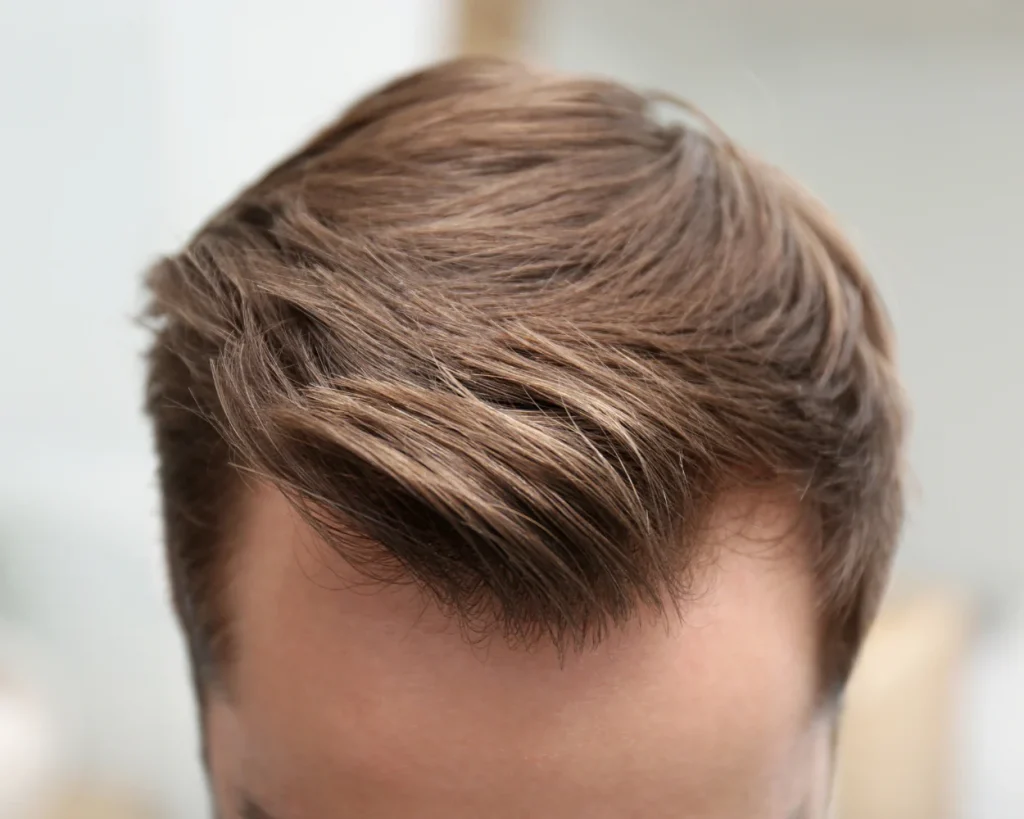
Widow’s peak or receding hairline?
This is the question behind most of the anxiety, and the distinction is usually clear once you know what to look at.
| Widow’s peak | Receding hairline | |
|---|---|---|
| When it appeared | Present since childhood or adolescence | Developed over months or years |
| What changes | Stable shape | Corners keep moving back |
| The hair itself | Full-calibre terminal hair right to the edge | Thinner, shorter, finer hairs at the margin |
| Symmetry | Central point, generally symmetrical | Often uneven between the two sides |
| Old photographs | The same shape ten years ago | Visibly different ten years ago |
There is a third possibility that catches men in their twenties: normal hairline maturation. Hairlines change shape from birth onwards, and the childhood hairline gives way to an adult one as facial morphology matures. That mature hairline sits higher and has deeper temporal corners than the childhood one, and it is not hair loss. Distinguishing maturation from early androgenetic alopecia is a clinical judgement based on hair calibre at the margin, not on the shape alone — our page on the mature versus receding hairline covers this in detail.
The single most useful thing you can do at home is find a photograph of yourself from five or ten years ago. A widow’s peak looks the same in both pictures. Recession does not.
Does a widow’s peak mean you are going bald?
No. A widow’s peak is a developmental hairline shape; androgenetic alopecia is a hormone-driven miniaturisation of follicles. They are unrelated processes, and having one does not predict the other.
The confusion arises because a widow’s peak and early recession can look alike in a mirror. As the temples recede on either side of a central point, the point becomes more prominent — so someone who always had a mild widow’s peak may notice it for the first time at 30, and conclude the peak is new. It is the surrounding hairline that changed.
What is a reverse widow’s peak?
A reverse or inverted widow’s peak is a V-shape that points the other way — the hairline notches upward at the centre of the forehead instead of down, leaving the corners lower than the middle. Some people also use the term for a downward point at the nape rather than the forehead.
Like the standard version, it is a normal variation in hairline morphology rather than a condition. It can, however, make a frontal hairline read as uneven, and it is one of the shapes that has to be accounted for when a hairline is designed surgically.
What a hair transplant can and cannot do
People arrive with two quite different requests, and they have different answers.
“Fill in around my widow’s peak.” This is the common one and it is straightforward. The temporal corners on either side of the peak have receded and the patient wants them rebuilt so the hairline reads as continuous again. Grafts are placed into the recessed triangles; the central point is preserved deliberately, because removing it would look less natural, not more. This is standard FUE work and it is one of the more predictable hairline cases.
“Get rid of my widow’s peak.” A transplant cannot remove hair. What it can do is add hair on either side of the peak so that the V is no longer the lowest point — effectively rounding the hairline by building the areas beside it forward. That is a design decision with real consequences: it uses donor grafts, it lowers the hairline overall, and it cannot be undone. Anyone under about 30 should be cautious, because a hairline placed to suit today’s face has to still suit it in twenty years.
The rules that govern the design are the same ones that apply to any hairline: not closer than roughly 6 cm from the glabella, single-hair grafts at the leading edge, an irregular rather than a ruled border, and a forward angle that matches the surrounding hair. These are set out on our hairline design page, with the underlying principles in the encyclopedia entries on hairline design principles and natural versus artificial hairlines. Where the corners themselves are the issue, the relevant procedure is temple point reconstruction.
One thing a transplant is not: a treatment for a hairline that is still receding. If the loss is active, grafts placed today sit in front of hair that will thin behind them. Medical treatment and a stable pattern come first — otherwise the result is the classic badly designed hairline that has to be revised later.
How many grafts does a widow’s peak case need?
Fewer than most people assume, because the area involved is small. Rebuilding the two temporal triangles around a widow’s peak typically needs far fewer grafts than a full frontal restoration — but the honest number depends on the width and depth of the recessions, the density of the surrounding hair and the calibre of your donor hair, and it is set by measurement rather than by category.
Our graft calculator gives a planning range from a Norwood stage or a measured area. It is a starting point for a conversation, not a quote. Cost follows the graft number and is set out on the hair transplant cost page; results from hairline cases are on the before and after page.
If you simply do not like yours
A widow’s peak needs no treatment. If you dislike the look of yours, the options that do not involve surgery are:
- Styling. The most effective and the least permanent. A side part, forward-styled fringe or added length across the front all soften a central point. Our page on haircuts for an M-shaped hairline covers the same principles.
- Temporary hair removal. Waxing or depilatory cream on the peak itself. Both regrow, and both irritate the skin at the hairline, which is thin.
- Permanent hair removal. Electrolysis or laser can destroy the follicles at the point. This is irreversible — the hair does not come back if you change your mind, or if the hairline behind it later recedes and you would have wanted that hair. Think about it in the context of the next twenty years, not this year.
- Surgical hairline lowering. A different operation from a transplant, in which the forehead skin is advanced. It is not suitable for everyone and carries a scar at the hairline.

Before anything permanent, it is worth knowing where your hairline sits relative to your face — our page on average forehead size and the golden ratio hairline whitepaper both deal with the proportions that decide whether a hairline looks high or low.
Frequently asked questions
Is a widow’s peak normal?
Yes. It is a normal morphogenetic variant of the hairline, recorded in roughly a third of men and women in one large study and in a majority of women in another.
Does a widow’s peak mean I am balding?
No. It is a developmental hairline shape, present long before any hair loss. What changes with balding is the hairline around it.
Is a widow’s peak a dominant gene?
No. The single-dominant-gene version taught in school biology is not supported. A genome-wide study of 26,806 people found the trait to be polygenic, with at least two associated loci.
Can a hair transplant remove a widow’s peak?
A transplant adds hair; it cannot remove it. It can build up the areas on either side so the peak is no longer the lowest point of the hairline. Removing the peak itself requires hair removal, not transplantation.
How many grafts for a widow’s peak hair transplant?
It depends on the size of the recessions being rebuilt, the surrounding density and your donor hair calibre. Small corner cases need far fewer grafts than a full frontal restoration; the number comes from measurement, not from the diagnosis.
What is a reverse widow’s peak?
A hairline that notches upward at the centre instead of pointing down, leaving the corners lower than the middle. It is a normal variation, not a condition.
Can a widow’s peak go away on its own?
No. It is a fixed feature of hairline shape. If your central point seems to be disappearing, what is usually happening is that the hairline around it is receding and changing the outline.
References
- Kyriakou G, Glentis A, Papanikolaou S. Widow’s peak: a usually overlooked, yet significant morphogenetic trait. J Dtsch Dermatol Ges. 2021;19(9):1271–1275. PMID 34357692. pubmed.ncbi.nlm.nih.gov
- Kashiyama K, Haraguchi R, Ban F, et al. Study of Frontal and Temporal Hairline Patterns in Japanese Subjects. Plast Reconstr Surg Glob Open. 2021;9(8):e3751. PMID 34414058. pubmed.ncbi.nlm.nih.gov
- Nusbaum BP, Fuentefria S. Naturally occurring female hairline patterns. Dermatol Surg. 2009;35(6):907–913. PMID 19397668. pubmed.ncbi.nlm.nih.gov
- Wang P, Sun X, Miao Q, et al. Novel genetic associations with five aesthetic facial traits: A genome-wide association study in the Chinese population. Front Genet. 2022;13:967684. PMID 36035146. pubmed.ncbi.nlm.nih.gov
- Rassman WR, Pak JP, Kim J. Phenotype of normal hairline maturation. Facial Plast Surg Clin North Am. 2013;21(3):317–324. PMID 24017973. pubmed.ncbi.nlm.nih.gov
- Complications in Hair Transplantation. J Cutan Aesthet Surg. PMC6371733. pmc.ncbi.nlm.nih.gov
In short
A widow’s peak is a normal hairline shape, not a warning sign and not a defect. It is polygenic rather than a single dominant gene, it is present in roughly a third of men and women on strict criteria, and it does not predict hair loss. The reason it worries people is that receding temples make an existing peak look newly prominent — and the test for that is an old photograph, not a mirror. A transplant can rebuild the corners on either side of a peak, which is a predictable and common case; it cannot remove the peak itself, and it should not be done while the hairline is still moving.
If you are not sure whether what you see is a widow’s peak or the start of recession, send us photographs and we will tell you which one it is.