
 en
en TR
TR  SK
SK  ITA
ITA  FR
FR  DE
DE  ES
ES  BG
BG  RO
RO 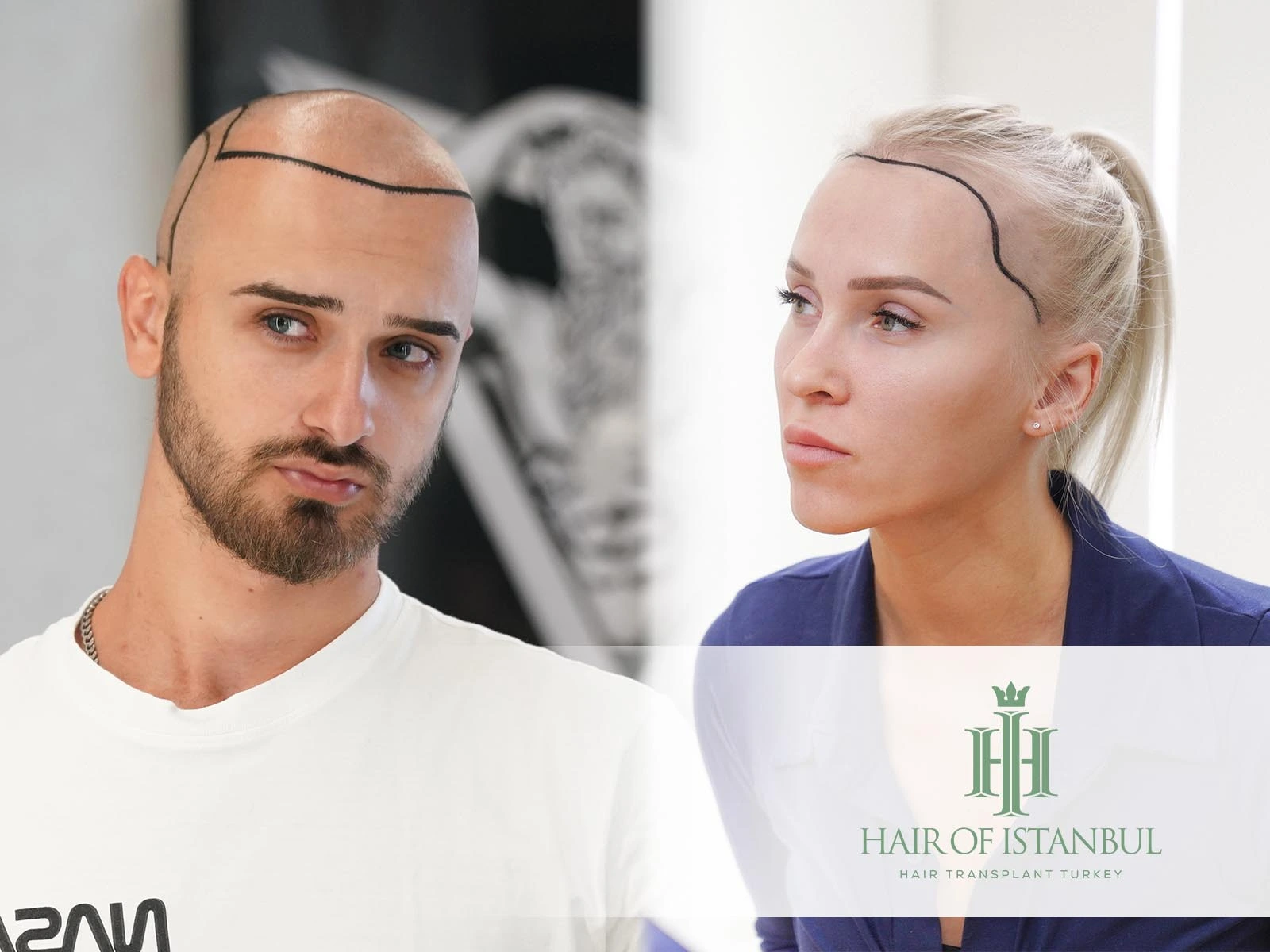
Transgender Hair Transplant: Hairline, Hormones and Timing
A transgender hair transplant is not one operation. For a transfeminine patient — a male to female (MTF) transition — it usually means moving a hairline that reads as male into one that reads as female. For a transmasculine patient — female to male (FTM) — it usually means treating hair loss that testosterone started, or building facial hair. The surgery is the same technique; the goal, the planning and the timing are not.
This page sets out what the procedure can change, what hormones change on their own, and when it makes sense to operate.
The short answer
- Feminizing hormones do not rebuild a receded hairline. They can slow or partly improve ongoing loss. Ground already lost to male-pattern recession stays lost without surgery.
- Testosterone can start or accelerate hair loss. In a cohort of 37,826 patients, transmasculine people on masculinizing hormone therapy had 2.5 times the rate of androgenetic alopecia compared with cisgender women.
- A transgender hair transplant moves your own follicles. Nothing is implanted that did not grow on you, and the donor area has a fixed limit.
- Medical treatment usually comes first, and it is decided with the clinician managing your hormone therapy, not separately from them.
Two different operations under one name
The search term is shared, the surgery is not. Hairline feminization surgery and treatment for testosterone-driven loss are different problems, and being clear about which one applies changes almost everything about planning. Female hair loss outside a gender-affirming context is covered separately on our hair transplant for women page.
| Transfeminine (MTF) | Transmasculine (FTM) | |
|---|---|---|
| Usual goal | Lower and round the hairline, fill the temporal recessions | Treat androgenetic loss; or build beard and moustache |
| What hormones do | May slow or partly improve loss; do not restore a receded hairline | May induce or accelerate loss on the scalp; increase facial hair |
| Main surgical question | How far forward the hairline can safely come | Whether the loss is stable enough to operate on |
| Donor risk | Usually stable donor if loss has stopped | Donor may still be changing under testosterone |
What hormone therapy actually changes
This is where expectations most often go wrong, and the literature is reasonably clear about the direction even where it is thin on numbers.
A systematic review of gender-affirming hormone therapy and hair growth found that feminizing therapy with antiandrogens may reduce facial and body hair and can improve androgenetic alopecia, while masculinizing therapy with testosterone may increase facial and body hair and induce or accelerate androgenetic alopecia. The same review noted that most studies relied on grading scales or subjective assessment, and very few used objective quantitative measurement — so the direction is established, the magnitude is not.
The largest incidence data come from a retrospective cohort of 37,826 patients. Transmasculine patients on masculinizing therapy had an adjusted incidence rate ratio for androgenetic alopecia of 2.50 (95% CI 1.71–3.65) compared with cisgender women. Transfeminine patients on feminizing therapy were not significantly different from cisgender men, but were significantly above cisgender women at 1.91 (95% CI 1.25–2.92).
Read that second finding carefully, because it is the one that matters for planning. Feminizing hormones did not bring the rate of pattern loss down to the cisgender female range. Whatever recession happened before treatment is still there, and androgenetic alopecia that has already miniaturised follicles does not reverse because oestrogen was added.
What makes a hairline read as female
Feminizing a hairline is not only about height. Measured comparisons of male and female hairlines identify several features that differ, and the temporal corners matter as much as the front.
In a study of 456 Japanese adults, the differences were consistent:
| Feature | Women | Men |
|---|---|---|
| Temporal hairless area present | 48.1% | 82.8% |
| M-shaped hairline | 18.2% | 42.6% |
| Round hairline | 38.5% | 10.7% |
| Mid-frontal height | 6.20 cm | 6.65 cm |
Two things follow. First, the height difference is under half a centimetre — far less than most people expect, and less than the shape difference. Second, the temporal corners do most of the work. A hairline brought forward centrally while the temples stay recessed still reads as male. This is the same design logic set out on our hairline design page, applied to a different target.
In a separate series of 360 women, a widow’s peak was present in 81% and lateral mounds in 98% — which is why a perfectly straight, symmetrical line is the wrong goal. Natural female hairlines are irregular. The reasoning is set out under natural versus artificial hairline.
Hairline feminization: transplant, or moving the scalp forward
There are two ways to bring a hairline down, and they are not interchangeable.
Hair transplantation moves individual follicular units from the back and sides into the new hairline and temporal corners. It creates a soft, irregular edge, works on scar tissue and on skin that has never had hair, and can be repeated. It is limited by the donor area and takes a year to show its result.
Scalp advancement is a different operation, performed as part of forehead reconstruction by facial feminization surgeons. It moves the whole hair-bearing scalp forward at once. A published technique from a group treating 492 transgender patients combines forehead reconstruction with simultaneous hair transplantation in a single operation, on the reasoning that after the forehead itself, the hairline pattern is the second most important feature for gender identification in the upper third of the face.
We perform the hair transplant. If forehead or brow-ridge surgery is part of your plan, that is done by a facial feminization surgeon, and the sequencing between the two operations should be agreed before either is booked — a coronal incision crosses exactly the area a transplanted hairline occupies.
Grafts, donor area and what limits the plan
The constraint is the same one that governs every hair transplant: the donor area is finite, and what is taken from it does not grow back.
Two questions decide the plan at assessment:
- How much recession is there already? A hairline that has receded to a mature male position needs the temporal corners rebuilt as well as the front. That is more grafts than lowering an intact hairline.
- Is the donor stable? If pattern loss is still advancing, transplanted hair placed in front of a receding line leaves an island. Donor density and miniaturisation are measured before any number is quoted — see hair miniaturization.
Any graft figure given before that assessment is a guess. Our graft calculator gives a rough range; it is not a plan, and it does not replace measurement.
Shaving is a practical question worth raising early. Donor shaving is normally required, and whether an unshaven approach is possible depends on the number of grafts and your existing hair length. Ask before you book if it matters to you.
Transmasculine patients: scalp and beard
Two separate situations, often in the same person.
Scalp loss. Testosterone can start pattern loss in someone who would not otherwise have developed it, or accelerate loss that had already begun. The 2.5-fold incidence figure above is the scale of it. Because the loss is often early and still moving, timing matters more than technique: operating on an unstable pattern produces a result that looks worse in three years than it did at one. Medical treatment and observation usually come first.
Facial hair. Testosterone increases facial hair, but the density and distribution it produces are not always what the patient wants, and the areas it leaves sparse tend to be the cheeks and the connection between moustache and beard. A beard transplant takes follicles from the same scalp donor area — which means it competes with any future scalp transplant for the same finite supply. If both are on your list, they should be planned together rather than in sequence.
Medical treatment comes first, and it is a shared decision
A review of therapeutics for androgenetic alopecia in transgender and gender-diverse patients sets out first-line options as topical minoxidil 5% once or twice daily, oral finasteride 1 mg daily, and low-level laser therapy, with spironolactone 200 mg daily also first-line for transfeminine patients. Second-line options include low-dose oral minoxidil, dutasteride, platelet-rich plasma and hair restoration procedures.
Two points from that review are worth carrying into the consultation.
First, it recommends assessing progress after 6–12 months using scales that are not based on sex — the Basic and Specific classification or the Bouhanna scale — rather than Norwood or Ludwig. Those two scales describe patterns as male or female by design, which makes them a poor fit for grading and an actively unhelpful thing to be handed in a consultation.
Second, it is explicit that dermatologists should coordinate with the clinician managing your gender-affirming care, so that everyone knows every medication involved. Several of these drugs act on the same androgen pathway as your hormone therapy. Adding one without telling the prescriber of the other is how interactions get missed.
What that means for us: bring your full medication list, including hormone therapy and doses, to the assessment. It is covered in hair transplant preparation, and for transgender patients it is not a formality.
When to operate
There is no fixed interval that applies to everyone, but three conditions are worth meeting before booking.
- Hormone therapy has been stable for a period your prescriber considers established. Hair changes on hormone therapy continue for a long time; operating into a moving picture makes the plan harder to get right.
- The loss itself is stable. Especially for transmasculine patients, where testosterone may still be driving progression.
- Any forehead or brow surgery is planned, if it is going to happen. Sequencing is easier to agree in advance than to repair afterwards.
If you are unsure where you are on those three, that is a reasonable thing to bring to an assessment rather than to resolve alone.
Frequently asked questions
Does a transgender hair transplant use your own hair?
Yes. Follicular units are taken from your own donor area at the back and sides of the scalp and moved to the recipient area. Nothing synthetic is implanted, and donor supply is finite.
Will feminizing hormones regrow my hairline?
They may slow or partly improve ongoing loss, but they do not rebuild a hairline that has already receded. In a cohort of 37,826 patients, transfeminine patients on feminizing therapy still had a significantly higher rate of androgenetic alopecia than cisgender women.
Does testosterone cause hair loss?
It can. Transmasculine patients on masculinizing hormone therapy had 2.5 times the rate of androgenetic alopecia compared with cisgender women in the same cohort. Whether it happens, and how fast, depends on genetic susceptibility.
What is the difference between a hair transplant and scalp advancement?
A transplant moves individual follicles and creates a soft, irregular hairline; it is limited by donor supply and takes a year to show. Scalp advancement moves the whole hair-bearing scalp forward in one operation and is performed as part of forehead reconstruction by facial feminization surgeons. We perform the transplant.
Should I have facial feminization surgery before or after a hair transplant?
It should be agreed in advance between both surgeons. A coronal incision for forehead surgery crosses the area a transplanted hairline occupies, so the order is not a detail.
Can I have a beard transplant and a scalp transplant?
Both draw on the same scalp donor area, so they compete for the same finite supply. If both are wanted, they should be planned together from the start rather than decided one at a time.
Can I take finasteride while on hormone therapy?
That is a decision for the clinician managing your hormone therapy, not one to make from a website. Finasteride 1 mg is listed as first-line in the published review, and spironolactone 200 mg daily is also first-line for transfeminine patients — but several of these act on the same pathway as gender-affirming hormones, which is exactly why the review asks for coordinated care.
How many grafts will I need?
It depends on how much recession there is and whether the temporal corners need rebuilding as well as the front. Any number given before donor density and miniaturisation have been measured is a guess.
References
- Tang GT, Zwickl S, Sinclair R, Zajac JD, Cheung AS. Effect of gender-affirming hormone therapy on hair growth: a systematic review of the literature. Clin Exp Dermatol. 2023;48(10):1117–1127. PMID 37311161. pubmed.ncbi.nlm.nih.gov
- Gao JL, Sanz J, Tan N, King DS, Tangpricha V, Goodman M. Androgenetic alopecia incidence in transgender and gender diverse populations: A retrospective comparative cohort study. J Am Acad Dermatol. 2023;89(3):504–510. PMID 36780950. pubmed.ncbi.nlm.nih.gov
- Gao JL, Streed CG Jr, Thompson J, Dommasch ED, Peebles JK. Androgenetic alopecia in transgender and gender diverse populations: A review of therapeutics. J Am Acad Dermatol. 2023;89(4):774–783. PMID 34756934. pubmed.ncbi.nlm.nih.gov
- Capitán L, Simon D, Meyer T, Alcaide A, et al. Facial Feminization Surgery: Simultaneous Hair Transplant during Forehead Reconstruction. Plast Reconstr Surg. 2017;139(3):573–584. PMID 28234823. pubmed.ncbi.nlm.nih.gov
- Kashiyama K, Kubo T, Nakazawa H, et al. Hairline Characteristics in Japanese Adults. Plast Reconstr Surg Glob Open. 2021;9(8):e3751. PMID 34414058. pubmed.ncbi.nlm.nih.gov
- Nusbaum BP, Fuentefria S. Naturally occurring female hairline patterns. Dermatol Surg. 2009;35(6):907–913. PMID 19397668. pubmed.ncbi.nlm.nih.gov
In short
A transgender hair transplant moves your own follicles, and which operation it is depends on which direction you are going. For transfeminine patients, hormones do not rebuild a receded hairline — feminizing therapy still left the rate of pattern loss significantly above cisgender women in a 37,826-patient cohort — and the temporal corners matter as much as the height, since the mid-frontal difference between male and female hairlines is under half a centimetre. For transmasculine patients, testosterone raised the rate of pattern loss 2.5-fold, and the question is usually whether the loss is stable enough to operate on yet. Medical treatment is first-line in both cases, progress should be graded on scales that are not built around sex, and every decision belongs in the same conversation as your hormone therapy.
If you want to know which of these applies to you, send us photographs and your current treatment list, and we will tell you what is realistic before anything is booked.