
 en
en TR
TR  SK
SK  ITA
ITA  FR
FR  DE
DE  ES
ES  BG
BG  RO
RO 
Clascoterone 5% (Breezula): What the Phase 3 Results Really Show
Medically reviewed by Dr. Mahmut SATEKİN, Medical Aesthetics Physician.
Clascoterone 5% solution — the product Cosmo calls Breezula — is not approved for hair loss anywhere in the world, and it cannot legally be bought. Most people arrive at this page having searched for where to buy it. That is the honest answer, and the rest of this page explains what the Phase 3 results actually showed, why one widely quoted number is misleading, and what is realistically available in the meantime.
The Short Answer
- Not approved for hair loss. Not in the United States, not in Europe, not anywhere.
- Approved for something else. Clascoterone is licensed as Winlevi, a 1% cream for acne — a different strength, formulation and indication.
- The trials are done and the results are real, but they are less uniform than the headlines suggest.
- The “539%” figure is one of two results. The second, identically designed study produced 168%.
- Nothing sold online as “Breezula” or “clascoterone 5%” is the licensed product, because there isn’t one.
Can You Buy Clascoterone 5% Yet?
No. Clascoterone 5% topical solution for androgenetic alopecia is investigational. It has not been approved by the FDA, the EMA, or any other regulator for hair loss, which means there is no licensed product, no legitimate prescription route and no pharmacy that can dispense it for this purpose.
Websites offering “Breezula”, “clascoterone 5% solution” or “CB-03-01” for sale are therefore selling something other than an approved medicine: a compounded preparation, a research chemical, or a counterfeit. None of these has been through the manufacturing, purity and stability controls that approval requires, and none carries the safety data the trials generated.
The one legitimate clascoterone product on the market is the acne cream described below — and using it on the scalp is off-label, at a fifth of the trial strength, in a formulation designed for facial skin rather than hair-bearing scalp.
Clascoterone Is Already Approved — as an Acne Cream
This is the source of most of the confusion. The molecule is not new or unapproved; the hair loss product is.
| Winlevi | Breezula | |
|---|---|---|
| Status | Approved (initial US approval 2020) | Investigational; not approved anywhere |
| Strength | 1% clascoterone (10 mg per gram) | 5% solution |
| Formulation | Cream | Topical solution |
| Indication | Topical treatment of acne vulgaris, patients 9 years and older | Androgenetic alopecia (under study) |
| Availability | On prescription | Not available |
The FDA label describes Winlevi as “an androgen receptor inhibitor indicated for the topical treatment of acne vulgaris in patients 9 years of age and older”, and lists erythema, reddening, pruritus, scaling and dryness among adverse reactions occurring in at least 10% of patients.
How Clascoterone Works
Androgenetic alopecia is driven by the effect of dihydrotestosterone on genetically susceptible follicles. The two established medical treatments approach this differently: finasteride and dutasteride reduce how much DHT the body produces, systemically; minoxidil does not address DHT at all and works through other mechanisms.
Clascoterone takes a third route. It is an androgen receptor inhibitor — it competes with DHT at the receptor in the follicle itself, locally, without lowering circulating hormone levels. That is the attraction: if it works, it addresses the driver of the condition topically rather than systemically, which is what patients concerned about the systemic effects of oral therapy have been waiting for.
Whether that theoretical advantage translates into a meaningful clinical difference is exactly what the Phase 3 programme was designed to answer.
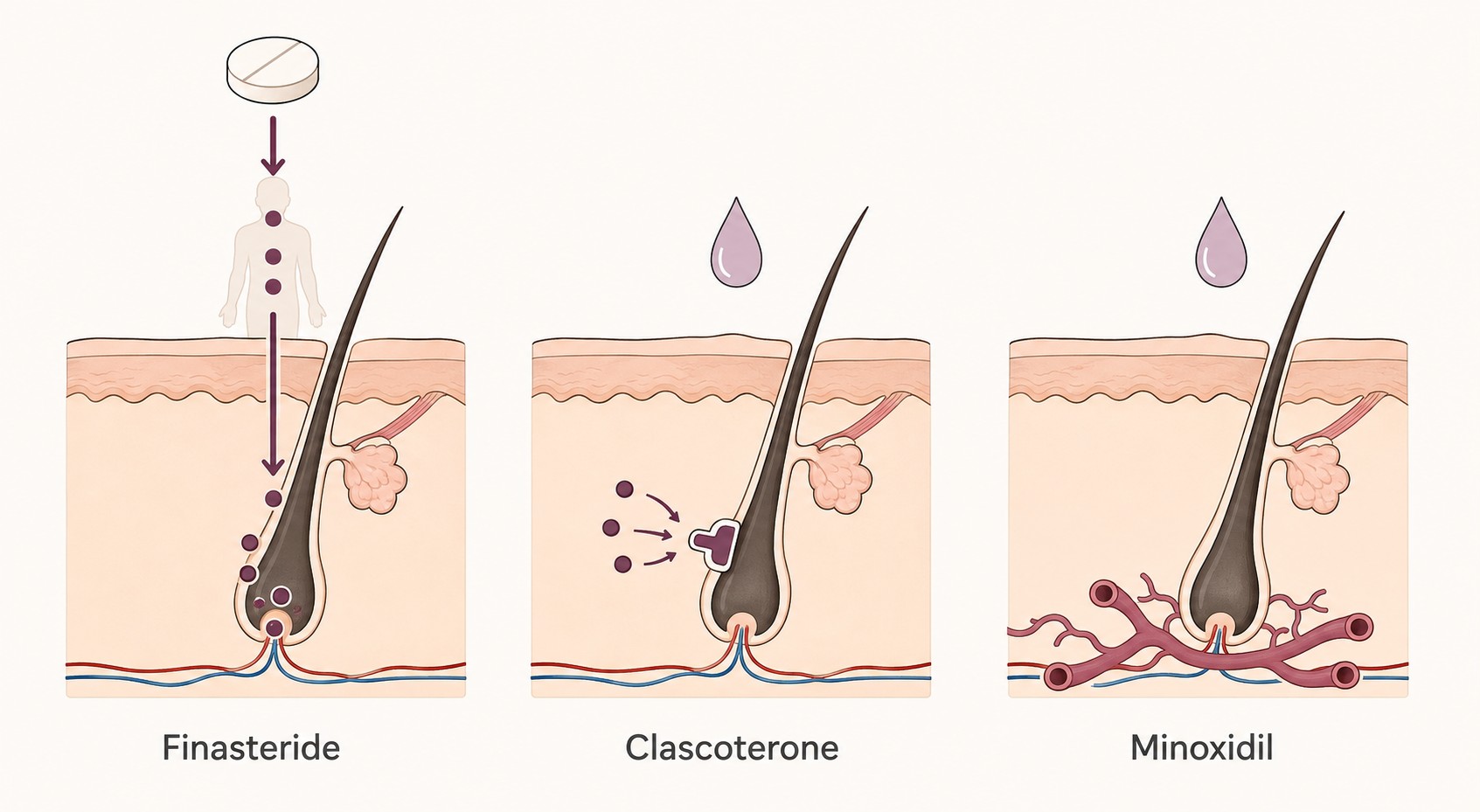
Three routes to the same follicle. Finasteride lowers DHT throughout the body; clascoterone blocks the receptor in the follicle itself, without changing circulating hormone levels; minoxidil does not act on DHT at all.
What the Phase 3 Results Actually Showed
Cosmo ran two identically designed Phase 3 studies, SCALP‑1 and SCALP‑2, randomising 1,465 patients in total. Both met their primary endpoint on target-area hair count. The size of the effect, however, differed substantially between them.
| Study | Target-area hair count vs vehicle |
|---|---|
| SCALP‑1 | 5.39× relative improvement (539%) |
| SCALP‑2 | 1.68× relative improvement (168%) |
On patient-reported outcomes, one study reached statistical significance, the other showed a positive trend, and the combined analysis across both was statistically significant.
The 539% Figure, Explained
This number is quoted everywhere, usually without its companion. Two things are worth understanding about it.
It is a relative improvement, not an absolute one. It compares the change in hair count under clascoterone with the change under vehicle — not with the starting point. A vehicle arm that performs modestly makes the ratio large. It does not mean anyone grew 539% more hair.
It is one of two results, and the studies were identical in design. SCALP‑2 produced 1.68×. When two identically designed trials of the same drug at the same dose return results a threefold factor apart, the honest reading is that the true effect lies somewhere between them and that the larger figure should not be treated as the expected outcome.
None of this means the drug does not work. Both studies met their primary endpoint, which is the standard that matters for approval. It means the headline number is the ceiling of the observed range rather than a typical result — and any clinic quoting 539% at you without mentioning 168% is selling rather than informing.
Safety So Far
Treatment-emergent adverse events were reported as similar across both studies and similar to vehicle, with most not related to the study drug. That is a good early signal and consistent with what would be expected from a topical agent that does not lower circulating hormone levels.
Two cautions. Trial populations are selected and monitored in ways that ordinary use is not, so post-approval surveillance regularly finds effects that trials do not. And the twelve-month safety follow-up is the part regulators scrutinise most closely for a drug intended to be used continuously for years.
How It Compares With What Exists Now
| Minoxidil | Finasteride / dutasteride | Clascoterone 5% | |
|---|---|---|---|
| Route | Topical or oral | Oral | Topical |
| Mechanism | Not DHT-related | Reduces DHT production, systemically | Blocks the androgen receptor, locally |
| Approved for hair loss | Yes | Yes (finasteride) | No |
| Evidence base | Decades of use | Decades of use | Two Phase 3 studies |
| Available now | Yes | Yes, on prescription | No |
Nothing about the clascoterone data changes what is appropriate today. Whatever is prescribed now remains the right thing to continue; a drug that may be approved in some years is not a reason to stop a treatment that is working.
When Could It Become Available?
Cosmo stated it was on track to complete the required twelve-month safety follow-up in spring 2026 and then to pursue parallel regulatory submissions in the United States and Europe. Submission is the beginning of a review, not the end of one: regulators typically take around a year, approval may be granted in one region and not another, and the licensed indication can end up narrower than the studied population.
A realistic expectation is therefore measured in years rather than months, and no date should be treated as firm until a regulator publishes a decision.
Who Might Be a Candidate, If It Is Approved
On the evidence so far, the profile that would benefit most resembles the trial population: men with established but not advanced androgenetic alopecia, where miniaturising follicles are still present to be protected. As with every medical therapy for hair loss, it would preserve and partially restore rather than regrow hair in areas where follicles are gone.
That last point matters for anyone considering surgery. Medical therapy and transplantation address different problems — one protects what remains, the other moves hair into areas that no longer have any. A new topical drug, however effective, does not remove the need for surgery in an area that is already bare, and it does not make an unstable hairline safe to operate on.
What to Do in the Meantime
- Do not buy it online. There is no legitimate source, and what arrives is unverified.
- Do not stop what you are on. Hair protected today is hair that will still be there if and when a new option arrives; hair lost while waiting is not recoverable by any of these drugs.
- Get a diagnosis rather than a product. Trichoscopy distinguishes androgenetic alopecia from telogen effluvium and other causes that look similar but respond to entirely different treatment.
- Judge the stage, not the news. If recession is established, the relevant conversation is about Norwood staging and whether the pattern has declared itself, not about a drug that is years away.
Frequently Asked Questions
Where can I buy clascoterone 5% or Breezula?
Nowhere legitimately. It is not approved for hair loss in any country, so no licensed product exists. Anything offered for sale under those names is compounded, counterfeit or a research chemical.
Can I use Winlevi on my scalp instead?
Winlevi is a 1% cream approved for acne, not a 5% scalp solution, and using it on the scalp is off-label at a fifth of the studied strength in the wrong vehicle. That is a decision for the doctor prescribing it, not a substitute for the investigational product.
Does clascoterone work for hair loss?
Both Phase 3 studies met their primary endpoint, so the evidence points to a real effect. The size of that effect is uncertain: the two identically designed studies returned 5.39× and 1.68× relative improvement in target-area hair count.
Is it better than finasteride?
Unknown. The Phase 3 studies compared clascoterone with vehicle, not with finasteride. Without a head-to-head trial, any claim that one outperforms the other is not supported by the data.
What does the 539% figure mean?
It is the relative improvement in target-area hair count versus vehicle in SCALP‑1 — a ratio between two changes, not an increase in anyone’s total hair. SCALP‑2 produced 168% by the same measure.
What are the side effects?
Adverse events in the hair loss trials were reported as similar to vehicle. For the approved 1% acne cream, the label lists erythema, reddening, pruritus, scaling and dryness among reactions occurring in at least 10% of patients.
Would it replace a hair transplant?
No. Medical therapy protects and partially restores miniaturising follicles; it does not create hair where follicles are gone. The two remain complementary rather than alternative.
Is it available in Turkey?
No. It is not approved in Turkey or in any other country for hair loss, and clinics offering it are not offering an approved medicine.
References
- Cosmo Pharmaceuticals, Phase III topline results, SCALP‑1 and SCALP‑2 — 1,465 patients randomised across two identically designed studies; 5.39× (539%) relative improvement in target-area hair count versus vehicle in one study and 1.68× (168%) in the other; treatment-emergent adverse events similar across studies and similar to vehicle; twelve-month safety follow-up on track for completion in spring 2026, followed by parallel US and EU submissions. cosmohealthconfidence.com
- US Food and Drug Administration, WINLEVI (clascoterone) cream prescribing information — androgen receptor inhibitor indicated for the topical treatment of acne vulgaris in patients 9 years of age and older; 1% clascoterone (10 mg per gram); initial US approval 2020; erythema, reddening, pruritus, scaling and dryness among adverse reactions occurring in ≥10% of patients. accessdata.fda.gov
- StatPearls, Androgenetic Alopecia (National Center for Biotechnology Information) — pattern, mechanism and established treatment context. ncbi.nlm.nih.gov/books/NBK430924
In Short
Clascoterone 5% solution is a genuinely interesting drug — a topical androgen receptor inhibitor, a mechanism no approved hair loss treatment currently uses — and its Phase 3 programme met its primary endpoint in both studies. It is also not approved anywhere for hair loss, cannot legally be bought, and is realistically years from availability. The 539% figure that circulates is the higher of two results from identically designed trials; the other was 168%, and the truth about the expected effect sits between them.
Until a regulator decides, the useful step is not acquiring an unapproved product but knowing what you actually have. Hair of Istanbul is a licensed clinic operating in Ataköy, Bakırköy, Istanbul since 2013; our medical team assesses miniaturisation directly, and you can read how established treatment and surgery fit together on our pages covering FUE and hair transplant for a receding hairline.